

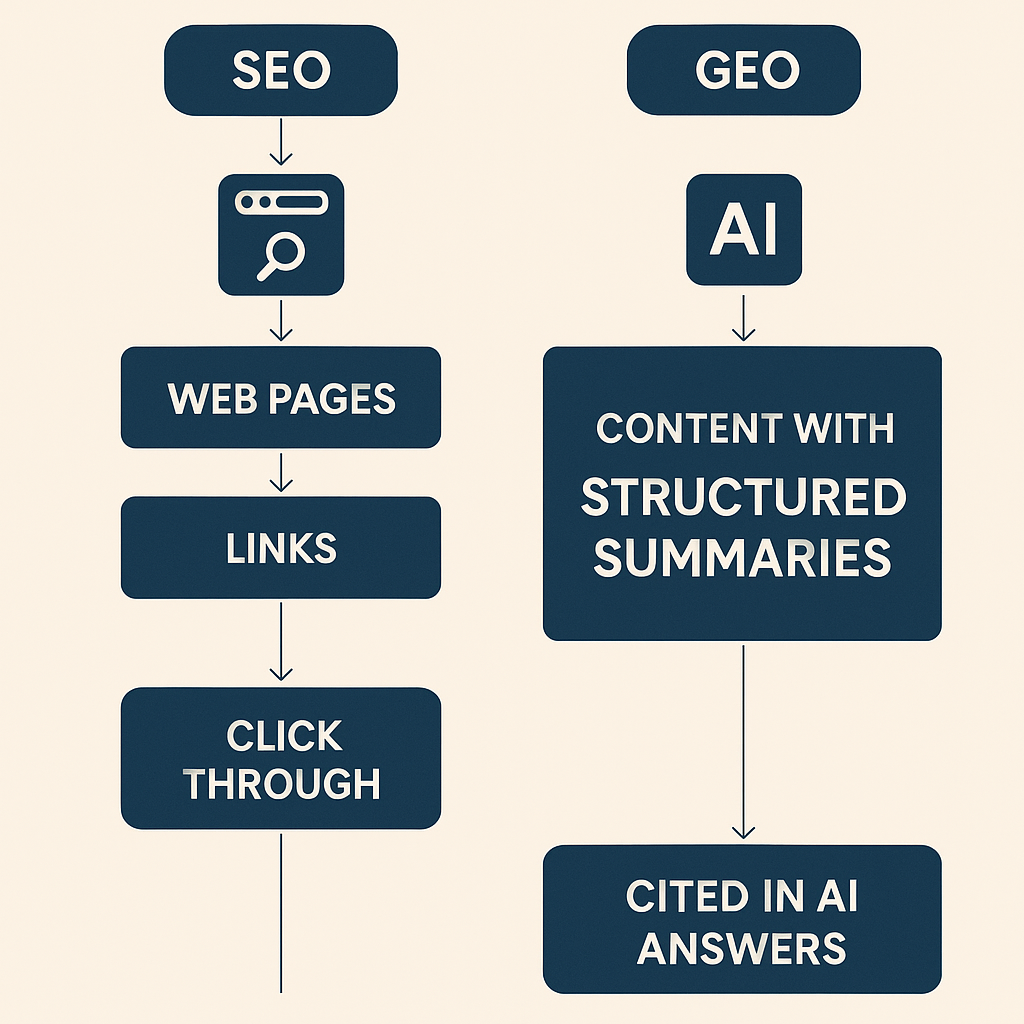
Generative Engine Optimization (GEO) is the 2025 evolution of SEO—focused on making your content the preferred citation source for AI-powered search engines like ChatGPT, Google AI Overviews, and Perplexity. Success depends on structured summaries, llms.txt metadata, and high-authority signals that AI models can easily extract and trust.
Problem Identification
Traditional search engine optimization is built around ranking in link-based SERPs. But AI search assistants increasingly bypass these links, summarizing content directly for users.
This creates a new visibility challenge:
- Citations Replace Clicks – If your content is not cited, you may lose exposure even if it ranks high in traditional SERPs.
- Opaque Inclusion Criteria – AI models pull from a mix of structured and unstructured sources, making traditional keyword strategies less effective.
- Authority Over Keywords – AI prioritizes reliable, high-traffic domains over exact-match keyword optimization.
Without GEO readiness, even high-quality niche content risks being overlooked in AI-generated answers.
Comprehensive Solution Framework
1. Structured Summaries for AI Extraction
- Concise, AI-Friendly Intros – Begin articles with a 30–50 word self-contained summary that directly answers the core query.
- Bullet & Numbered Lists – AI models prefer cleanly structured information for faster parsing.
- Example – A blog on “B2B Email Best Practices” starts with a 4-bullet executive summary, making it more likely to be cited in AI summaries.
2. Implement llms.txt for Content Access
- Metadata Control – Similar to
robots.txt,llms.txtsignals which parts of your site can be accessed by AI crawlers. - Citation Boost – Explicitly granting access to evergreen guides can increase the odds of inclusion in AI answers.
- Example – An e-commerce brand uses
llms.txtto allow indexing of its buying guides while excluding temporary sale pages.
3. Embed High-Authority Signals
- Link to Trusted Sources – AI uses outbound link quality as a reliability indicator.
- Consistent Entity Linking – Reference your brand, products, and key experts in ways that align with knowledge graphs.
- Third-Party Mentions – Publish guest posts on high-traffic sites to reinforce topical authority.
4. Optimize for Conversational Queries
- Question-Based Headers – Use natural language subheadings that mirror how users speak to AI assistants.
- Follow-Up Context – Provide related context for follow-up questions AI users are likely to ask.
Authority Building
- NY Mag Analysis (2024) – AI search is shifting from link-based to answer-based retrieval, making GEO critical for brand visibility [1].
- Wix AI Visibility Tool Data (2025) – Early adopters of GEO optimization saw a 20–40% increase in inclusion rates in AI-generated answers [2].
- Arxiv Preprint (2024) – Structured content with clear headings and summaries is statistically more likely to be included in AI answers [3].
Practical Implementation — Fast-Start Checklist
Step 1: Add a 30–50 word structured answer at the top of each article.
Step 2: Format content with numbered steps and bullet lists for easy parsing.
Step 3: Deploy llms.txt to control and enable AI crawler access.
Step 4: Syndicate your best content to authority sites for external trust signals.
Step 5: Monitor AI citation frequency with tools like Perplexity Alerts or Wix AI Visibility.
References
- New York Magazine. “SEO Is Dead. Say Hello to GEO.” NY Mag Intelligencer. November 2024.
- Wix. “AI Visibility Overview: First-Generation GEO Results.” Wix Business Blog. June 2025.
- Arxiv.org. “Generative Engine Optimization: Ranking for AI-Powered Search.” Preprint 2311.09735. December 2024.


0 Comments