

Google Ads classifies entire industries under “Sensitive Interest Categories,” which strips out remarketing, Customer Match, and lookalike audiences — three of the most powerful targeting levers in the platform. If you advertise for healthcare clinics, rehab centers, law firms, housing providers, or financial services companies, you already know the frustration of logging in and seeing that “Eligible (Limited)” status badge. This tutorial shows you exactly how to drive qualified conversions without those tools by leaning on intent signals, creative qualification, and offline data — strategies documented in the 2026 SEM Strategic Briefing and corroborated by the Search Engine Land source report.
What This Is
Google Ads has always had policy guardrails, but in 2026 the platform significantly tightened enforcement around what it calls Sensitive Interest Categories. These are verticals where serving highly personalized ads — particularly retargeted ones — risks being invasive, discriminatory, or ethically harmful to users who may be in vulnerable situations.
The policy breaks down into four primary buckets, as outlined in the 2026 SEM Strategic Briefing:
| Category Type | Examples | Restricted Features |
|---|---|---|
| Personal Hardship | Divorce, addiction, health struggles, financial stress | No remarketing, no Customer Match, no lookalike segments |
| Identity & Belief | Religion, sexual orientation, race, political affiliation | No personalized targeting based on these identifiers |
| Access to Opportunity | Housing, employment, credit (US & Canada) | No targeting by age, gender, parental status, or ZIP code |
| Health & Wellness | Chronic conditions, intimate body health, medical procedures | Strict limits on drug terms and speculative treatments |
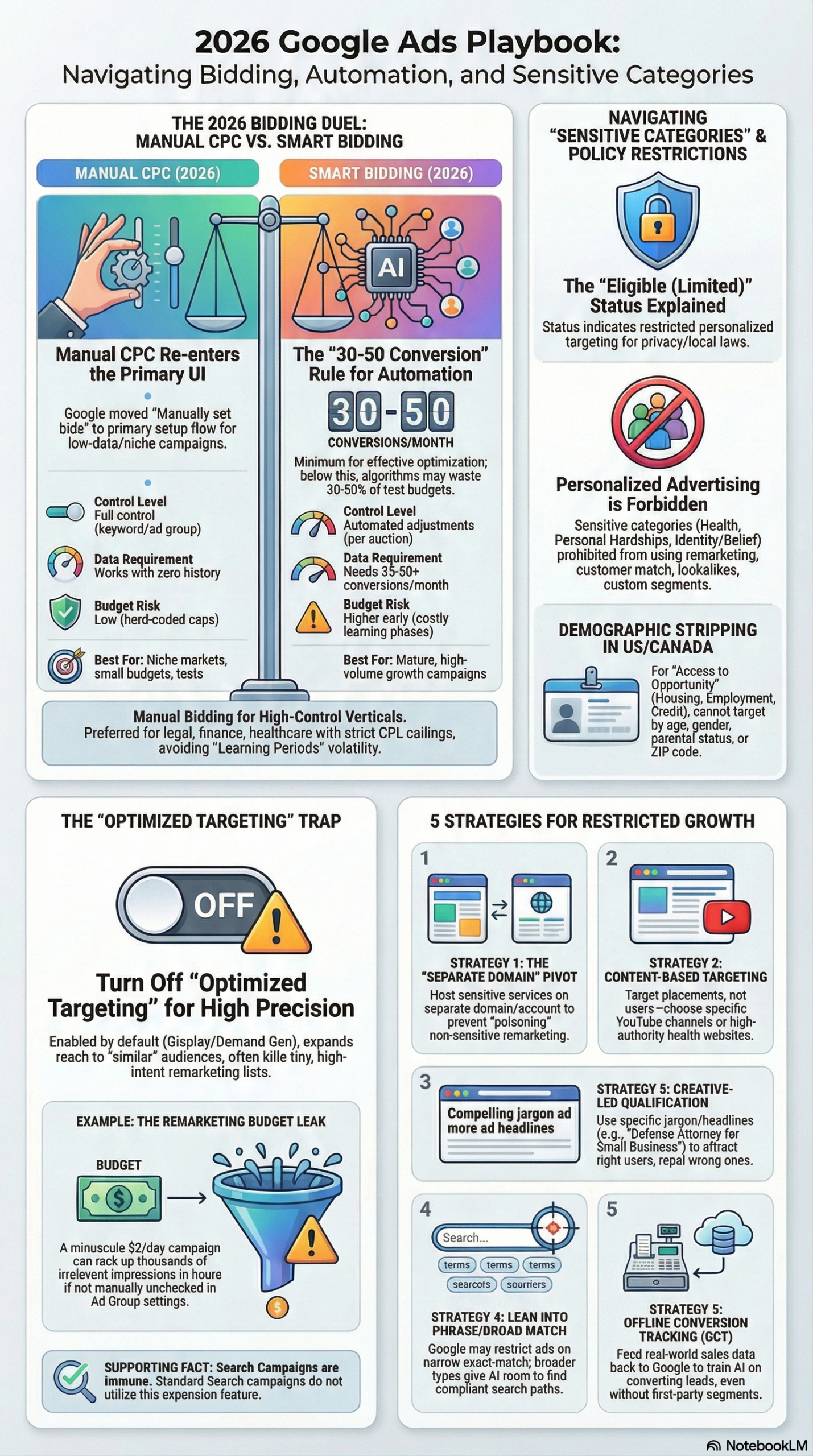
When your account or campaign falls into one of these categories, Google assigns an “Eligible (Limited)” status. As the research report clarifies: “It’s not bad, and there’s nothing you need to do to ‘fix it.’ The eligible (limited) status means you can still advertise… but there are certain policies in place that limit the kind of targeting or language you can use.”
This is a critical distinction. Many advertisers panic, interpret the status as a policy violation, and either pause campaigns or spend hours trying to appeal something that isn’t actually an error. The platform is telling you: “We know what you’re selling. Here’s the lane you can operate in.”
What gets disabled includes: website and app remarketing lists, Google-engaged audiences, Customer Match (email, phone numbers), YouTube audience targeting, custom segments based on search terms or website visits, and — for housing, employment, and credit advertisers in the US — demographic targeting by age, gender, parental status, and ZIP code, as required by the Fair Housing Act and related employment laws.
In 2026, Google also reintroduced limited Healthcare Professional (HCP) targeting for eligible B2B advertisers — primarily medical device manufacturers trying to reach clinical audiences. This is a meaningful carve-out that restores some audience capability for those operating in compliant B2B health contexts. However, subscription-based health products and e-pharmacies face even stricter Google Shopping eligibility, often requiring third-party certifications like LegitScript or G2 before ads can run at all, per the 2026 SEM Strategic Briefing.
The bottom line: you are not locked out of Google Ads if you’re in a sensitive category. You are locked into a different playbook — one that prioritizes what the user is actively searching for over who Google thinks that user is.
Why It Matters
The shift from identity-based to intent-based targeting is not just a Google policy decision — it reflects where the entire advertising ecosystem is heading. As the research report notes, the 2026 SEM environment is built on three pillars: automated bidding, semantic intent matching, and privacy-first tracking. Sensitive category restrictions are the most visible expression of the third pillar.
For practitioners running campaigns in healthcare, legal, housing, or financial services, this has immediate workflow implications:
You lose the retargeting funnel. The classic Google Ads playbook — cast wide with broad match, retarget site visitors, exclude converters, build lookalikes from your best customers — is fully unavailable. You cannot follow someone who visited your addiction treatment landing page around the web. According to the Search Engine Land source, this is deliberate: “That kind of remarketing is intrusive and, frankly, predatory when it targets someone’s health and struggles.”
You have to earn the click at the keyword level. Without the retargeting net, your keyword targeting, match types, and ad copy have to do all the qualification work upfront. Every click costs money that cannot be “recovered” through a cheaper retargeting touch later.
Your CPL modeling changes fundamentally. For industries like legal and financial services where conversions often happen offline (a signed retainer, a loan application via phone), you need offline conversion tracking feeding your bidding algorithms or Smart Bidding will optimize toward micro-conversions that don’t represent real business value.
Agencies managing mixed-category accounts face structural risk. If a healthcare clinic also sells wellness supplements (non-restricted), running both under the same account can cause the sensitive category policy to bleed across campaigns. The research report explicitly recommends a separate domain strategy to prevent this.
The advertisers who win in this environment are the ones who understand that intent replaces identity. You cannot know who your user is. You can know — with precision — what they are searching for, where they are looking, and what language resonates with their specific situation.
The Data: What You Can and Cannot Use
| Targeting Feature | Standard Advertiser | Sensitive Category Advertiser |
|---|---|---|
| Search keywords | ✅ Available | ✅ Available |
| Broad / phrase / exact match | ✅ Available | ✅ Available (expand recommended) |
| In-market audiences | ✅ Available | ✅ Available |
| Affinity audiences | ✅ Available | ✅ Available |
| Life event targeting | ✅ Available | ✅ Available |
| Content targeting (placements/topics) | ✅ Available | ✅ Available |
| Enhanced conversions | ✅ Available | ✅ Available |
| Offline conversion tracking | ✅ Available | ✅ Available |
| Website remarketing lists | ✅ Available | ❌ Disabled |
| Customer Match (email/phone) | ✅ Available | ❌ Disabled |
| YouTube audience retargeting | ✅ Available | ❌ Disabled |
| Lookalike / similar audiences | ✅ Available | ❌ Disabled |
| Custom intent segments | ✅ Available | ❌ Disabled |
| Age/gender targeting (HEC categories, US) | ✅ Available | ❌ Disabled |
| ZIP code targeting (HEC categories, US) | ✅ Available | ❌ Disabled |
| HCP targeting (B2B medical devices) | ✅ Available | ✅ Conditionally available |
Source: Search Engine Land and 2026 SEM Strategic Briefing
The table above should immediately reframe your strategy session. You still have access to roughly half the platform’s capabilities — and the ones you keep are often the highest-intent signals available. A user searching for “outpatient rehab center near me” or “defense attorney small business lawsuit” is expressing commercial intent in real time. That signal is more valuable than a cookie from three weeks ago.
Step-by-Step Tutorial: Building a Sensitive Category Campaign That Converts
This walkthrough is based on the 10-step framework documented in the 2026 SEM Strategic Briefing and the tactical guidance from Search Engine Land. Follow it in sequence — shortcuts here cause expensive mistakes later.
Phase 1: Account Architecture Decisions
Step 1: Decide Whether to Separate Your Account
Before building a single campaign, make a structural decision: does your sensitive-category business also run unrestricted products or services?
If yes, create a separate Google Ads account and domain for your sensitive services. The research report warns that hosting sensitive and non-sensitive services in the same account risks policy restrictions “poisoning” the tracking capabilities of your non-sensitive business lines. A drug and alcohol treatment center that also sells wellness courses should not advertise both under the same account. Set up Account B for the treatment center with its own domain, tracking pixels, and conversion goals. This is not optional if your non-sensitive revenue matters.
If your entire business falls under a single sensitive category, keep one account but document the policy status clearly for any client or team member who might panic when they see “Eligible (Limited).”
Step 2: Define Your Conversion Events Carefully
In a standard account, you might optimize toward micro-conversions: page visits, video views, time on site. In a sensitive category campaign, those signals are often meaningless. Define your primary conversion event as the highest-value action measurable: form submission, phone call lasting over 90 seconds, or a completed intake form. Secondary conversions are fine to track but should not be included in Smart Bidding optimization signals until your primary conversion volume is stable.
For legal and financial services where the real conversion is offline (signed contract, funded loan), you must set up Offline Conversion Tracking (OCT) via CRM data import before launching Smart Bidding. Without OCT, you are training Google’s algorithm to optimize toward phone calls or form fills — not actual revenue.
Phase 2: Keyword and Campaign Structure
Step 3: Build Intent-First Keyword Lists
Start with “seed keywords” — the most specific terms your target prospect would type at the moment they are actively looking for help. For a housing attorney: “tenant rights attorney lease dispute,” “eviction defense lawyer [city],” “landlord harassment legal help.” For a financial counselor: “debt consolidation nonprofit counseling,” “credit counseling for bankruptcy alternative.”
The research report recommends prioritizing commercial and transactional intent over informational intent. Someone searching “what is debt consolidation” is not your prospect. Someone searching “debt consolidation program enrollment” is.
For sensitive categories specifically, expand your match types further than you might in an unrestricted account. The Search Engine Land source notes that Google may restrict impressions on narrow exact match queries for privacy reasons, meaning phrase and broad match become more important for generating volume. This is counterintuitive — broad match in sensitive categories — but the platform’s semantic matching means broad match on “addiction treatment center” will not serve your ad to someone searching “how to make cocktails.”
Step 4: Build Tightly Themed Ad Groups
Use 10–20 closely related keywords per ad group, as recommended by the 2026 SEM Strategic Briefing. This preserves the ad relevance score that affects Quality Score and auction position. If your account structure is too flat (one ad group with 100 keywords), your ad copy cannot match the intent of every search, and your Quality Scores suffer — which raises CPCs precisely when your budget efficiency already matters most.
Step 5: Layer In Pre-Built Google Audiences as Observation (Not Targeting)
Here is the tactical move that many sensitive category advertisers miss. You cannot build custom audiences, but Google’s pre-built in-market segments, affinity audiences, and life event segments are still available. Add them in “observation” mode first — do not target to them, just watch the performance data. Life events like “Currently Renting,” “New Job,” and “Retiring Soon” will almost certainly show index scores above 100 for the right legal, financial, and health categories.
Once you have two to four weeks of data showing that a specific life event segment converts at a higher rate, you can move it from observation to targeting — narrowing your audience to those signals without using any personally identifiable or sensitive data. This is what the research report calls “Non-Linear Targeting”: reaching your audience through adjacent, policy-compliant signals rather than direct identity targeting.
Phase 3: Creative-Led Qualification
Step 6: Write Ads That Repel as Well as Attract
The most important shift in creative strategy for sensitive category campaigns: your ad copy must qualify and disqualify simultaneously. Without remarketing to re-engage near-misses cheaply, every click you pay for must have a higher pre-click probability of converting.
The Search Engine Land source gives a clear example: “Defense Attorney for Small Business” outperforms “Need a Lawyer?” for a small business defense firm — not because it gets more clicks, but because the clicks it gets are far more likely to be the right prospect. This is creative-led targeting: using specific language in headlines and descriptions to attract exactly the right user while actively discouraging irrelevant clicks.
For Responsive Search Ads (RSAs), provide all 15 headlines and 4 descriptions with meaningful variation in specificity. Some headlines should be highly specific (“Outpatient Rehab Programs — Medicaid Accepted”) while others address a specific objection (“No Wait List — Same-Week Intake”). Let Google’s AI test combinations, but seed it with copy that already does qualification work.
Step 7: Ensure Landing Page Message Match
The research report emphasizes “Message Match” as a core landing page requirement: the headline of your landing page should directly reflect the intent expressed in the search query and ad headline. For a search like “affordable debt counseling nonprofit,” the landing page should open with language like “Nonprofit Debt Counseling — Free Initial Consultation” — not a generic “Welcome to Our Financial Services” heading.
Target page load speeds under two seconds. In sensitive categories where trust is a conversion factor, a slow page is a direct conversion killer. Users who are anxious or in crisis (the typical sensitive category prospect) do not wait for a three-second load.
Phase 4: Conversion Tracking and Bidding
Step 8: Implement Enhanced Conversions and OCT Before Launch
Set up Google Analytics 4 with enhanced conversion measurement before your first campaign goes live. Enhanced conversions hash and send first-party data (email, phone) from conversion events back to Google without violating privacy policies — this is explicitly permitted even in sensitive categories and dramatically improves attribution accuracy compared to standard conversion pixels.
For industries with offline conversion paths, upload CRM conversion data weekly via the OCT import. The research report states: “Feeding sales data from your CRM back into Google Ads is the only way to train the AI to find higher-quality leads when identity signals are stripped.”
Step 9: Choose Your Bidding Strategy Based on Data Volume
This decision depends entirely on your conversion volume. The 2026 SEM Strategic Briefing provides a clear framework:
- Use Manual CPC if: you have a new account with no history, monthly budgets under $2,000, niche B2B keywords, or strict CPL caps. Google’s 2026 UI update moved Manual CPC back into the primary campaign setup flow — use it when data is sparse.
- Use Smart Bidding (Target CPA or Target ROAS) if: you have 30–50 monthly conversions, a mature campaign with stable performance history, and accurate conversion tracking in place.
The failure mode to avoid: launching Smart Bidding with fewer than 30 monthly conversions and inaccurate conversion data. The algorithm needs real signal to optimize toward. Without it, it will spend your budget learning on poor proxies.
Step 10: Manage the Learning Period Deliberately
After launch, plan for a 60–90 day learning period for new campaigns using Smart Bidding, per the research report. During this window:
- Do not change your bidding strategy
- Do not increase or decrease budgets by more than 20% at a time
- Do not restructure ad groups or swap out large numbers of keywords
- Review search term reports weekly and add negative keywords — this is the one optimization action that does not disrupt the learning phase
After the learning period, scale budgets at 20–30% increments every 5–7 days to maintain efficiency while growing volume.
Real-World Use Cases
Use Case 1: Addiction Treatment Center (Healthcare)
Scenario: A residential rehab facility in the Southwest wants to run Google Ads but cannot use remarketing or Customer Match due to their healthcare sensitive category classification.
Implementation: The facility builds a separate Google Ads account specifically for its treatment services. Campaign structure uses tightly themed ad groups around specific treatment types: “alcohol detox programs,” “30-day inpatient rehab,” “dual diagnosis treatment.” Headlines are specific: “Medically Supervised Detox — Insurance Verified.” Life event audiences (“Major Life Change”) are added in observation mode. Enhanced conversions capture form fills; call tracking captures phone inquiries over 90 seconds as primary conversions.
Expected Outcome: Higher CPL than a standard account — typically 20–40% higher in restricted categories — but with a conversion-to-admission rate that compensates because unqualified traffic has been systematically excluded. Over 90 days, Smart Bidding trains on real admission signals via OCT upload.
Use Case 2: Small Business Defense Attorney (Legal)
Scenario: A boutique law firm specializing in defending small businesses in commercial disputes needs leads but cannot remarket to past site visitors.
Implementation: Per Search Engine Land guidance, the firm uses creative-led targeting aggressively. Every ad group headline leads with the specific legal situation: “Commercial Lease Dispute Defense,” “Vendor Contract Breach Attorney,” “Business Partnership Dispute Lawyer.” Broad match is expanded beyond the firm’s comfort zone. In-market audiences for “Legal Services” are added in observation mode. OCT is set up to import signed-retainer events from the firm’s CRM within 48 hours of deal close.
Expected Outcome: Lower volume than an unrestricted competitor, but a higher percentage of leads that are ready to hire. The firm’s cost-per-retained-client drops over 90 days as Smart Bidding learns from the CRM data.
Use Case 3: Non-Profit Housing Counselor (Housing / Access to Opportunity)
Scenario: A HUD-approved housing counseling agency needs to reach first-time homebuyers and tenants at risk of eviction — but cannot target by ZIP code, age, or demographic signals in the US per Fair Housing Act compliance.
Implementation: The agency uses content targeting to place ads on specific real estate research websites and YouTube channels covering first-time homebuyer topics. Search keywords focus on transactional intent: “free HUD housing counselor near me,” “first time homebuyer assistance program.” No demographic filters are applied. The research report specifically recommends content targeting as a way to “bypass the ban on personal remarketing” by placing ads in contextually relevant environments.
Expected Outcome: Impressions skew toward actively interested users based on content context. Cost per qualified counseling session appointment holds steady despite the demographic targeting restrictions.
Use Case 4: Medical Device Manufacturer (B2B Healthcare)
Scenario: A company manufacturing surgical instruments wants to reach hospital procurement officers and clinical staff.
Implementation: The company qualifies for the Healthcare Professional (HCP) targeting tier that Google reintroduced in 2026 for eligible B2B advertisers per the research report. This requires verification through Google’s partner certification process. Search campaigns target procedure-specific keywords (“laparoscopic instrument supplier,” “OR supply chain manager tools”). The account is kept separate from any DTC health product lines.
Expected Outcome: Access to HCP targeting layers that are unavailable to standard healthcare advertisers, allowing precise reach to clinical buyers while remaining fully compliant.
Use Case 5: Nonprofit Credit Counseling Agency (Financial / Credit)
Scenario: A nonprofit helping consumers manage debt needs leads but faces demographic targeting restrictions under the credit category rules.
Implementation: The agency uses Demand Gen campaigns instead of standard Display, per Search Engine Land guidance that Demand Gen delivers higher-quality audiences in restricted niches. Life event segments (“Major Purchase: Home,” “Recently Married”) are layered into observation. Search campaigns use phrase and broad match to capture “debt help,” “credit counseling program,” and “nonprofit debt consolidation” intent. Offline conversions (completed counseling enrollment) are imported weekly.
Expected Outcome: The Demand Gen campaigns outperform standard Display in lead quality at comparable CPL. OCT data over 60 days trains the system to identify enrollment-likely prospects more accurately.
Common Pitfalls
Pitfall 1: Panicking About “Eligible (Limited)” and Trying to Fix It
This is the most common mistake. Advertisers see the status, escalate to support, or attempt policy workarounds. The research report is explicit: this is a policy-driven state, not a technical error. Accept it, understand what it restricts, and move to a strategy that works within it.
Pitfall 2: Launching Smart Bidding Without Sufficient Conversion Data
Smart Bidding requires 30–50 monthly conversions to function correctly, per the 2026 SEM Strategic Briefing. Launching Target CPA with 8 monthly conversions and expecting performance will result in erratic spend. Start with Manual CPC, build conversion volume, then switch. Switching too early wastes significant budget during a learning phase that has no useful data to learn from.
Pitfall 3: Running Sensitive and Non-Sensitive Services in the Same Account
If your business has both restricted and unrestricted product lines, mixing them in one account risks the restricted policy status limiting tracking and bidding capabilities across all campaigns. The research report recommends a dedicated separate domain strategy as a non-negotiable structural requirement.
Pitfall 4: Ignoring Offline Conversion Tracking
For any sensitive category where the actual conversion event happens off-platform — a signed contract, a filled prescription, an in-person intake — running without OCT means your bidding algorithm is optimizing toward form fills that may or may not represent real conversions. This consistently inflates reported conversion volume while degrading actual lead quality.
Pitfall 5: Using Exact Match Exclusively for Volume-Constrained Categories
The Search Engine Land source flags a counter-intuitive platform behavior: Google may restrict impressions on narrow exact match queries for privacy reasons in sensitive categories. Staying exclusively on exact match can leave significant impression volume on the table. Expand to phrase and broad match with robust negative keyword lists to capture intent without losing control of what triggers your ads.
Expert Tips
Tip 1: Use “Optimized Targeting” Selectively
For Display and Video campaigns in tight-budget scenarios, uncheck the “Optimized Targeting” box. This forces spend to stay within your defined audience rather than Google’s expanded “similar” suggestions. For sensitive categories with limited budgets, allowing Google to expand beyond your defined targeting parameters without your data to guide it almost always degrades performance, per the research report.
Tip 2: Anchor Bid Floors to Your Business Economics
Do not rely on Google’s “Top of Page” bid estimates as the basis for your CPC targets. Calculate your CPL floor and ceiling from your actual business data: average close rate × average contract value = maximum allowable CPL. Then set Manual CPC bids that keep you within that ceiling. The research report calls this “anchoring bids to economics” — it prevents bidding yourself into unprofitable CPLs during a learning period.
Tip 3: Prioritize Demand Gen Over Standard Display for Restricted Niches
Standard Display Network performance in sensitive categories tends to be poor because audience expansion and remarketing — the mechanisms that make Display efficient — are unavailable. Search Engine Land recommends Demand Gen campaigns as a higher-quality alternative that is better suited to serving restricted-category ads at scale.
Tip 4: Build Negative Keyword Lists from Day One
In the absence of remarketing to filter your audience after the click, negative keywords are your primary pre-click filter. Build a comprehensive negative list before launch (typically 200–400 negatives for a mature sensitive category account) and review the search terms report weekly. The research report makes this a core step in the 10-step framework — it is not optional maintenance, it is campaign infrastructure.
Tip 5: Test LegitScript Certification for Healthcare E-Commerce
If you’re running a subscription health product or e-pharmacy, pursue LegitScript certification before launching. Per the 2026 SEM Strategic Briefing, Google Shopping eligibility for these categories increasingly requires third-party certification. Running without it means campaigns are denied, not just limited — eliminating Shopping as a channel entirely until certification is obtained.
FAQ
Q1: What exactly is “Eligible (Limited)” status and do I need to fix it?
No. “Eligible (Limited)” is a policy classification, not a policy violation. It means your campaigns can run but with restrictions on specific targeting features like remarketing and Customer Match. Per the research report, there is nothing to appeal or troubleshoot — the status simply tells you which targeting tools are off the table for your industry.
Q2: Can I still use Smart Bidding if I’m in a sensitive category?
Yes, with an important caveat: Smart Bidding requires clean, sufficient conversion data to work. For sensitive categories where conversions happen offline, you must implement Offline Conversion Tracking and upload CRM data before switching to Smart Bidding. Without accurate conversion signals, the algorithm cannot learn effectively. The research report recommends 30–50 monthly conversions as the minimum threshold before activating Target CPA or Target ROAS.
Q3: Is there any way to use audience data for sensitive categories at all?
Yes — through Google’s pre-built in-market segments, affinity audiences, and life event segments, which are not restricted. These are anonymized, aggregate audience pools, not personally identified lists. Add them in observation mode first, gather performance data for two to four weeks, and then shift high-performing segments to targeting mode. This approach is documented in the research report as “Non-Linear Targeting.”
Q4: How do housing, employment, and credit categories differ from other sensitive categories?
Housing, employment, and credit (HEC) advertisers in the US face additional restrictions beyond the standard sensitive category rules: no targeting by age, gender, parental status, or ZIP code. These restrictions are legally mandated under the Fair Housing Act and related employment laws, and they apply regardless of whether you’re using Google Ads or any other advertising platform. The Search Engine Land source confirms that Google enforces these as platform-level policy to ensure legal compliance.
Q5: What’s the best channel strategy if Display and remarketing are unavailable?
Prioritize Search campaigns for active intent capture, then layer Demand Gen for awareness at scale. According to Search Engine Land, Demand Gen delivers higher-quality audiences in restricted niches compared to standard Display. For B2B health advertisers who qualify, HCP targeting on Search is worth exploring. YouTube can still work using content targeting (placing ads on relevant channels and topics) without requiring audience-based remarketing.
Bottom Line
Running Google Ads in sensitive categories is harder than running an unrestricted account — and that is the point. The platform has deliberately limited the most invasive targeting tools to protect users in vulnerable situations. But the tools that remain are powerful: high-intent search keywords, pre-built life event audiences, content targeting, enhanced conversions, and offline conversion tracking form a complete playbook that can drive real business results when executed correctly. The shift required is strategic, not technical: stop optimizing for who your user is and start optimizing for what they are actively searching for and how specifically your ads speak to their exact situation. Advertisers who make that shift — and who implement the structural safeguards around account separation, OCT, and deliberate learning period management — will consistently outperform competitors who are still fighting the policy restrictions instead of working within them.


0 Comments