

Brand awareness measurement has split into two parallel disciplines: what humans say about your brand and what AI models say about it. Both matter, and as of 2026, neglecting either one leaves you flying blind in the channels where your buyers actually make decisions. This tutorial walks through all nine measurement methods—from branded search tracking to AI Share of Voice—with specific tools, configuration steps, and formulas you can implement this week.
What Brand Awareness Measurement Actually Is
Brand awareness is how well consumers recognize and remember your brand, its products, and its services—but that definition is increasingly incomplete. Recognition and recall used to happen almost entirely through human experiences: someone saw your ad, searched your name, or heard about you from a colleague. In 2026, a growing portion of that “recognition” happens inside AI model responses before a buyer ever visits your website or talks to a human.
According to Semrush’s brand awareness guide, there are four levels of brand awareness a company can achieve:
- Zero awareness — The brand is unknown to the target audience.
- Brand recognition (aided recall) — The audience can identify the brand when prompted.
- Brand recall (unaided recall) — The audience can recall the brand without being prompted.
- Top-of-mind awareness — The brand is the first name that comes to mind in its category.
Moving from level one to level four is the goal. The challenge is that the measurement signals for each level now come from multiple distinct ecosystems—social platforms, search engines, review sites, and AI models—each requiring different tools and configurations.
The research report compiled for this post (MarketingAgent NotebookLM Research, March 2026) identifies the core tension: traditional social listening measures what people say about your brand; AI brand sentiment tracking measures what AI models say about your brand when answering buyer queries. Both signals are real. Both drive revenue. And they require separate measurement stacks.
Here’s what makes this especially relevant for practitioners right now: Gartner’s 2025 data shows that 73% of B2B buyers trust AI product recommendations over traditional ads. That means AI model positioning is not a vanity metric—it’s a primary purchase influence channel. If ChatGPT, Perplexity, or Google Gemini characterizes your brand as “lacking enterprise features” or “suitable for smaller teams,” you are being eliminated from shortlists before a single sales conversation starts.
Understanding this dual-track measurement model—traditional and AI-native—is the foundation for everything that follows.
Why Measuring Brand Awareness Matters Now More Than Ever
The reason brand awareness measurement has become more complex is directly tied to where discovery now happens. Semrush’s research identifies branded searches, share of voice, and AI visibility as the three recommended KPIs for brand health in 2026. That third one is new, and it changes the game.
For marketing teams, the shift is operational. You used to measure campaign effectiveness through clicks, impressions, and direct traffic spikes. Now you need to know whether your latest content push improved how AI models characterize you in category queries. A blog post that ranks #3 on Google and gets picked up as a citation source in ChatGPT responses is worth significantly more than a blog post that ranks #1 and gets no AI traction.
For agencies, this creates a new deliverable category: AI visibility audits. Clients need to know how they appear in AI-generated answers across ChatGPT, Perplexity, Google AI Mode, and Gemini. That’s four distinct platforms with different retrieval mechanisms, each requiring its own monitoring strategy.
For B2B enterprises, the stakes are highest. The MarketingAgent research report documents what Visiblie calls “the illusion of traffic”—a scenario where rising referral traffic from AI platforms does not actually reflect rising brand visibility. AI models frequently credit aggregator sites (Wikipedia, Reddit, Quora) for information that originated from a brand’s own content. You can be invisible in AI answers while still seeing a small uptick in referral clicks. That’s a false signal.
What makes brand awareness measurement different from standard web analytics is the time horizon. Website traffic is a lagging indicator; brand awareness is a leading indicator. When branded search volume drops, sales will follow—usually in 30 to 90 days. When AI models begin framing your brand with cautious language (“may be suitable for,” “worth considering but”), enterprise buyers start ruling you out in the research phase. Catching these signals early is the entire point of the measurement frameworks in this post.
The Data: Brand Awareness Tools Compared
The tool ecosystem for brand awareness measurement divides cleanly into two categories: traditional social listening and AI-native visibility platforms. Here is how the major options stack up across the dimensions that matter most to practitioners.
| Tool | Primary Use Case | Data Coverage | AI Visibility | B2B/CRM Integration | Best For |
|---|---|---|---|---|---|
| Brandwatch | Social listening at scale | 100M+ sources, 1.6T conversations | No | Limited | Enterprise reputation monitoring |
| Sprout Social | Social management + listening | Major social platforms | No | Yes (basic) | Mid-market teams |
| Sprinklr | Unified CX management | Broad cross-channel | No | Yes (enterprise) | Large enterprises (3–6 mo. setup) |
| Oktopost | B2B social + CRM alignment | LinkedIn-heavy | No | Yes (Salesforce, HubSpot) | B2B revenue attribution |
| Wynter | B2B message testing | 70,000+ verified professionals | No | No | Direct brand perception surveys |
| Semrush AI Visibility Toolkit | AI + SEO visibility | Search + AI platforms | Yes | No | SEO teams adding AI tracking |
| Visiblie | AI sentiment tracking | 8+ AI platforms | Yes (NSS) | No | AI brand positioning |
| Promptmonitor | PR source discovery | AI citation sources | Yes | No | PR teams targeting AI sources |
| OtterlyAI | AI mention/citation analysis | ChatGPT + Google AI | Yes | No | GEO audits |
| Akii | AI trust gap diagnosis | Multi-model | Yes | No | Diagnosing AI exclusion |
Sources: MarketingAgent NotebookLM Research Report, Semrush Brand Awareness Guide
Key takeaway from the data: No single tool covers both traditional social listening and AI model visibility. Most teams will need at least two platforms—one from the traditional column and one from the AI-native column—to get full coverage. The exception is Semrush’s AI Visibility Toolkit, which bridges SEO and AI tracking within a single platform, making it the most practical starting point for teams that aren’t ready to manage multiple vendor relationships.
Step-by-Step Tutorial: Building a Complete Brand Awareness Measurement System
This tutorial builds a two-track measurement system: traditional brand metrics and AI visibility metrics. You’ll set up monitoring, configure analytics, and create a reporting cadence that surfaces both types of signal in a single weekly review.
Prerequisites
- Access to Google Analytics 4 (GA4) for your website
- A Semrush account (Pro or higher for AI Visibility Toolkit)
- Access to at least one social listening tool (Brandwatch, Sprout Social, or equivalent)
- A spreadsheet for baseline tracking
- Time estimate: 3–4 hours for initial setup, 30 minutes per week for ongoing review
Phase 1: Establish Your Baseline (Week 1)
Before you can track change, you need to know where you stand. Spend the first week capturing baseline data across all nine measurement dimensions.
Step 1: Document your current branded search volume.
Open Google Search Console and filter for your brand name and common variations (misspellings, product names, acronyms). Export the last 12 months of data. This is your branded search baseline. According to Semrush’s guide, increased branded searches indicate growing awareness and active consumer interest—so tracking this trend over time is more valuable than any single snapshot.
Step 2: Set up GA4 direct traffic isolation.
In GA4, direct traffic is the strongest single indicator of brand recall—people who type your URL or click a bookmark already know who you are. To isolate it cleanly:
– Navigate to Reports > Acquisition > Traffic Acquisition
– Filter by “Session default channel group = Direct”
– Set a date comparison to the same period in the prior year
– Note the baseline percentage: what share of total sessions comes from direct traffic?
Step 3: Configure AI referral traffic tracking in GA4.
AI platforms (ChatGPT, Perplexity, Gemini) often appear as “Direct” traffic because they don’t pass referrer headers consistently. The MarketingAgent research report recommends a specific GA4 configuration to isolate AI referrals:
– Go to Admin > Custom Definitions > Custom Channel Groups
– Create a new channel group called “AI Referrals”
– Add a regex rule to the Session Source dimension: chatgpt\.com|perplexity\.ai|gemini\.google\.com|claude\.ai|copilot\.microsoft\.com
– Also configure a GA4 Exploration report using the “Page Referrer” dimension to catch any AI traffic that does pass referrer data
– Record the baseline volume for this new channel group
Step 4: Run your first AI visibility audit.
Using Semrush’s AI Visibility Toolkit (or OtterlyAI for a standalone option), run prompts across four query categories as recommended in the MarketingAgent research report:
– Category definition: “What is [your product category]?” / “What are the best [tools/solutions] for [use case]?”
– Recommendation: “What are the top [product category] tools?” / “What do experts recommend for [problem]?”
– Comparison: “[Your brand] vs [Competitor A]” / “[Your brand] vs [Competitor B]”
– Narrative: “How do I choose a [product category] solution?” / “What should I look for in [product category]?”
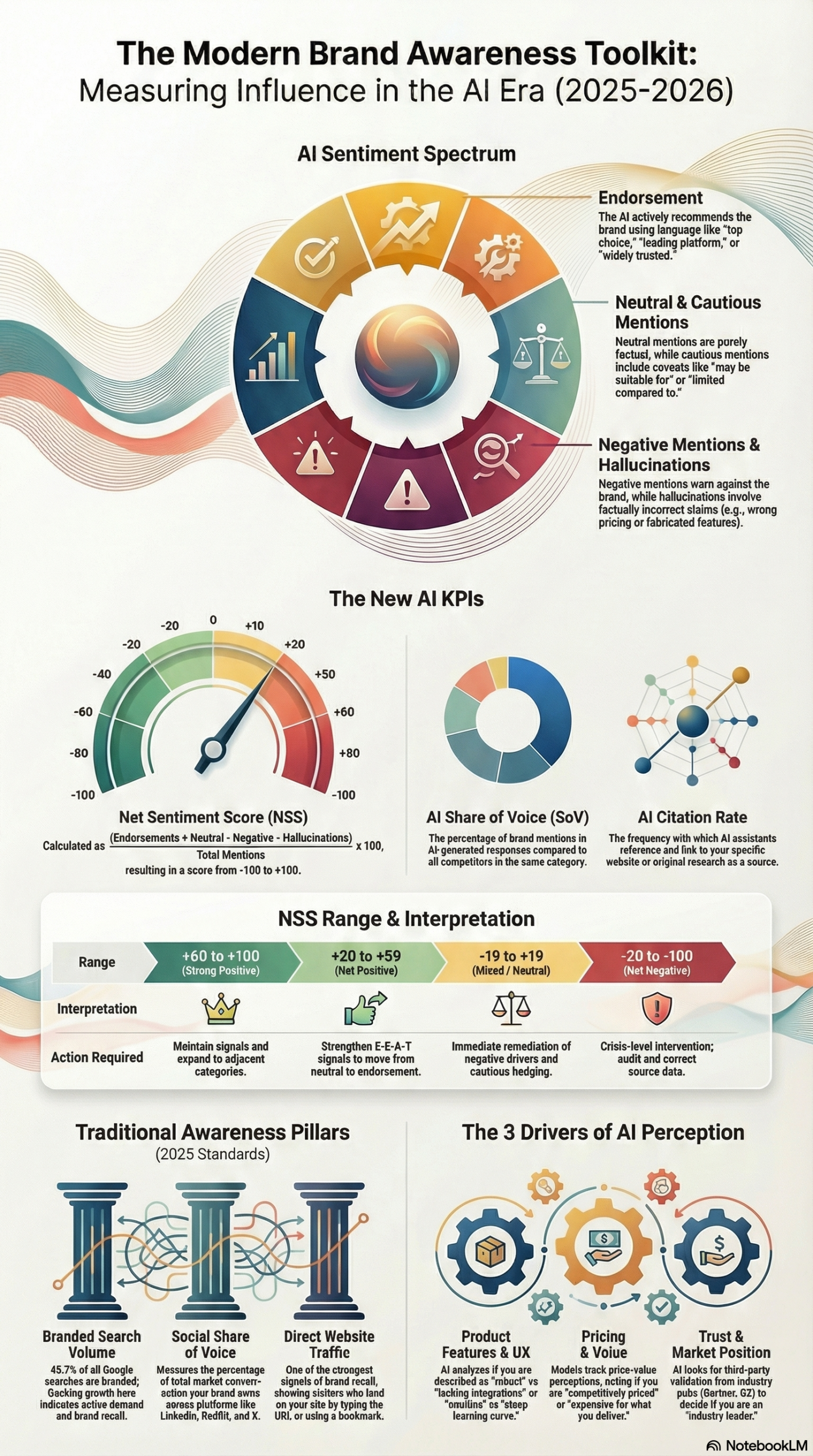
Run 30–60 prompt variations. For each response, classify the mention using the five-category AI sentiment spectrum defined in the MarketingAgent research report: Endorsement, Neutral Mention, Cautious Mention, Negative Mention, or Hallucination.
Phase 2: Activate Ongoing Monitoring (Week 2)
Step 5: Set up brand mention monitoring.
Configure your social listening tool (Brandwatch, Sprout Social, or Semrush’s Media Monitoring app) to track:
– Your brand name and common misspellings
– Your flagship product names
– Your CEO and key executives (for thought leadership tracking)
– Your primary competitors (for share of voice comparison)
Semrush recommends tracking mention frequency over time, sentiment breakdown (positive/negative/neutral), reach metrics, and which websites carry the most influential mentions. Set alerts for any spike in negative sentiment—these are early warning signals for reputation issues.
Step 6: Configure share of voice tracking.
Share of Voice (SoV) is the percentage of category-level conversations your brand owns relative to competitors. Set this up in two places:
– SEO SoV: In Semrush Position Tracking, add your top 20–30 branded and category keywords, plus the same keywords for two to three key competitors. The visibility percentage differential is your SEO share of voice.
– Social SoV: In your social listening tool, filter all mentions of your product category and calculate what percentage reference your brand versus competitors. Track this monthly.
Step 7: Activate survey and review monitoring.
Semrush’s guide recommends distributing brand perception surveys via platforms like Pollfish and tracking review volume on Google Business Profile and Yelp. Set up:
– A monthly or quarterly brand survey with three core questions: Have you heard of [brand]? How would you describe [brand]? Would you recommend [brand]? These map directly to the four awareness levels.
– Google Alerts for your brand name + “review” to catch new review content as it’s published
– A backlink monitoring alert in Semrush Backlink Checker—growing inbound links from publishers signal increasing brand recognition
Phase 3: Calculate Your AI Sentiment Score (Week 2–3)
Step 8: Calculate your Net Sentiment Score (NSS).
The NSS is the quantified AI brand health metric used by Visiblie to track AI perception over time. The formula, from the MarketingAgent research report:
NSS = (Endorsement Mentions + Neutral Mentions - Negative Mentions - Hallucinations) / Total Mentions × 100
NSS ranges from -100 to +100. A score above +50 indicates strong AI positioning; a score below 0 means AI models are actively framing your brand negatively more often than positively. Calculate this from the 30–60 prompt audit you ran in Step 4. This becomes your AI brand health baseline.
Step 9: Identify your citation sources.
Using Promptmonitor or OtterlyAI, analyze which domains appear as source citations in AI responses for your category prompts. The MarketingAgent research report distinguishes between mentions (presence) and citations (attribution with links). Citations indicate authority in the AI’s retrieval system. Export the list of recurring cited domains where competitors appear but your brand does not—these become your priority targets for earned media outreach.
Phase 4: Build Your Reporting Cadence
Step 10: Create your weekly brand health dashboard.
Consolidate all metrics into a single weekly review document with five sections:
| Section | Metrics | Source | Frequency |
|---|---|---|---|
| Branded Search | Search volume, click-through rate | Google Search Console | Weekly |
| Website Traffic | Direct %, new users, AI referral % | GA4 | Weekly |
| Share of Voice | SEO SoV, Social SoV | Semrush + Social Tool | Monthly |
| AI Visibility | NSS score, mention count, citation count | Visiblie / OtterlyAI | Monthly |
| Qualitative | Sentiment drivers, hallucinations found | Manual review | Monthly |
Semrush recommends tracking most metrics monthly with a maintained baseline for year-over-year comparison. Weekly monitoring is appropriate for branded search and direct traffic, where sudden drops can signal a PR issue or a brand impersonation campaign that needs immediate response.
Expected outcome: After four weeks, you will have a complete brand awareness baseline across traditional and AI-native channels, a repeatable audit process for AI visibility, an NSS score to track over time, and a citation gap list for your PR team to target. From this baseline, quarterly reviews will show whether your content and PR efforts are moving the needle where it counts.
Real-World Use Cases
Use Case 1: B2B SaaS Company Running a Quarterly Brand Audit
Scenario: A mid-market HR tech company (500 employees, $20M ARR) wants to understand why their sales team is encountering more competitive objections in deals. The hypothesis: competitors are getting better AI visibility.
Implementation: The marketing team runs 40 prompts across all four query categories in OtterlyAI, covering “best HR software for mid-market companies,” direct brand comparisons, and feature-specific queries. They calculate an NSS of +12, which seems acceptable until they see that 65% of their mentions are “Cautious”—AI models consistently frame them with language like “suitable for teams under 500 employees.”
They use Promptmonitor to identify the G2 review pages, Forrester Wave reports, and two industry blog posts that AI models cite when making these claims. Those citations all contain outdated positioning from two years ago.
Expected Outcome: By updating case studies with enterprise client data, submitting for the next Forrester evaluation, and doing targeted outreach to the two industry blogs, they shift AI framing from “cautious” to “neutral” within 60 days—measurable via monthly NSS tracking.
Use Case 2: Agency Building an AI Visibility Report for a Client
Scenario: A digital marketing agency needs to add AI visibility as a deliverable to their monthly client reporting. The client is an e-commerce brand in the home goods space.
Implementation: The agency uses Semrush’s AI Visibility Toolkit to track the client’s presence in AI responses for 20 core category queries. They configure a GA4 Custom Channel Group with the AI referral regex to track traffic attribution. Monthly reports now include: AI mention count, NSS trend, top citation sources driving traffic, and a competitors’ AI SoV comparison.
Expected Outcome: The agency demonstrates a new reporting category that competitors can’t yet offer, increases perceived value, and identifies that 40% of the client’s AI traffic comes from a single Wirecutter-style review post—a fragile dependency that becomes the foundation for a new content strategy recommendation.
Use Case 3: Enterprise Brand Addressing AI Hallucinations
Scenario: A fintech company discovers during an AI audit that ChatGPT is citing an incorrect pricing tier (a discontinued plan from 18 months ago) when comparing them to competitors.
Implementation: Following the MarketingAgent research report’s hallucination remediation protocol, they trace the incorrect claim to two sources: an outdated press release still indexed on their site, and a third-party review article that cited the old pricing. They update the structured data on their pricing page, add explicit schema markup, submit a content correction to the review site, and publish a new comparison post with canonical pricing information.
Expected Outcome: Within 60–90 days (one or two AI model update cycles), the hallucination disappears from responses. The hallucination count in their NSS calculation drops to zero, improving their score from +28 to +41.
Use Case 4: Early-Stage Startup Building Awareness from Zero
Scenario: A seed-stage DevOps tool startup has zero AI visibility and wants to build a measurement system before launching their content strategy, so they can attribute early awareness gains accurately.
Implementation: They establish all baselines at launch week: zero branded search volume, zero AI mentions, zero direct traffic. They set up Google Search Console, configure GA4 with AI referral tracking, and run a 20-prompt AI visibility audit monthly. They use Semrush’s brand awareness guide four-levels framework to set quarterly milestones: 100 branded searches/month by Q2, first neutral AI mention by Q3, 5% direct traffic by Q4.
Expected Outcome: With measurement in place before any content launches, the team can attribute exactly which content formats (comparison posts, integration guides, developer tutorials) generated the first AI citations—feeding a loop of compounding data back into their content strategy.
Use Case 5: PR Team Targeting AI Citation Sources
Scenario: A cybersecurity company’s PR team wants to earn placements that actually improve AI visibility, not just traditional media metrics.
Implementation: Using Promptmonitor, they export all domains that AI models cite when answering “best endpoint security solutions” and related prompts. They identify 12 domains their competitors appear in but they do not: three analyst reports, four review/comparison sites, and five industry publications. They reorient their earned media outreach list around these 12 targets, deprioritizing publications with high domain authority but zero AI citation history.
Expected Outcome: Six months of targeted outreach improves citation rate from 8% to 23% of category prompts, directly measurable in monthly OtterlyAI reports. The PR team can now demonstrate revenue-adjacent impact rather than just clip counts.
Common Pitfalls
Pitfall 1: Treating AI referral traffic as your AI visibility proxy.
Rising traffic from chatgpt.com or perplexity.ai does not mean your brand is well-represented in AI answers. As the MarketingAgent research report explains, AI models frequently credit aggregator sites (Reddit, Quora, Wikipedia) even when the original data came from your content. You can have near-zero AI visibility in category queries while still seeing referral clicks because of link placement in those aggregator pages. Measure mention count and sentiment directly—don’t use traffic as a proxy.
Pitfall 2: Measuring mention count without sentiment context.
The MarketingAgent research report cites a specific example from Visiblie: “A brand mentioned in 60% of category prompts sounds strong, until the dominant tone is ‘Brand X exists but lacks the enterprise features of Competitor Y.'” High mention frequency with negative or cautious sentiment is worse than low mention frequency with endorsement framing, because you’re appearing on more buyer shortlists only to be eliminated. Always pair mention count with NSS.
Pitfall 3: Running AI audits without tracking hallucinations specifically.
Hallucinations are a separate measurement category, not just a subset of negative mentions. An AI model that cites the wrong pricing, claims a discontinued integration exists, or attributes a competitor’s product feature to your brand creates buyer confusion that is uniquely hard to correct. Track hallucinations as their own metric in your NSS calculation, and treat any hallucination count above zero as an immediate action item.
Pitfall 4: Ignoring the SEO-PR gap.
According to the MarketingAgent research report, in 2026 both SEO and PR effectively report to the same KPI: “influence over the default AI answer.” If your SEO team is optimizing for keyword rankings and your PR team is optimizing for media placements, but neither team is coordinating on which sources AI models actually cite, you have a structural coverage gap. The fix: merge your branded keyword list with your AI prompt library and share the citation gap report with both teams.
Pitfall 5: Setting measurement cadence too infrequently.
Quarterly brand reviews made sense when campaigns ran on quarterly cycles. In 2026, AI model updates, algorithm changes, and competitor PR pushes can shift your AI visibility in weeks. The Semrush guide recommends monthly tracking for most brand metrics. For AI visibility specifically, monthly is the minimum—bi-weekly is better if you’re running active awareness campaigns.
Expert Tips
Tip 1: Target “citation magnets” over raw domain authority.
Not all high-DA publications feed AI model retrieval equally. Prioritize outreach to the specific domains that Promptmonitor or OtterlyAI identifies as recurring sources in AI-generated category responses. A placement in a mid-authority review site that AI models consistently cite is worth more for AI visibility than a placement in a Tier-1 publication that AI models rarely reference, per MarketingAgent research.
Tip 2: Build an “entity consensus” across your web properties.
AI models reconcile conflicting information about a brand by picking the most frequently reinforced version. If your pricing page, press releases, G2 profile, and partner directory listings all say slightly different things about your core features, AI models may generate cautious or hedged responses because the signal is mixed. Audit all public-facing brand information assets annually and enforce consistent language across them.
Tip 3: Fix E-E-A-T signals to address cautious AI framing.
If your NSS audit shows frequent “Cautious Mention” language from AI models (“may be suitable for smaller teams”), the root cause is usually weak Experience, Expertise, Authoritativeness, and Trustworthiness signals. The MarketingAgent research report recommends publishing case studies with quantified outcomes and securing mentions in Tier-1 analyst reports (Gartner, Forrester) to directly counteract hedged AI framing.
Tip 4: Use Google Trends to detect early awareness signals before search volume shows up.
Semrush’s guide notes that Google Trends provides historical branded search popularity data. When a campaign or PR push lands, Trends often shows directional movement before it appears in Search Console volume data. Use Trends as an early-warning indicator and Search Console as the confirmation metric.
Tip 5: Track AI SoV as a percentage, not an absolute count.
Your absolute AI mention count will fluctuate with AI platform query volume, model updates, and seasonal factors. What matters is your share of category mentions relative to competitors. If your mention count drops from 45% to 38% of category prompts while your top competitor goes from 30% to 41%, you’ve lost ground even if your absolute numbers stayed flat. Always track AI visibility as share of voice, not raw counts, per Visiblie’s methodology.
FAQ
Q1: How often should I run an AI visibility audit?
Monthly is the minimum for stable brands; bi-weekly is recommended for brands actively running awareness campaigns or operating in competitive categories. AI models update their retrieval and fine-tuning cycles on irregular schedules, meaning your positioning can shift without any action on your part. Establish a monthly NSS calculation as your primary KPI, and run a full 30–60 prompt audit quarterly, per the MarketingAgent research report.
Q2: What’s a good Net Sentiment Score (NSS) to target?
The NSS scale runs from -100 to +100, and context matters enormously. An NSS above +50 indicates strong AI positioning with mostly endorsement and neutral mentions. An NSS between 0 and +50 is typical for established brands—most mentions are neutral or mildly positive. An NSS below 0 means negative framing and hallucinations are outweighing positive signals, which is an urgent priority. Start by benchmarking your NSS against competitors rather than against an absolute target, using Visiblie’s competitor comparison features.
Q3: Can I track AI visibility without paid tools?
Yes, but it requires more manual effort. You can manually query ChatGPT, Perplexity, Google Gemini, and Claude with your 30–60 audit prompts, record the responses in a spreadsheet, and categorize them using the five-sentiment spectrum from the MarketingAgent research report. The free version of Google Trends covers branded search volume. GA4 with the AI referral regex configuration is free. The manual approach works for quarterly audits; for monthly tracking at scale, a paid tool like OtterlyAI or Semrush’s AI Visibility Toolkit becomes practical.
Q4: What’s the difference between a brand mention and a brand citation in AI responses?
A mention means the AI included your brand name in a response. A citation means the AI referenced your brand as a source—often with a link or explicit attribution. As the MarketingAgent research report explains, citations indicate authority in the AI’s retrieval system and carry more weight than passive mentions. A brand can have high mention frequency (appearing in many answers) but low citation rate (never being the source the AI credits), which signals you’re being acknowledged but not trusted as an authority in your category.
Q5: How do branded searches and AI visibility relate to each other?
They’re complementary but distinct channels. Branded search volume (tracked via Google Search Console) measures how many people are actively seeking your brand in traditional search—it’s a strong indicator of existing awareness and intent. AI visibility measures how often and how favorably AI models represent your brand when buyers haven’t already decided to search for you specifically. As Louise Linehan of Ahrefs notes, the more your brand is mentioned in topically relevant conversations online, the more likely it is to be cited by LLMs—meaning strong branded search and strong content authority feed AI visibility over time. They’re part of the same compounding system.
Bottom Line
Measuring brand awareness in 2026 requires two parallel tracks: traditional metrics (branded search volume, direct traffic, share of voice, social mentions, backlinks) and AI-native metrics (Net Sentiment Score, AI Share of Voice, citation rate). Neither track alone gives you the full picture. The Gartner 2025 finding that 73% of B2B buyers trust AI product recommendations over traditional ads has made AI visibility a primary purchase influence channel—which means an NSS below zero or persistent “cautious mention” framing is a revenue problem, not just a marketing vanity issue. Start with the 10-step setup in this tutorial, establish baselines across all nine measurement dimensions, and build a monthly review cadence that tracks your NSS alongside branded search trends. The brands that build systematic AI visibility measurement now will have a compounding data advantage that becomes increasingly difficult for slower-moving competitors to close.


0 Comments