

Google Gemini more than doubled its referral traffic to websites between November 2025 and January 2026 — surpassing Perplexity by 29% globally and by 41% in the U.S. — while ChatGPT simultaneously declined from its October 2025 peak, according to SE Ranking’s analysis of 101,574+ websites. This isn’t a curiosity — it’s a signal that the referral traffic map is actively being redrawn by AI platforms, and the sites that understand how each model selects its sources will win the next phase of search. In this tutorial, you will learn exactly how each major AI platform generates referral traffic, what signals determine citation selection, and how to implement Generative Engine Optimization (GEO) to maximize your brand’s presence in the Answer Economy.
What This Is: The AI Referral Traffic Landscape in 2026
AI referral traffic is the volume of website visits generated when an AI platform — Gemini, ChatGPT/SearchGPT, Claude, or Perplexity — cites or links to a page as a source within its answer interface. Unlike traditional search, where users actively browse a list of ten results, AI referral visits are generated only when the model names a specific source as authoritative enough to surface in its synthesized response.
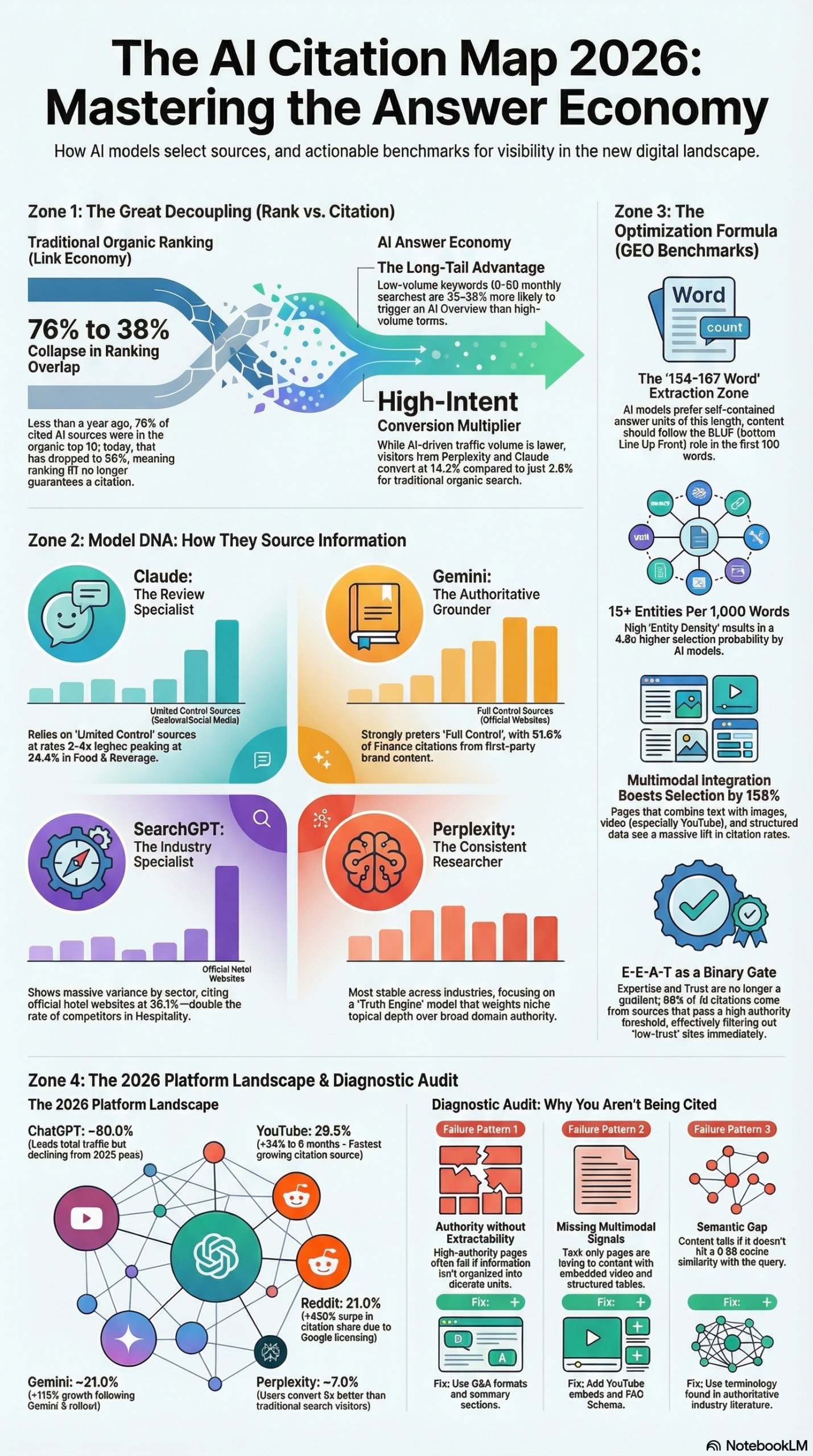
SE Ranking tracked referral data across more than 101,574 websites connected to Google Analytics to produce this benchmark. The headline finding: Google Gemini grew its referral traffic by approximately 115% combined across December (+51%) and January (+42%), crossing Perplexity for the first time in January 2026 after trailing badly for months. As recently as August 2025, Perplexity sent roughly three times more referral traffic than Gemini.
ChatGPT’s trajectory is more complicated. It still accounts for approximately 80% of all AI referral traffic and remains the dominant platform by a significant margin — but it peaked in October 2025, declined 8% in November, fell another 18% in December, and only partially recovered in January. The gap between ChatGPT and Gemini, once as wide as 22x in October, compressed to 8x by January 2026. That compression happened in three months.
Critically, all AI platforms combined represent only 0.24% of global internet traffic as of January 2026, up from 0.15% in 2025. That figure sounds small, but the composition of that traffic is what makes it commercially important. A separate NotebookLM research analysis of 17.2 million AI citations from Q4 2025 found that AI-referred visitors convert at approximately 14.2%, compared to roughly 2.8% for traditional organic search visitors. These are decision-ready users, not browsers.
To understand why Gemini surged, you have to look at what triggered it. Google rolled out its Gemini 3 model family between November 18 and December 17, 2025. That model improvement directly correlated with Gemini’s explosive referral traffic growth during that exact window, according to Search Engine Journal’s reporting.
Each platform has a distinct citation profile. The NotebookLM research report on 17.2 million citations identified model-specific behaviors that vary more by industry than by model architecture alone:
- Google Gemini strongly favors official brand websites (“Full Control” content) and applies Google’s E-E-A-T signals (Experience, Expertise, Authoritativeness, Trustworthiness) as a primary citation filter.
- Claude relies on user-generated content — reviews, social posts, forums — at rates 2x to 4x higher than competitors. In the Food & Beverage sector, Claude’s dependence on review content reaches 24.35%, nearly 10x higher than Gemini’s rate in the same sector.
- Perplexity is the most consistent model across industries. Its search-first RAG (Retrieval Augmented Generation) architecture prioritizes stable, verifiable facts over context-dependent adaptation.
- SearchGPT shows high variance by industry, with a notable “Hospitality Anomaly”: it cites official hotel websites at 38.1% — double the rate of other models in the hospitality sector.
Understanding these profiles is not optional for practitioners. Optimizing content for “AI search” as a monolithic concept will underperform optimizing for each model’s specific citation logic.
Why It Matters: The End of the Link Economy
The shift Gemini’s traffic surge signals is structural, not cyclical. The NotebookLM research report frames this as the transition from a “Link Economy” — defined by ranked URL lists and click-through traffic — to an “Answer Economy,” where AI synthesizes value directly on result pages.
The most telling data point is the collapse of the correlation between traditional organic search rankings and AI citations. That correlation dropped from 76% to 38% in less than a year. In practical terms: 62% of AI citations now come from sources that don’t rank in the organic top 10. If you are optimizing exclusively for Google’s blue links, you are invisible to more than half of AI citation selection events.
For marketers and SEOs, this creates three concrete workflow disruptions:
Visibility is now binary, not gradient. In traditional search, ranking #5 still gets you traffic. In AI search, you are either cited or you are not. The pool of cited sources per query is typically 5-15 sources, versus 10-100 results in traditional search. Missing the cut entirely is a real outcome.
CTR math has inverted. According to the research report, organic click-through rates drop by 61% when an AI-generated overview is present on the results page. The top-of-funnel informational click is disappearing. What’s left is the high-converting, decision-ready click from AI platforms — at 14.2% conversion versus 2.8% for traditional search.
The AIO Citation Flywheel is a real growth mechanism. Being cited in an AI overview increases branded searches by 35%, which strengthens E-E-A-T signals, which improves future citation probability. As one digital marketing practitioner noted on r/AskMarketing: “Even if they don’t click, being the source cited in the overview builds massive authority for when they’re actually ready to buy.”
Agencies, enterprises with large content libraries, and e-commerce brands in competitive verticals face the most acute need to adapt. The playbook has fundamentally changed.
The Data: AI Platform Citation and Traffic Benchmarks
The following table consolidates key performance and citation metrics across the four major AI platforms, sourced from the SE Ranking study and the NotebookLM citation analysis of 17.2 million data points:
| Metric | Google Gemini | ChatGPT / SearchGPT | Claude | Perplexity |
|---|---|---|---|---|
| Referral Traffic Share (Jan 2026) | Growing rapidly | ~80% of AI referral total | Minimal direct referral | Below Gemini (Jan 2026) |
| Traffic Growth (Nov–Jan) | +115% combined | Peaked Oct; –18% Dec | N/A (limited referral data) | Declining vs. Gemini |
| Primary Citation Source | Official brand websites (E-E-A-T) | High variance by industry | User-generated content (reviews, social) | Verifiable facts; stable sources |
| UGC Reliance vs. Competitors | Baseline | High variance | 2x–4x higher | Consistent; below Claude |
| Industry Anomaly | E-E-A-T gate strongest | Hospitality: 38.1% official sites | F&B reviews: 24.35% | Most consistent across sectors |
| Architecture Type | Search-Grounded | RAG + External Retrieval | Constitutional AI | Search-First RAG |
| Visibility Pool Size | 5–15 cited sources | 5–15 cited sources | 5–15 cited sources | 5–15 cited sources |
| Traditional vs. AI Search Comparison | Traditional Organic Search | AI Search (AIO/Perplexity/Gemini) |
|---|---|---|
| Primary Visibility Predictor | Domain Authority / Backlinks | Citation Authority / E-E-A-T Signals |
| Click-Through Rate Impact | High for top positions | 61% drop in organic CTR when AI present |
| Conversion Rate (Referred Traffic) | ~2.8% | ~14.2% |
| Citation Pool | Top 10–100 results | 5–15 cited sources |
| AI Citation vs. Top 10 Correlation | 76% (one year ago) | 38% (current) |
| Sources Outside Top 10 Cited | N/A | 62% of citations |
Step-by-Step Tutorial: Implementing GEO for AI Referral Traffic
Generative Engine Optimization (GEO) is the practice of structuring content so that AI models can retrieve, evaluate, and cite it. Here is how to implement it across your content stack, starting with the highest-leverage actions.
Prerequisites
Before starting, you need:
– Google Search Console access to identify your current top-performing organic pages
– A site crawler (Screaming Frog, Sitebulb, or equivalent) to audit technical blocking
– Access to your robots.txt file and the ability to edit meta tags
– Google Analytics 4 or equivalent to create a segment for AI referral traffic
– Schema markup capabilities (via plugin, tag manager, or direct code access)
Phase 1: Audit and Unblock AI Crawlers
The first step is ensuring AI platforms can access your content. A technically sound site that blocks AI bots gets zero citations — regardless of content quality. According to the NotebookLM research report: “Retrieval quality is the primary bottleneck, not LLM capability. A brilliant synthesis model can’t compensate for poor upstream retrieval.”
Step 1: Audit your robots.txt file. Open yourdomain.com/robots.txt and look for any Disallow rules targeting the following user agents:
– GPTBot (OpenAI / SearchGPT)
– PerplexityBot
– Google-Extended (Gemini)
– ClaudeBot (Anthropic)
– Amazonbot
If any of these are disallowed, you are explicitly excluded from those models’ citation pools. Remove the disallow rules for any platforms you want to be cited by.
Step 2: Check <meta name="robots"> tags. Some CMS platforms add noindex or noai meta directives at the page level that override robots.txt. Use your site crawler to flag any pages with these tags on your highest-traffic content.
Step 3: Verify crawl accessibility. Use Google’s Rich Results Test and manually test with curl -A "GPTBot" https://yourdomain.com/your-page to confirm bots can reach the page without being redirected or blocked.
Phase 2: Restructure Content for Machine Extractability
The research report identified three specific structural requirements that maximize AI citation selection:
Step 4: Implement Bottom Line Up Front (BLUF). Place a direct, concise answer (40–60 words) within the first 100 words of every page. AI models perform passage-level extraction, and the opening passage is the highest-priority retrieval target. Rewrite your page introductions to answer the primary query before providing supporting detail. Example: if your page is about “how to reduce customer churn,” your first paragraph should contain a direct, specific answer — not background context.
Step 5: Restructure body content into 134–167-word answer units. The citation analysis found that AI models favor self-contained passage units of 134–167 words. Audit your existing H2 and H3 sections. If sections run longer than 200 words without a clear self-contained answer, split them. If sections run shorter than 100 words, they may be too thin to extract reliably. Each section should function as a standalone answer to its heading question.
Step 6: Convert headers to Q&A format. Transform declarative headings into question-based headings. Change “Benefits of Email Automation” to “What Are the Key Benefits of Email Automation?” This aligns with how conversational AI queries are phrased and increases semantic match probability between user queries and your content structure.
Step 7: Add FAQ schema (JSON-LD) to every page. Implement FAQ structured data using JSON-LD — not Microdata. Structure it as follows:
{
  "@context": "https://schema.org",
  "@type": "FAQPage",
  "mainEntity": [
    {
      "@type": "Question",
      "name": "How does Google Gemini select sources for citations?",
      "acceptedAnswer": {
        "@type": "Answer",
        "text": "Google Gemini prioritizes official brand websites and applies E-E-A-T signals — Experience, Expertise, Authoritativeness, and Trustworthiness — as its primary citation filter. Content from verified authors with clear credentials and consistent entity profiles across channels has significantly higher citation probability."
      }
    }
  ]
}
Add 3–5 FAQ entries per page covering the most common queries related to the page topic.
Phase 3: Boost Entity Density and Knowledge Graph Signals
Step 8: Audit and increase entity density. The research report found that pages containing 15 or more Knowledge Graph-recognized entities per 1,000 words have a 4.8x higher selection probability for AI citation. Run your top pages through a semantic analysis tool (InLinks, Surfer SEO, or equivalent) to identify current entity density. A “Knowledge Graph entity” is a specific, named concept that Google’s Knowledge Graph recognizes — people, organizations, places, products, standards, or tools.
For a page about email marketing automation, entities might include: Mailchimp, HubSpot, CAN-SPAM Act, GDPR, ESP (Email Service Provider), open rate, click-through rate, drip campaign, segmentation, behavioral trigger. Count them, then add missing ones contextually — never keyword-stuff.
Step 9: Implement Person schema for all authors. Because Google Gemini applies E-E-A-T as a binary gate, author credibility signals are mandatory. Add Person schema JSON-LD to every article page, linking the author to their LinkedIn profile, published credentials, and any other verifiable platforms. Ensure the author’s name, bio, and credential information is consistent across your website, LinkedIn, and any external profiles.
Step 10: Build consistent entity profiles across platforms. The research report identifies YouTube (29.5% citation share) and Reddit (21% citation share) as platforms whose content is cited at rates that brand websites alone cannot match. This does not mean abandoning your site — it means extending your entity presence. Publish consistent content using identical brand positioning and key phrase patterns across your website, YouTube channel, LinkedIn, and where relevant, Reddit. This consistency solidifies your brand’s entity profile in the Knowledge Graph, which directly strengthens Gemini’s confidence in citing you.
Phase 4: Implement Multimodal Content Signals
Step 11: Add structured data beyond FAQ. Pages using multiple schema types — Article, FAQPage, HowTo, BreadcrumbList — alongside JSON-LD for video and image objects see a 156% increase in AI model selection rates, according to the research report. Implement HowTo schema for tutorial pages, Article schema for editorial content, and VideoObject schema for any embedded video.
Step 12: Embed and caption images and video. Add descriptive alt text to all images, and use <figcaption> tags with entity-rich descriptions. For embedded YouTube videos, ensure the video itself uses keyword-aligned titles and descriptions, since YouTube content represents a significant share of AI citation pools.
Phase 5: Monitor “Share of Model”
Step 13: Create an AI referral traffic segment in GA4. In Google Analytics 4, create a custom segment filtering sessions where Session source contains gemini.google.com, perplexity.ai, chat.openai.com, claude.ai, or chatgpt.com. Track this segment weekly, broken out by source platform, landing page, and conversion event. This gives you a baseline and lets you measure the impact of GEO changes.
Step 14: Run weekly “Share of Model” queries. Manually query each AI platform for your primary categorical keywords — e.g., “best [your product category] for [use case]” — and record whether your brand is cited. This is currently manual, but tools for automated Share of Model tracking are emerging. For now, build a simple spreadsheet tracking brand mentions across 10–15 priority queries per week across Gemini, ChatGPT, Perplexity, and Claude.
Expected Outcomes: After 60–90 days of consistent GEO implementation, expect to see AI referral traffic measurable in GA4, improved presence in AI overview citations for primary keywords, and an increase in branded search volume (the 35% branded search lift from AI citations documented in the research report typically takes 6–8 weeks to appear).
Real-World Use Cases
Use Case 1: E-Commerce Brand Optimizing for Gemini Citations
Scenario: A mid-size sustainable apparel brand ranks on page 2 for most of its primary keywords in traditional search and has no AI referral traffic in GA4.
Implementation: The brand audits robots.txt (finds Google-Extended was blocked, removes the rule), restructures its 15 highest-traffic product category pages using BLUF openings and 150-word answer units under Q&A headers, adds FAQ JSON-LD schema to each, and implements Person schema for its editorial team. It also publishes one YouTube product comparison video per month, using entity-rich descriptions.
Expected Outcome: Within 90 days, Gemini begins citing the brand’s category pages for “best sustainable [product type]” queries. Because Gemini strongly favors E-E-A-T signals and official brand content, the brand’s website becomes the preferred source over third-party review sites for these queries. AI-referred conversion rate comes in near the 14.2% benchmark.
Use Case 2: Restaurant Group Optimizing for Claude and SearchGPT
Scenario: A multi-location restaurant group notices that AI platforms aren’t citing their official website, but are citing Yelp and TripAdvisor reviews about their restaurants.
Implementation: Recognizing that Claude relies on user-generated content at rates nearly 10x higher than Gemini in the Food & Beverage sector, the group runs a systematic review-generation campaign — post-visit follow-up emails, QR codes at tables — and begins actively responding to all reviews on Yelp and TripAdvisor using brand-consistent language. They also claim and optimize their Google Business Profile with structured hours, menu data, and photo content.
Expected Outcome: As review volume and recency improve, Claude’s citation frequency for “best [cuisine type] in [city]” queries increases. Because the brand cannot directly control review platforms, this strategy focuses on maximizing the quality and volume of “Limited Control” content that Claude already prefers.
Use Case 3: SaaS Company Capturing Perplexity Citations
Scenario: A B2B SaaS tool for project management wants to appear in Perplexity’s citations for queries like “best project management software for remote teams.”
Implementation: Because Perplexity’s search-first RAG architecture prioritizes verifiable, stable facts, the company focuses on publishing deeply factual comparison content — feature matrices, benchmarks, and methodology breakdowns — with specific numbers and cited sources. Each comparison page uses 15+ named entities (competing tools, integrations, certification standards) and is structured in self-contained 150-word answer units. The company also creates a YouTube walkthrough series covering each major feature.
Expected Outcome: Perplexity, which is the most consistent model across industries, begins surfacing the company’s comparison pages for research-intent queries. Because Perplexity prioritizes fact density and source verifiability over brand authority alone, well-structured factual content from lower-authority domains can outperform higher-authority generic pages.
Use Case 4: Healthcare Provider Building Gemini Citation Authority
Scenario: A regional healthcare network wants AI platforms to cite its physicians and health content for medical queries.
Implementation: The network adds Person and MedicalOrganization schema to all physician profile pages, implements BLUF answer paragraphs on every condition and treatment page, ensures all content is authored by board-certified physicians with verifiable credentials linked via schema, and maintains consistent entity positioning across its website, LinkedIn, and Google Business Profiles.
Expected Outcome: Gemini, which applies E-E-A-T most stringently of all models, begins citing the network’s condition pages for local health queries. The 4.8x selection lift from high entity density, combined with verified author credentials, gives the network’s content a structural advantage over generic health publishers for local queries.
Common Pitfalls
Pitfall 1: Blocking AI crawlers without realizing it. Many websites added broad bot-blocking rules during the AI content scraping debates of 2024–2025. If your robots.txt disallows GPTBot, Google-Extended, or PerplexityBot, you are invisible to those models — full stop. Audit this first, before any content work. It’s the highest-leverage single fix available.
Pitfall 2: Treating all AI platforms as identical. Optimizing for “AI search” as a monolith wastes resources. Claude prioritizes UGC and reviews; Gemini prioritizes E-E-A-T and official brand content; SearchGPT shows dramatic industry-specific variance; Perplexity is the most consistent. A strategy tuned for one platform may actively misalign with another. Build model-specific tactics for your highest-priority platforms.
Pitfall 3: Ignoring author credibility signals. Because Gemini uses E-E-A-T as a binary gate — you either pass or you don’t — content published without verifiable author attribution is structurally disadvantaged for Gemini citations. Anonymous content, “Staff Writer” bylines, and missing Person schema all reduce citation probability. Every page that targets a knowledge-domain query needs a named, credentialed author.
Pitfall 4: Measuring AI success with traditional click-based metrics. The research report notes that organic CTR drops 61% when AI is present. Measuring GEO success solely through clicks will make the strategy look like a failure even when it’s working. Track branded search volume (which rises 35% when cited in AI overviews), Share of Model mentions, and AI-specific referral traffic conversion rates separately.
Pitfall 5: Content that’s too long or too short per section. Passage-level extraction favors 134–167-word self-contained units. Pages with walls of 800-word narrative text are hard for AI retrieval systems to parse into discrete answers. Pages with thin 50-word sections don’t provide enough context to be trustworthy. Calibrate section length deliberately.
Expert Tips
Tip 1: Monitor Gemini’s model release calendar. Gemini’s referral traffic surge directly coincided with the Gemini 3 model rollout (November 18 – December 17, 2025). Major model releases tend to reset citation patterns as retrieval logic is updated. Track Google’s model release announcements and audit your AI referral traffic in the two weeks following any major update. Spikes and drops in citation frequency during these windows often reveal which content format changes matter most.
Tip 2: Use Reddit strategically, not casually. Reddit holds a 21% AI citation share, making it one of the most-cited platforms across all AI models, per the research report. High-quality, expert-authored posts in relevant subreddits — with proper disclosure — can earn citations in ways your domain cannot. Focus on threads where your team has genuine expertise to contribute, and link back to authoritative resources. Thin promotional posts get removed; genuine expert answers persist and get cited.
Tip 3: Apply SearchGPT’s Hospitality Anomaly logic to your industry. SearchGPT cites official hotel websites at 38.1% — double other models in the same sector. This anomaly suggests that SearchGPT assigns heavy weight to official sources in certain verticals. Investigate whether your industry shows a similar pattern by testing SearchGPT with 10–15 industry queries and recording which sources it cites. If official brand sources dominate, invest aggressively in your own domain’s technical authority signals.
Tip 4: Build the BLUF habit into your editorial workflow. The single highest-leverage GEO change for most teams is writing BLUF paragraphs — direct 40–60-word answers within the first 100 words of a page. Make this a template requirement in your CMS and a standard editorial checklist item. It costs almost nothing to implement on new content and can be retrofitted into existing content systematically.
Tip 5: Track “Citation Conversion” separately from total conversions. AI-referred visitors convert at approximately 14.2% versus 2.8% for traditional organic, according to the research report. Build a dedicated GA4 conversion segment for AI referral traffic and calculate its revenue contribution separately. When presenting GEO ROI internally, the quality-adjusted revenue impact will look dramatically better than raw traffic volume comparisons.
FAQ
Q1: Is Google Gemini referral traffic significant enough to invest in right now?
As of January 2026, all AI platforms combined represent 0.24% of global internet traffic, per SE Ranking’s analysis. That’s not enormous in volume terms. But AI-referred traffic converts at approximately 14.2%, compared to 2.8% for traditional organic search. The investment case is not about current volume — it’s about conversion quality and the trajectory of growth. Gemini alone grew 115% in two months. The time to build citation authority is before the volume arrives, not after.
Q2: Does traditional SEO still matter if AI citations don’t correlate with rankings?
Yes, but its role has changed. The correlation between organic rankings and AI citations dropped from 76% to 38% in under a year, meaning rankings are no longer a reliable proxy for AI visibility. However, the signals that drive strong rankings — domain authority, E-E-A-T compliance, technical site health — still matter because AI models use them as partial inputs. The gap is that 62% of AI citations now come from outside the organic top 10, so rankings alone are insufficient. Think of GEO and SEO as overlapping but distinct disciplines.
Q3: Which AI platform should I prioritize first?
It depends on your industry and content type. If you operate an e-commerce or B2B brand with strong website content, prioritize Google Gemini first — it favors official brand websites and E-E-A-T signals, giving you direct leverage through your own domain. If you operate in hospitality, food, or service industries where reviews are central, Claude and Yelp/TripAdvisor presence become equally important alongside your website. Use the model-specific citation profiles from the research report as your prioritization framework.
Q4: How long does it take to see AI referral traffic growth from GEO changes?
Based on observed patterns, expect 60–90 days for structural content changes to index and be retrieved by AI crawlers. Branded search lift from AI overview citations typically appears within 6–8 weeks. Technical changes — unblocking AI crawlers, adding schema markup — can show impact within days. Do not evaluate GEO effectiveness on a two-week horizon; the retrieval indexing cycle is longer than traditional SEO.
Q5: Can smaller sites without high domain authority earn AI citations?
Yes. The research report confirms that 62% of AI citations come from outside the organic top 10. Perplexity in particular prioritizes stable, verifiable facts and consistent entity coverage over domain authority as a primary signal. A lower-authority site with high entity density (15+ Knowledge Graph entities per 1,000 words), clear author credentials, and well-structured self-contained answer units can outperform high-authority sites that are poorly structured for passage-level extraction. The playing field is not level — but it is less unequal than traditional SEO.
Bottom Line
Google Gemini’s 115% referral traffic growth between November 2025 and January 2026, surpassing Perplexity for the first time, confirms that AI referral traffic is now a multi-platform competition — not a ChatGPT-only story. The practitioners who will win this transition are those who treat each AI platform as a distinct citation system with its own retrieval logic, rather than optimizing for “AI search” as a monolith. The GEO implementation framework in this tutorial — unblocking AI crawlers, restructuring content for passage-level extraction, building entity density, and implementing model-appropriate trust signals — is executable today with existing content and technical resources. AI referral traffic currently converts at 14.2%, making it among the highest-quality traffic sources available; the brands building citation authority now will hold structural advantages that compound as AI referral volumes continue their trajectory upward.


0 Comments