

OpenAI crossed $100 million in annualized ad revenue within six weeks of launching its beta advertising program in February 2026 — and that milestone came from showing ads to fewer than 20% of eligible users, according to the NotebookLM Strategic Briefing on the ChatGPT Advertising Ecosystem. Self-serve access opens in April 2026, which means the window to get ahead of your competitors is right now. This guide walks you through exactly how the platform works, what you need to prepare, and how to run your first campaigns when the doors open.
What This Is
ChatGPT advertising is OpenAI’s first native monetization layer built directly into the conversational AI interface. Officially rolled out in February 2026, the system moves decisively away from the keyword-bidding and cookie-retargeting model that has defined digital advertising for the last two decades. Instead, it introduces what the research report calls “Conversational Discovery” — ads that surface based on the semantic intent of an entire multi-turn conversation, not a single search query.
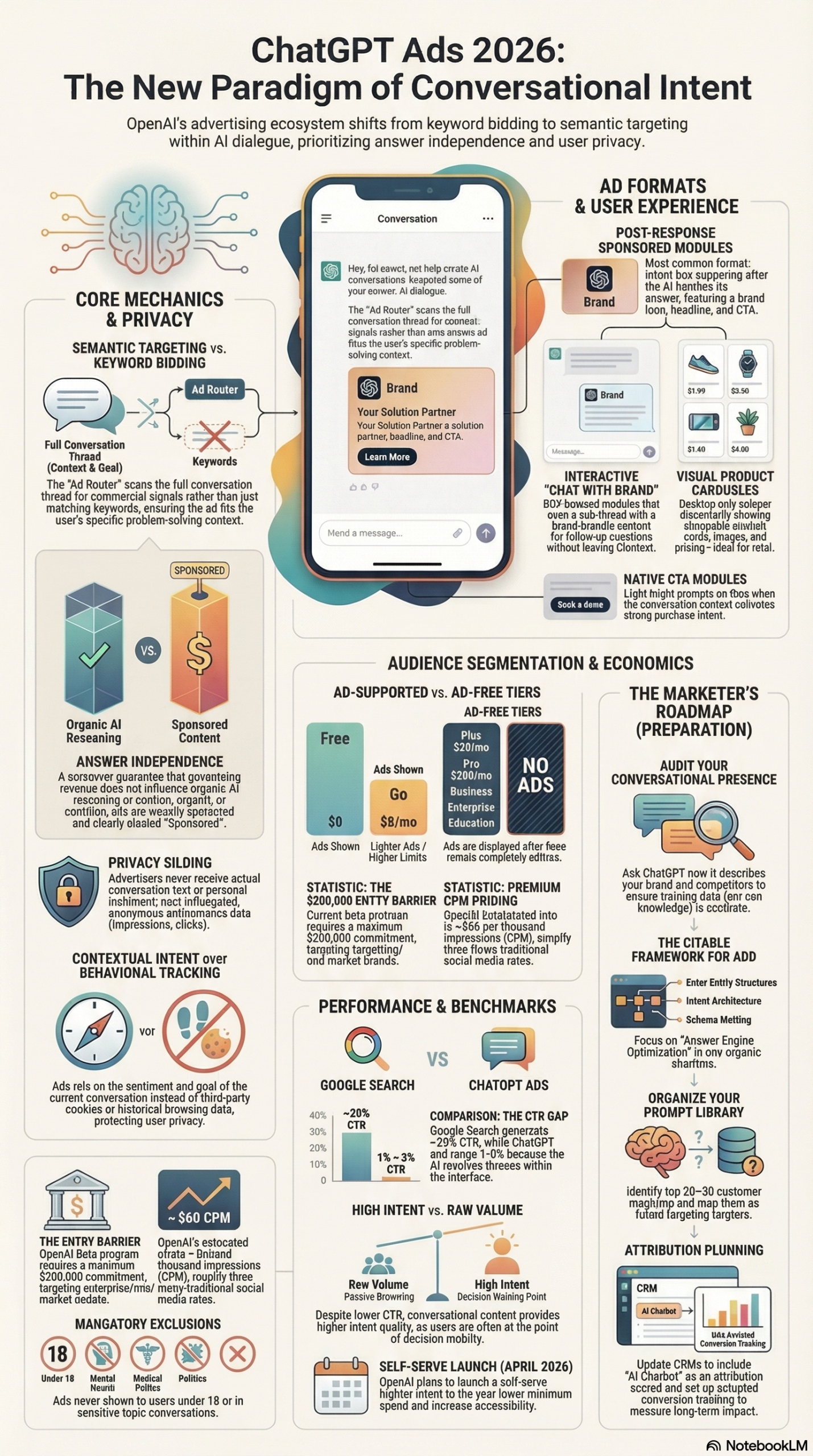
The technical heart of the system is the Ad Router, a component that runs parallel to the core Large Language Model. While the LLM is generating an answer to a user’s question, the Ad Router is simultaneously scanning the conversation for commercial signals — things like product comparisons, service recommendations, and purchase-adjacent questions. When it detects a match, it pulls a relevant sponsored placement and surfaces it after the AI’s organic response is complete.
Crucially, the Ad Router never interferes with the AI’s reasoning. The research report makes this a structural principle: “A core structural principle ensures that ad revenue never influences the AI’s organic reasoning or citations. The AI completes its advisory response before any sponsored content is presented.” That separation matters for advertisers too — your brand appears in a context where the user has already received genuinely useful information, which sets a very different psychological stage than an interruption-based ad.
The platform launched in a closed enterprise beta requiring a $200,000 minimum spend commitment, according to the research report. That threshold isn’t arbitrary — it signals that OpenAI is deliberately curating who gets in first, prioritizing brands with robust analytics infrastructure capable of measuring a new attribution model.
On the ad format side, five confirmed placements are in market as of early 2026:
- Post-Response Sponsored Modules — A tinted box appearing at the bottom of the AI’s answer, featuring a brand icon, headline, value proposition, and CTA link. This is the core format.
- SearchGPT Placements — Sponsored results integrated into the AI’s synthesized summary during search-optimized queries.
- Interactive “Chat with Brand” Modules — Users can open a sub-thread with a brand-specific chatbot to ask follow-up questions without leaving the interface.
- Visual Ad Cards — Desktop-focused product comparison cards with logos, headlines under 40 characters, and descriptions under 150 characters.
- Native CTA Modules — Lightweight prompts like “Book a demo” or “Start free trial” adjacent to high-intent answers.
The pricing model in the beta operates on CPM (cost per thousand impressions), estimated at approximately $60 — substantially higher than typical social media CPMs, according to the research report. That premium reflects the quality of intent context; these are users actively seeking advice, not passively scrolling a feed.
Why It Matters
The reason practitioners should pay attention isn’t the revenue milestone — it’s what that milestone reveals about where the advertising market is heading. The $100M run rate came from less than 20% ad penetration into an eligible base of 85% of Free and Go tier users, per the research report. That means OpenAI has a massive inventory expansion lever it hasn’t pulled yet. By the time self-serve opens in April, the total addressable audience will be enormous.
More importantly, ChatGPT represents the clearest example yet of what the research report calls a “zero-click paradigm” — a world where users research and make decisions entirely within the AI interface without clicking through to brand websites. The report quotes directly on the structural shift: “ChatGPT sits inside the user’s thinking process… Users treat conversational AI more like an advisor than a media channel. When ads appear in this environment… they carry a level of relevance and timing that traditional display or search ads cannot match.”
This creates three distinct groups of practitioners who need to act now:
Performance marketers running Google or Meta campaigns need to understand that a significant portion of top-of-funnel research is now happening inside ChatGPT before a user ever sees your Google ad. If your brand isn’t showing up organically in AI responses and eventually paid placements, you’re invisible at the most critical moment of consideration.
Brand marketers need to audit what ChatGPT currently says about their brand. The AI is already forming opinions about your company based on public web data, review sites, and structured content. That organic presence is the foundation your paid placements will either amplify or undermine.
Marketing agencies have a narrow window to develop ChatGPT advertising competency before clients start asking for it. The self-serve launch in April 2026 is the starting gun.
What makes this categorically different from Meta or Google is the conversational depth. A user asking ChatGPT to compare CRM tools isn’t showing a single intent signal — they’re often revealing business size, pain points, budget constraints, and evaluation criteria across a multi-turn thread. The Ad Router uses all of that semantic context. No other ad platform has anything close to this.
The Data
ChatGPT Ads vs. Google Search: Early 2026 Benchmark Comparison
The performance metrics look strange on the surface until you understand the pricing model shift from CPC to CPM, per the research report.
| Metric | Google Search | ChatGPT (Early 2026) |
|---|---|---|
| Click-Through Rate (CTR) | ~29% | 1% – 3% |
| Traffic Referral Volume | High (primary driver of web traffic) | Low (resolves queries within the UI) |
| Primary Pricing Model | CPC (Cost Per Click) | CPM (Cost Per Thousand Impressions) |
| Targeting Basis | Keywords / Cookies | Semantic Context / Intent |
| Estimated CPM | Variable ($2–$15 typical display) | ~$60 |
| Ad Format | Text/Shopping/Display | Conversational native placements |
| Attribution Complexity | Low (last-click native) | High (requires multi-touch modeling) |
ChatGPT User Tier Structure and Ad Exposure
| Tier | Monthly Cost | Ad Status | Primary Audience |
|---|---|---|---|
| Free | $0 | Full ads | Largest segment; flagship model access in exchange for ads |
| Go | $8 | Lighter ads | Light power users; higher usage limits |
| Plus | $20 | Ad-free | Individual power users, early adopters |
| Pro | $200 | Ad-free | Researchers, developers, heavy users |
| Business / Enterprise | Custom | Ad-free | Corporate accounts with SOC 2 compliance |
Source: ChatGPT Advertising Ecosystem Research Report
The CTR gap between Google and ChatGPT is real, but it’s measuring different things. On Google, a click is the primary value delivery mechanism — you pay per click. On ChatGPT, the model is CPM because impression-level context is the value. A 2% CTR at $60 CPM with verified high-intent context may outperform a 29% CTR at $3 CPC on generic informational queries depending on your product category.
Step-by-Step Tutorial: Preparing for and Running Your First ChatGPT Ad Campaign
Prerequisites
Before you can run effectively on ChatGPT, you need four things in place:
– A verified brand presence on your website with updated structured data (schema markup)
– A presence on third-party review and directory sites (G2, Capterra, Trustpilot, etc.)
– GA4 or equivalent analytics with multi-touch attribution enabled
– A budget model for testing: the research report recommends $10,000–$25,000 for an initial self-serve pilot
Phase 1: Audit Your Conversational Presence (Do This Before April)
The single most important pre-launch step is understanding what ChatGPT currently says about your brand. The research report provides a specific audit framework.
Step 1: Run the baseline brand queries
Open ChatGPT (free account is fine for auditing) and run each of these prompts, recording the responses verbatim:
– “What do you know about [Your Company Name]?”
– “Compare [Your Company] to [Top Competitor] for [Your Core Use Case].”
– “What are the best [Category] tools for [Specific Problem Your Product Solves]?”
– “Who are the leading providers of [Your Service]?”
Document: Does your brand appear? What language does ChatGPT use to describe you? What competitors are mentioned alongside you? Where does your brand rank in comparison lists?
Step 2: Identify content gaps
If ChatGPT’s description of your company is outdated, thin, or wrong, the paid placements will appear against a weak organic foundation. Your Intent Mapping (the mechanism advertisers use to describe what problems their product solves, per the research report) will be undermined by contradictory or missing information in the AI’s knowledge base.
Cross-reference ChatGPT’s answers against your actual product capabilities. Make a list of every gap.
Step 3: Fix public-facing factual content
ChatGPT’s knowledge about your brand comes from public sources: your website, press coverage, review platforms, and structured directories. To close the gaps you identified, update:
– Your website’s “About,” product pages, and FAQ sections to explicitly state the problems you solve in plain language
– Your G2, Capterra, and Trustpilot profiles with accurate, current feature descriptions
– Any industry directory listings (Crunchbase, LinkedIn company page, etc.)
This is Answer Engine Optimization (AEO) — the practice of structuring your content to earn organic AI citations. The research report provides the CITABLE framework for this:
- Confirmed Entity Structure: Add schema markup and structured data to your website
- Intent Architecture: Map your content directly to specific user problems, not just product features
- Third-party Validation: Build presence on review sites and authoritative directories
- Answer Grounding: Publish factual, specific, claim-based content (not fluffy marketing copy)
- Block-structured Content: Use clear headers and modular sections that an AI can extract from
- Link Consistency: Make sure your NAP (Name, Address, Phone) and product claims are uniform across all web properties
- Entity Graphing: Build a clear semantic map of what you do, who you serve, and what problems you solve
Phase 2: Build Your Intent Mappings
When the self-serve platform opens, you will not be bidding on keywords. You will be submitting Intent Mappings — structured descriptions of the specific problems your product solves, which the Ad Router matches against live conversation threads, according to the research report.
Step 4: Write your Intent Mappings
An Intent Mapping is not a tagline. It describes a problem scenario in the language a user would actually use when seeking help. For each core use case your product addresses, write a 2-4 sentence problem statement from the user’s perspective.
Example for a project management SaaS:
“A team is struggling to keep track of who owns what tasks across multiple ongoing projects. Team members are missing deadlines because there’s no central place to see priorities. The manager needs a system that gives visibility without adding to meeting overhead.”
Write 5–10 Intent Mappings covering your primary user scenarios. These become your targeting layer.
Step 5: Develop modular ad creative
ChatGPT ads operate on tight character limits, according to the research report: headlines under 40 characters, descriptions under 150 characters. This requires a fundamentally different creative approach than display or social.
The shift the research report recommends is from “visual-heavy display assets” to “text-first, context-native creative.” Specifically, develop Modular Copywriting — short snippets that function as helpful extensions of the AI’s advice rather than interruptive sales messages.
For each Intent Mapping, write:
– A headline (under 40 characters): Focus on the specific outcome the user wants
– A description (under 150 characters): Name the problem and your solution in plain language
– A CTA: One of the proven formats — “Book a demo,” “Start free trial,” “See pricing,” “Compare plans”
Bad example: “The #1 Project Management Tool — Try Free!”
Good example: “Track team tasks without spreadsheets — See how 500+ teams stay on deadline. Start free.”
Step 6: Set your campaign budget and measurement framework
The research report recommends a test budget of $10,000–$25,000 for an initial self-serve pilot, with the goal of comparing Cost-Per-Acquisition against your existing Google or Meta benchmarks.
Set up your measurement infrastructure before you spend a dollar:
-
Add “AI Assistant / ChatGPT” to your lead form’s “How did you hear about us?” field. This captures self-reported attribution from users who remember the conversational touchpoint.
-
Enable assisted conversion reporting in GA4. Monitor conversion paths where ChatGPT appears as an early touchpoint, even if another channel gets last-click credit.
-
Set up UTM parameters for all ChatGPT ad URLs using a consistent naming convention (e.g.,
utm_source=chatgpt&utm_medium=cpm&utm_campaign=[intent-mapping-name]). -
If you have a mobile app, brief your Mobile Measurement Partner (MMP) on tracking direct installs from conversational placements — the research report flags this as an attribution gap brands need to close proactively.
Phase 3: Campaign Launch and Optimization
Step 7: Structure your first campaign
When self-serve access opens in April, structure your initial campaign around your highest-intent use case — the scenario where a user is closest to a purchase decision. Don’t try to cover all your Intent Mappings at once.
Recommended first campaign structure:
– 1 campaign with a single conversion goal (demo bookings, trial signups, or direct purchases)
– 3–5 Intent Mappings targeting your highest-intent scenarios
– 2–3 creative variations per Intent Mapping to test headline/description combinations
– Daily budget cap to control initial spend while you gather data
Step 8: Evaluate at the 2-week mark
Unlike Google Search where you can optimize based on CTR and CPC in the first few days, ChatGPT’s CPM model requires evaluating impression quality and downstream conversions. At the two-week mark, review:
- Impression volume: Are your Intent Mappings triggering at the volume you expected?
- Assisted conversions: Are you seeing ChatGPT appear in multi-touch conversion paths?
- Self-reported attribution: Is “AI Assistant/ChatGPT” showing up on lead forms?
- CPA vs. benchmarks: How does your cost per acquisition compare to Google or Meta campaigns for the same conversion goal?
Expected Outcomes
If your organic AEO foundation is solid and your Intent Mappings are well-written, you should see: qualified lead volume from users who mention AI research in conversations, improving CPA as you refine creative against impression data, and a measurable lift in brand-recall metrics for top-of-funnel awareness campaigns.
Real-World Use Cases
Use Case 1: B2B SaaS — High-Intent Trial Acquisition
Scenario: A project management platform wants to acquire users who are actively evaluating tools. Their Google CPCs have been climbing as the category gets more competitive.
Implementation: The team writes Intent Mappings around comparison queries (“teams switching from spreadsheets,” “project management for remote teams,” “tracking deadlines across departments”). They develop native CTA ads pointing directly to a free trial signup. They ensure their G2 and Capterra profiles are current before launch so the AI’s organic citations align with paid placements.
Expected Outcome: A lower-funnel prospect who has just asked ChatGPT to compare project management tools sees the sponsored module immediately after a thorough organic comparison. The user’s decision-making is already in progress — the ad appears at the exact moment of consideration with a clear CTA. CPA on these sessions is likely to outperform cold social traffic.
Use Case 2: E-commerce — Product Discovery via Visual Ad Cards
Scenario: A consumer electronics brand wants to reach buyers researching product purchases before they go to Amazon or Google Shopping.
Implementation: They deploy Visual Ad Cards targeting queries around product categories (“best wireless headphones for commuting,” “laptop under $1,000 for students”). Cards include product images, key specs, and a direct purchase link. Attribution is tracked through UTM parameters and the brand’s e-commerce platform.
Expected Outcome: Users who previously would have researched on Google and bought on Amazon now encounter the brand inside their research interface. Even where they don’t click immediately, the branded impression within a high-consideration research session builds recall that influences later purchase decisions.
Use Case 3: Professional Services — Demand Generation via “Chat with Brand” Module
Scenario: A mid-market accounting firm wants to reach small business owners researching tax planning, bookkeeping software options, or financial management.
Implementation: They activate the Interactive “Chat with Brand” module, allowing users to ask specific questions about the firm’s services within a sub-thread. They train their brand chatbot on their service catalog, pricing tiers, and common objections. Intent Mappings focus on pain points: “small business taxes,” “quarterly bookkeeping service,” “R&D tax credit eligibility.”
Expected Outcome: Instead of a click-through that leads to a generic landing page, prospective clients can ask specific questions and self-qualify within the interface. The brand captures more information about prospect needs before the first human sales conversation, improving conversion rates downstream.
Use Case 4: Agency — Client Audit and New Business Positioning
Scenario: A performance marketing agency wants to position itself as a ChatGPT advertising specialist before the market gets crowded.
Implementation: The agency runs the research report’s recommended brand audit prompts on behalf of every client: “What do you know about [Client]?”, “Compare [Client] to [Competitor].” They deliver audit reports identifying AEO gaps and a 90-day remediation roadmap as a new service offering. They also prepare media planning frameworks for self-serve ChatGPT ad campaigns.
Expected Outcome: Agency positions itself as first-mover specialist. Clients with budget for the self-serve beta engage immediately. The agency builds real campaign data that becomes a competitive moat.
Common Pitfalls
1. Treating ChatGPT ads like Google Search campaigns
The CTR of 1–3% will alarm any performance marketer used to Google’s ~29%, per the research report. But the measurement model is fundamentally different — it’s CPM, not CPC. Optimizing for CTR alone misses the point. Evaluate on CPM efficiency, impression context quality, and downstream CPA, not clicks.
2. Launching paid placements before fixing organic presence
If ChatGPT’s organic citations about your brand are outdated, thin, or incorrect, your paid placement appears after an AI answer that may contradict or undermine your message. Run the full AEO audit (CITABLE framework) before spending a dollar on paid placement.
3. Using display-style creative in a text-native environment
ChatGPT ads have strict character limits and appear in a reading-heavy interface. Importing a value proposition designed for a display banner will not work. Every character has to earn its place. The research report explicitly warns to move away from visual-heavy assets toward “text-first, context-native creative.”
4. Ignoring the attribution gap
Standard last-click attribution will attribute zero value to ChatGPT placements if the user converts later on another channel. Without adding self-reported attribution to lead forms and enabling assisted conversion tracking in GA4, you’ll under-report the channel’s value and cut it from budget prematurely.
5. Writing Intent Mappings that describe your product, not user problems
An Intent Mapping that reads like a product description will get poor match rates. The Ad Router is looking for problem signals in conversation, not brand keywords. Write Intent Mappings from the perspective of the user’s problem, not your solution.
Expert Tips
1. Maintain separate Intent Mapping sets for each funnel stage. Top-of-funnel queries (e.g., “what is [category]”) need awareness messaging; bottom-of-funnel queries (e.g., “best [category] for [specific use case]”) need conversion-focused CTAs. Mixing them produces inconsistent performance.
2. Use the “Chat with Brand” module for objection handling, not sales pitches. Users who engage with it are already interested — they want specific questions answered. Train the brand chatbot on your 10 most common sales objections and your most precise differentiators, not top-level marketing messaging.
3. Monitor SearchGPT placements separately from standard ChatGPT placements. Search-optimized queries attract a different intent profile than open-ended conversational queries. Track these segments independently to understand where your CPA is strongest.
4. Build your AEO presence on third-party sites before launch. The AI draws from the entire public web, not just your own site. A strong presence on G2, Capterra, Reddit threads in your category, and industry publications directly improves both organic citation frequency and the relevance scoring of your paid placements.
5. Set a 90-day learning budget with no optimization pressure. The research report frames the initial self-serve period as a CPA benchmarking exercise against Google and Meta. Set your test budget ($10,000–$25,000), define one conversion goal, and commit to 90 days before making budget allocation decisions. The model needs data, and you need a statistically meaningful baseline.
FAQ
Q: When exactly does ChatGPT self-serve advertising open?
A: According to the research report citing the Search Engine Land source article, OpenAI is scheduled to launch self-serve access in April 2026. As of the time this article was written (March 27, 2026), the platform remains in enterprise beta with a $200,000 minimum commitment.
Q: Will my conversations with ChatGPT be shared with advertisers?
A: No. According to OpenAI’s documentation cited in the research report, advertisers do not receive personal identifiers or specific chat logs. Ad matching happens within OpenAI’s internal infrastructure using anonymized signals. Advertisers only receive aggregated performance data: impressions, clicks, and conversation depth.
Q: What CPM should I expect to pay?
A: The current beta operates at an estimated CPM of approximately $60, per the research report. This is significantly higher than typical social display CPMs. However, the comparison point isn’t display advertising — it’s the cost of reaching a user who has explicitly indicated purchasing intent through a multi-turn advisory conversation.
Q: Can I use ChatGPT ads if I’m not an enterprise brand?
A: The current beta requires a $200,000 minimum commitment, making it accessible only to enterprise and larger mid-market brands. The April 2026 self-serve launch removes that floor, opening the platform to smaller brands with modest test budgets of $10,000–$25,000 as outlined in the research report.
Q: How do I know if my ChatGPT ads are actually working if CTR is only 1–3%?
A: Shift your measurement frame. The primary metrics for ChatGPT advertising are: (1) Cost-Per-Acquisition tracked through UTM parameters on landing pages, (2) self-reported attribution from “How did you hear about us?” fields, and (3) assisted conversion data in GA4 showing ChatGPT as a touchpoint in multi-channel paths. The research report specifically recommends against relying on last-click models for this channel.
Bottom Line
ChatGPT’s advertising ecosystem is not an incremental update to existing digital ad channels — it’s a structurally different medium where intent context, semantic matching, and conversational depth replace keywords and cookies. The $100 million revenue milestone in six weeks, generated from fewer than 20% of eligible users, tells you the demand is real and the inventory expansion is coming, according to the research report. The April 2026 self-serve launch is the entry point for brands and agencies that want to build competency before the channel becomes crowded. The practitioners who win here will be the ones who do the AEO groundwork now, write Intent Mappings from the user’s problem perspective, and build attribution infrastructure before they spend a dollar on CPM. The window between now and April is your competitive advantage — use it.


0 Comments