

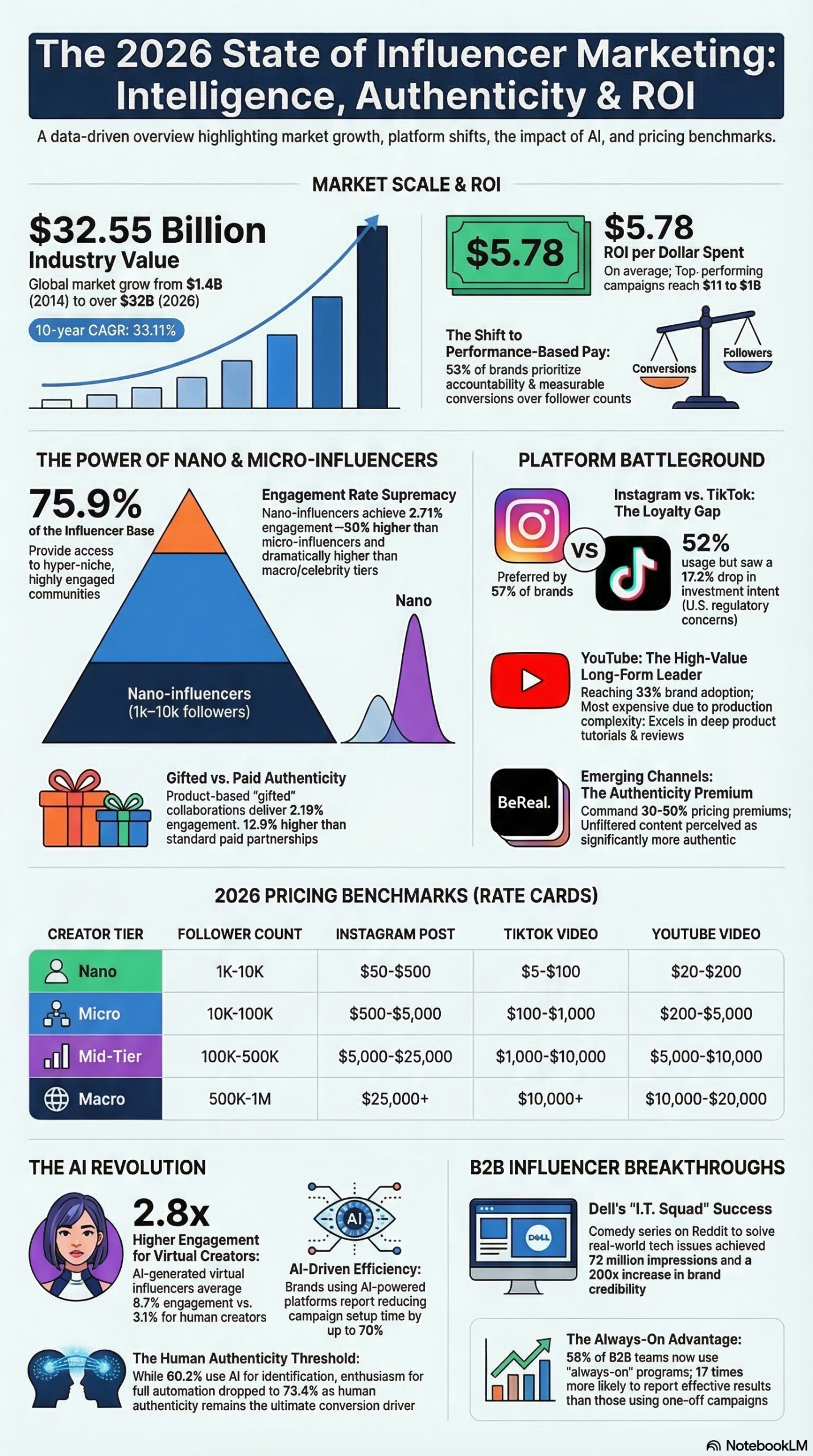
The influencer marketing industry now returns an average of $5.78 for every dollar spent — but that average hides a wide spread between campaigns that generate 12x ROI and campaigns that generate less than 1x. According to the 2026 Influencer Marketing Landscape Report, the global market has reached $32.55 billion and pricing models have fundamentally shifted away from follower count toward engagement, niche alignment, and performance. This tutorial walks you through exactly what influencers charge in 2026, what drives rate variation, and how to structure a budget that reaches the high end of that ROI range.
What Influencer Pricing in 2026 Actually Looks Like
Influencer marketing grew from $1.4 billion in 2014 to $32.55 billion in 2026 — a compound annual growth rate of 33.11% over a decade, according to the 2026 Influencer Marketing Landscape Report. That growth has created a mature but still fragmented pricing market, where rates are highly negotiable and the variables driving them are often invisible to brands that haven’t done the work to understand them.
In 2026, the four primary creator tiers break down as follows, based on follower count and average per-post fees across platforms:
Nano-influencers (1,000–10,000 followers) are the most underutilized tier in most brand budgets. On Instagram, sponsored posts from nano creators typically run $20–$200 per post. On TikTok, $20–$500 per video. On YouTube, $100–$500 per video, per Hootsuite’s 2026 influencer pricing guide. These aren’t budget placements — they’re high-trust placements. Nano-influencers achieve a 2.71% engagement rate on Instagram, 50% higher than micro-influencers, and they represent 75.9% of the influencer base on the platform and 87.68% on TikTok, according to the research report.
Micro-influencers (10,000–100,000 followers) represent the sweet spot for most brand budgets. Instagram rates run $200–$5,000 per post, TikTok $500–$10,000 per video, and YouTube $500–$5,000 per video, according to Hootsuite. The key advantage: 73% of brands now prefer micro and mid-tier creators over celebrities because they combine niche authority with measurable engagement and far lower cost.
Mid-tier influencers (100,000–500,000 followers) have crossed into mass-market reach while retaining community depth. Instagram posts run $2,000–$25,000; TikTok $2,000–$100,000; YouTube $5,000–$15,000, per Hootsuite. They work best for product launches that need both credibility and reach — particularly when niche alignment is strong.
Macro and mega influencers (500,000–1M+ followers) are primarily an awareness play. Instagram posts from macro influencers range $5,000–$15,000, with mega influencers commanding $15,000–$50,000+. On TikTok, macro rates run $5,000–$20,000, and mega influencers charge $20,000 or more per video, according to Hootsuite. YouTube commands the highest production premium: $15,000–$25,000 for macro and $25,000+ for mega. At these tiers, you need a surrounding media strategy to make the economics work.
Beyond base tier rates, five variables can dramatically shift what you actually pay:
- Usage Rights: Perpetual rights for repurposing influencer content in paid ads typically cost 50–100% more than a standard 30-day limited license, according to the research report.
- Exclusivity: Restricting a creator from working with competitors for 30 days adds a 50% premium; 90-day exclusivity doubles the base rate.
- Whitelisting: Running paid ads from a creator’s account handle adds $100–$1,500+ on top of content fees, depending on tier.
- No-AI Authenticity Premium: Creators who guarantee human-only content now charge a 15–30% premium on their base rates.
- Performance Modifiers: Hybrid models — base fee plus commission or CPA bonus — are now used by 53% of brands and can reduce upfront base fees in exchange for performance upside.
There’s also a pricing formula published by Hootsuite that many brands use as a starting point: Base rate = $100 × 10,000 followers, adjusted upward for post type, platform, and the above modifiers. This formula gives you a quick sanity check before entering negotiations — if a creator’s quote is significantly above this baseline without justification, you have room to negotiate.
Why This Matters for Your Marketing Budget
The macro shift in influencer marketing is documented in the research report: 80% of brands maintained or increased their influencer budgets in 2026 — but total industry budget allocation actually decreased 10.2% year-over-year. Brands aren’t spending less on influencer marketing; they’re spending more deliberately. Money is moving from high-cost macro campaigns toward leaner, performance-tracked nano and micro programs.
For brand marketers: The 37.20% of brands that fully optimize niche alignment — matching creator category to product category — are seeing 13.59% higher engagement and 81.39% more views than those that don’t, per the research report. If you’re selecting creators based on follower count without auditing niche alignment, you’re leaving a measurable performance gain on the table.
For agencies: Performance-based compensation is standard for 53% of the industry. Flat-fee-only campaign proposals need clear justification, or they’ll look behind the curve. Clients increasingly expect hybrid models — base fee plus conversion-based incentives — that align creator incentives with business outcomes.
For creators: Understanding how brands calculate your rate means you can negotiate from a position of knowledge. Knowing that usage rights and exclusivity are the two biggest rate multipliers lets you price these as separate line items rather than bundling them into a flat fee you’re likely undervaluing.
The $5.78 average ROI from the research report is a market average. Some campaigns return $1 per dollar spent; others return $12+. The difference is almost entirely in how the campaign is structured, how creators are selected, and how performance is tracked. Every element in this tutorial addresses one of those levers.
The Data: Rate Benchmarks and Platform Performance
2026 Influencer Rate Benchmarks by Platform and Tier
| Tier | Followers | TikTok | YouTube | ||
|---|---|---|---|---|---|
| Nano | 1K–10K | $20–$200 | $20–$500 | $100–$500 | $25–$200 |
| Micro | 10K–100K | $200–$5,000 | $500–$10,000 | $500–$5,000 | $200–$1,000 |
| Mid-Tier | 100K–500K | $2,000–$25,000 | $2,000–$100,000 | $5,000–$15,000 | $1,000–$5,000 |
| Macro | 500K–1M | $5,000–$15,000 | $5,000–$20,000 | $15,000–$25,000 | $5,000–$10,000 |
| Mega | 1M+ | $15,000–$50,000+ | $20,000+ | $25,000+ | $10,000+ |
Source: Hootsuite Influencer Pricing Guide 2026
Platform Engagement Rate Comparison (2024 vs. 2025)
| Platform | 2024 Engagement Rate | 2025 Engagement Rate | Year-over-Year Change |
|---|---|---|---|
| TikTok | 2.50% | 3.70% | +49% |
| 0.50% | 0.48% | −4% | |
| 0.15% | 0.15% | 0% | |
| X (Twitter) | 0.15% | 0.12% | −20% |
Source: MarketingAgent 2026 Influencer Landscape Report
Rate Modifier Cost Impact
| Modifier | Cost Impact on Base Rate |
|---|---|
| Perpetual usage rights | +50–100% |
| 30-day category exclusivity | +50% |
| 90-day category exclusivity | +100% |
| Whitelisting (ads from creator handle) | +$100–$1,500+ |
| No-AI authenticity guarantee | +15–30% |
| Digital twin / AI likeness rights | +50%+ |
Source: MarketingAgent 2026 Influencer Landscape Report
The TikTok data point deserves attention: its engagement rate is 7.7x higher than Instagram’s (3.70% vs. 0.48%), yet TikTok rates are often competitive with or lower than Instagram rates at the same tier — especially now that a 17.2% drop in marketer investment intentions due to US regulatory uncertainty has reduced competition for creator time, per the research report. That gap represents genuine budget arbitrage for brands willing to produce TikTok content.
Step-by-Step Tutorial: How to Build an Influencer Budget That Maximizes ROI
This is a structured 12-step framework for building and operating an influencer budget. It’s built on the pricing models, performance benchmarks, and operational practices documented in the 2026 Influencer Marketing Landscape Report.
Prerequisites:
– A defined campaign objective (awareness, engagement, conversions, or a combination)
– A total available spend figure
– At least one target platform
– Access to a creator analytics or audience verification tool
Phase 1: Define Your Budget Architecture
Step 1: Divide Your Budget into Three Functional Buckets
Before you approach a single creator, allocate your total spend:
– Talent fees (60–70%): What you pay creators for content
– Production support (10–15%): Creative direction, reshoots, or studio support if needed
– Performance bonuses (15–20%): Commission or CPA incentives reserved for top performers
This structure keeps you from overspending on flat fees and creates a financial incentive structure that motivates creators to drive actual results.
Step 2: Choose Your Creator Tier Mix Based on Objective
Different campaign goals require different tier allocations:
– Awareness campaigns: Allocate 40% to mid-tier and macro, 60% to micro
– Conversion campaigns: Direct 70–80% to nano and micro creators with verified niche engagement
– B2B thought leadership: Focus entirely on subject matter experts with domain credibility, regardless of follower count
The data from the research report consistently supports concentration in smaller tiers: gifted collaborations with nano-influencers generate 12.9% higher engagement than paid partnerships, and nano creators achieve 50% higher engagement rates than micro-influencers on Instagram.
Step 3: Calculate Creator Count Per Tier
Divide your tier allocation by the average rate per post at that tier. Example: a $20,000 micro-influencer Instagram budget at an average rate of $1,200 per post gives you approximately 16 creator activations. Spreading that budget across 16 niche micro-influencers will almost always outperform a single $20,000 macro placement in both engagement volume and conversion attribution.
Phase 2: Creator Discovery and Qualification
Step 4: Write a Creator Discovery Brief
Before opening any discovery tool or database, document:
– Product category and target customer profile
– Platform priority (TikTok, Instagram, YouTube, or multi-platform)
– Minimum engagement rate threshold (set 2%+ for Instagram, 3%+ for TikTok based on platform benchmarks from the research report)
– Content style required: tutorial, lifestyle integration, product demo, or UGC-style review
– Audience demographics (age range, geography, income bracket if relevant)
Step 5: Qualify Every Creator Before Outreach
48% of marketers cite influencer discovery as their biggest challenge, per the research report. AI-powered discovery tools now allow natural language searches — “fitness-focused women who run outdoors in the Pacific Northwest” — rather than simple follower filters. 60.2% of marketers now use AI for this step.
For every creator who passes discovery, verify four data points before reaching out:
- Engagement rate: Calculate manually (total likes + comments ÷ followers × 100) or via an analytics tool. Flag anything below 1% on Instagram.
- Audience authenticity: AI fraud detection tools identify fake follower patterns. Without this step, wasted spend averages $37 per $100 spent, according to the research report. This check pays for itself on the first campaign.
- Niche alignment: Has the creator posted in your product category in the last 90 days? Campaigns with strong niche-to-category alignment achieve 13.59% higher engagement and 81.39% more views — yet only 37.20% of brands fully utilize this, per the research report.
- Commercialization level: How many paid posts per month? Creators who post sponsored content more than 30–40% of the time often see declining audience trust and engagement.
Phase 3: Rate Negotiation
Step 6: Request a Rate Card, Then Negotiate Line by Line
Most professional creators have a rate card. Request it. Once you have the base rate, negotiate each modifier as a separate discussion:
- Usage rights: Be explicit — which platforms, for how long, paid or organic only? Propose a 60-day limited license at the base rate with a pre-agreed extension cost. Avoid open-ended “perpetual usage” without defining scope; it’s the modifier that creates the most disputes.
- Exclusivity: Only request it if you need it. A 30-day request adds 50% to cost, per the research report. Push for a duration that exactly matches your campaign window rather than a rounded 30 or 90-day term.
- Whitelisting: Budget this separately from talent fees. If you plan to run paid ads from a creator’s handle, the $100–$1,500+ whitelisting fee should be categorized as a media cost, not a talent cost — it changes the ROI calculation for each budget category.
Step 7: Propose a Hybrid Compensation Model
Offer to lower the base fee by 20–30% in exchange for a performance bonus tied to tracked conversions. This model is now standard for 53% of the industry, per the research report. It reduces your upfront risk and directly aligns creator incentives with your business objectives. For new creator relationships where you don’t yet have performance history, this structure is significantly lower risk than a flat fee.
Step 8: Cover These Five Contract Provisions
Before signing, confirm your contract explicitly addresses:
1. Deliverables: number of posts, format, length, caption requirements, revision rounds
2. Timeline: posting dates and approval windows
3. Usage rights scope: platforms, duration, paid vs. organic
4. Exclusivity scope: category definition (be specific) and duration
5. AI policy: define whether AI-generated images, voiceovers, or captions are permitted — and if the brand wants to use the creator’s likeness to train AI models or create digital twin content, the research report recommends pricing this at a 50%+ licensing premium above standard rates
Phase 4: Campaign Launch and Tracking
Step 9: Build Attribution Infrastructure Before Launch
Every creator needs a unique UTM-tracked link and/or a unique discount code before they post — not after. Retroactive attribution is practically impossible. Build your tracking stack: UTM parameters, tracked landing pages, discount code redemption reporting, and any third-party attribution platform integration, before any content goes live.
Step 10: Monitor in Real Time with AI-Powered Listening Tools
Manual tracking of tagged posts, story mentions, and comment sentiment does not scale at the current pace of the industry (33.11% CAGR). AI-powered social listening tools capture this data automatically and alert you to performance outliers — both underperformers you may want to replace and overperformers you may want to amplify with paid spend.
Step 11: Calculate ROI Per Creator at Campaign Close
Run this calculation for every creator:
– Direct revenue: Sum of purchases through tracked link or discount code
– Earned media value (if direct conversion is hard to track): Impressions × platform CPM benchmark
– Total creator cost: Base fee + bonuses + whitelisting fees + any production support
– ROI: (Revenue + Earned Media Value − Total Creator Cost) ÷ Total Creator Cost
Sort all creators by ROI. Your top performers become the foundation of your next campaign — and the starting point for an always-on partnership model.
Phase 5: Content Repurposing
Step 12: Extend the Life of Every High-Performing Asset
Influencer-generated content doesn’t stop delivering value after the posting window. Integrate top-performing posts as shoppable UGC on product pages — this can increase conversion rates by up to 17% and revenue by 28.5%, according to the research report. The usage rights you negotiated in Step 6 are what make this possible.
Run the best-performing organic content as paid social ads (whitelisted from the creator’s account, or from your brand account depending on your license). Creator content that already has proven organic engagement consistently outperforms brand-produced creative in paid placement — you’re borrowing the authenticity signal.
Expected Outcome of the Full 12-Step Process:
– 20–40% reduction in cost-per-engagement versus an unstructured budget approach
– Measurable ROI attribution at the individual creator level
– A pre-qualified creator roster you can reactivate without repeating the full discovery cycle
– Repurposed content assets that extend the value of talent spend well past the campaign window
Real-World Use Cases
Use Case 1: DTC Skincare Brand on a $15,000 Budget
Scenario: A direct-to-consumer skincare brand wants to drive trial purchases of a new serum. Budget: $15,000. Platform: Instagram and TikTok.
Implementation: Allocate $9,000 (60%) to nano and micro-influencers in the beauty and skincare niche. Send 20 gifted collaborations (product only, no cash) to nano creators under 10,000 followers, then activate 8–10 micro-influencers at $600–$1,200 per post. Reserve $3,000 for whitelisting the two best-performing posts as paid Instagram ads. Hold $3,000 for performance bonuses tied to tracked discount code redemptions.
Expected Outcome: Gifted collaborations generate 12.9% higher engagement than paid ones on average, per the research report. Combined with whitelisted paid amplification on organic top performers, this approach generates measurable trial purchases at a cost-per-acquisition below standard paid social benchmarks.
Use Case 2: B2B SaaS Company Building Category Authority
Scenario: A B2B SaaS company wants to build awareness in the enterprise data space without relying exclusively on paid search. Budget: $50,000 annually.
Implementation: Build an always-on SME influencer program with 5–8 subject matter experts who actively create content in the data and analytics space. Prioritize LinkedIn and YouTube. Structure engagements as co-created content: whitepapers, research reports, and tutorial videos where the SME provides expertise and the brand provides research, production support, and distribution. Per the research report, 99% of B2B teams using always-on programs rate them as effective, versus campaign-based teams who are 17 times more likely to report program ineffectiveness.
Expected Outcome: Sustained niche visibility, compounding organic search assets, and measurable pipeline attribution through tracked content CTAs and gated downloads.
Use Case 3: Retail Brand Driving In-Store Traffic
Scenario: A regional grocery chain wants to increase foot traffic to physical locations using influencer content across five markets.
Implementation: Partner with local food and lifestyle micro-influencers (10,000–75,000 followers) in each market. Produce Instagram Reels and TikTok videos featuring in-store experiences, seasonal displays, and exclusive products. Issue location-specific discount codes for in-store redemption to track campaign attribution. Per the research report, 60% of consumers report that social media influences their purchasing decisions while shopping in-store — meaning influencer content doesn’t just drive digital traffic, it shapes in-aisle behavior.
Expected Outcome: Measurable lift in store visits via discount code redemption tracking, with secondary value in local community engagement and brand perception.
Use Case 4: Brand Exploring Virtual Influencer Economics
Scenario: A fashion brand wants to reduce creator management overhead and maintain 24/7 content availability across global markets.
Implementation: Commission a virtual influencer — a CGI persona — for long-term brand representation. Upfront creation costs run $50,000–$500,000 depending on animation quality, per the research report. Post-creation, the brand controls all content, eliminates scandal risk, and can post across time zones without scheduling constraints. Virtual influencers like Lil Miquela (3 million followers) and Lu do Magalu (14 million followers) demonstrate that synthetic personas can build genuine audience relationships at scale.
Expected Outcome: Virtual influencers achieve engagement rates averaging 2.8x higher than human influencers, per the research report. The high upfront investment amortizes rapidly if you factor in the ongoing cost of talent fees, negotiation, and creator management at scale.
Common Pitfalls
Pitfall 1: Selecting Creators by Follower Count Instead of Engagement
A macro influencer with 2 million followers and 0.3% engagement delivers fewer actual interactions than a micro-influencer with 80,000 followers and 3.5% engagement — at a fraction of the cost. Always calculate expected engagement volume (followers × engagement rate) before evaluating a rate quote. This single change eliminates most budget waste.
Pitfall 2: Skipping Audience Authenticity Verification
Fake followers are still a significant and quantified problem. Without AI fraud detection, brands waste an average of $37 per $100 spent on fraudulent audience inventory, according to the research report. This step pays for itself on the first campaign and should be non-negotiable in your qualification process.
Pitfall 3: Not Defining Usage Rights Before Signing
Brands frequently discover after a campaign that they want to run a creator’s content as a paid ad — only to find they have no license to do so. Post-campaign usage rights negotiation costs significantly more than building the terms into the initial contract. Define platform, duration, and paid-vs-organic scope upfront, every time.
Pitfall 4: Ignoring Niche Alignment in Creator Selection
Campaigns that match influencer content niche to product category achieve 13.59% higher engagement and 81.39% more views than misaligned campaigns, per the research report. Yet only 37.20% of brands fully execute this. Placing your software product with a fitness influencer because they have a large audience is a predictable path to underperformance.
Pitfall 5: Running Campaign-Only Instead of Always-On Programs
Episodic campaigns create spikes of visibility followed by long gaps. In B2B, campaign-based teams are 17 times more likely to report program ineffectiveness versus always-on teams, per the research report. If your budget supports sustained engagement with even two or three creators, build the always-on structure — the compounding value far exceeds the one-off campaign model.
Expert Tips
Tip 1: Negotiate Usage Rights as a Separate Line Item
Never bundle content creation and usage rights into a single flat fee. Negotiate them as distinct contract items with separate pricing logic. A creator may quote $2,000 for a post — but 12-month perpetual rights for paid social should be a separately priced add-on at $1,000–$2,000 more. This creates transparency, protects future flexibility, and prevents you from unknowingly paying a massive markup on rights you don’t actually need.
Tip 2: Use Gifted Collaborations to Test New Creators
Before committing cash to an unproven creator, send a gifted collaboration first. Gifted posts generate 12.9% higher engagement than paid ones on average, per the research report, because they read as more authentic. You also get real performance data before committing budget — which is significantly more reliable than historical metrics from a media kit.
Tip 3: Lock in Whitelisting Rights for Anticipated Top Performers
When a creator’s organic post performs well, the highest-leverage next move is to whitelist it and run paid traffic to it. Build whitelisting rights into contracts for your top three or four expected performers upfront, at the negotiated $100–$1,500+ fee depending on tier. Trying to add whitelisting rights after a post has gone live costs more and takes longer.
Tip 4: Use TikTok’s Engagement Advantage While Investment Competition Is Low
TikTok’s 17.2% drop in marketer investment intentions due to regulatory uncertainty means less competition for creator time and attention — and potentially lower negotiated rates — at a moment when the platform’s engagement rate hit 3.70%, the highest of any major platform, per the research report. Negotiate TikTok-first contracts with content formatted for cross-posting to Instagram Reels and YouTube Shorts, so one production covers three platforms.
Tip 5: Address AI Content Policy and Digital Twin Rights Before They Become Disputes
This is the contract issue most brands haven’t addressed yet. Define whether AI-generated images, voiceovers, or captions are permitted in deliverables. If you plan to use a creator’s likeness to train AI models or generate synthetic content, the research report recommends pricing this at a 50%+ licensing premium above standard rates. Address it in the contract now — the dispute resolution path is significantly more expensive than the upfront negotiation.
FAQ
Q1: What’s the simplest formula for calculating a fair influencer rate?
Hootsuite’s 2026 pricing guide documents a widely-used baseline: $100 × 10,000 followers, adjusted for post type, platform, and modifiers. A micro-influencer with 50,000 followers would baseline at $500 per post before adding for video format, usage rights, or exclusivity. This gives you a quick sanity check before entering formal negotiations. If a creator’s quote is significantly above this baseline, ask them to itemize what’s driving the premium.
Q2: How do I know if an influencer’s followers are real?
Run their profile through an AI-powered audience authenticity tool before contracting. Key fraud signals: sudden follower count spikes, engagement rate below 0.5% on Instagram despite a large audience, comments that are generic or emoji-only, and follower accounts with no profile photos or activity. Per the research report, fraudulent audiences cost brands an average of $37 per $100 spent without detection tools — this is a fixed step in the qualification process, not an optional one.
Q3: Should I work with one large influencer or many smaller ones?
For conversion and engagement campaigns, the data supports multiple smaller creators. Nano-influencers achieve 50% higher engagement than micro-influencers on Instagram, and niche-aligned campaigns generate 81.39% more views, according to the research report. The one scenario where macro influencers make clear sense is pure brand awareness — where raw impression volume is the primary KPI and you have a surrounding media strategy to capture and convert that reach.
Q4: Is TikTok worth budgeting for given the regulatory uncertainty?
Yes, strategically. TikTok’s engagement rate reached 3.70% in 2025 — up 49% year-over-year and 7.7x higher than Instagram — making it the highest-engagement platform available, per the research report. The regulatory uncertainty is actually a tactical advantage for brands willing to invest: reduced competition for creator time means better rates and more creator availability. The hedge: negotiate content shot in a vertical format that can cross-post to Instagram Reels and YouTube Shorts from the same production.
Q5: How do I structure performance-based influencer compensation?
The standard hybrid model (used by 53% of brands, per the research report) works as follows: negotiate a base flat fee 20–30% below the creator’s standard rate, then add a commission or CPA bonus triggered by tracked conversions through a unique link or discount code. Set the bonus at a rate where hitting your target conversion volume results in a total creator payout slightly above their standard rate — this aligns incentives while reducing your downside risk on underperforming placements.
Bottom Line
Influencer marketing at $32.55 billion is no longer an experimental budget line — it’s a core channel that demands the same pricing discipline and ROI accountability as paid search or display. The brands generating $5.78 or more per dollar spent are doing three things right: they prioritize nano and micro-creators with verified engagement over macro reach, they structure performance-based compensation that ties creator incentives to business outcomes, and they run always-on programs that compound value instead of chasing campaign spikes. The pricing frameworks in this guide — tier benchmarks, modifier costs, negotiation structure, contract provisions, and attribution systems — give you a complete operational foundation for 2026. Use it to negotiate from a position of knowledge, allocate with precision, and measure what actually drives revenue.


0 Comments