

AI search engines — ChatGPT, Gemini, and Google’s AI Overviews — are now the first point of contact between your brand and a growing share of potential customers, and most brands have zero visibility into what those tools are actually saying about them. Czech SEO specialist Zbyněk Fridrich built a repeatable six-step workflow that took a coworking space client from 17% to 34% AI Overview visibility and drove a nearly 20x increase in ChatGPT referral traffic in just five months, using Semrush’s AI Visibility Toolkit. This tutorial breaks down every step of that workflow so you can replicate it on your own clients and accounts.
What This Is
Semrush’s AI Visibility Toolkit is a purpose-built suite of analytics reports and monitoring tools that measures and manages how large language models (LLMs) — including ChatGPT, Gemini, and Google AI — describe, cite, and recommend a brand in response to user queries. It is not a standalone product; it integrates directly into Semrush’s existing platform alongside Position Tracking, Site Audit, and the My Reports layer, giving SEO practitioners a single workspace to manage both traditional and AI search performance simultaneously.
According to the NotebookLM research report on AI Visibility and Modern Search Optimization, traditional SEO focuses on keyword positioning and click-through rates, while AI search optimization targets a different set of metrics entirely: citation authority and AI Visibility Scores — specifically, how frequently AI models cite a brand in their responses and how positive the language is when they do.
The toolkit centers on five core components:
- Visibility Overview: A top-level dashboard showing your AI Visibility Score (0–100), total brand mentions across AI platforms, which of your pages are being cited, and benchmarking data against up to five competitor domains.
- Brand Performance: Deep perception analysis covering share of voice, sentiment scoring, sentiment volatility, and a full breakdown of the attributes AI systems associate with your brand — accurate and inaccurate alike.
- Business Drivers / Narrative Drivers: A sub-report that surfaces the specific attributes and topic associations driving AI perception, along with the actual user prompts that are triggering your brand’s appearance — or absence — in AI responses.
- Prompt Research: A discovery tool for uncovering the real questions your target audience submits to AI platforms, with AI Topic Volume, user intent classification, and topic difficulty metrics for each.
- AI Search Site Audit: A technical crawlability check that identifies whether AI bots — GPTBot (OpenAI), ClaudeBot (Anthropic), and Google-Extended — can access and parse the pages that matter most to your brand.
Fridrich, who has 17 years of SEO experience and holds a Best SEO Project award, requires all clients to use Semrush and has made the AI Visibility Toolkit central to his client strategy since AI-driven referral traffic became measurable. As documented in the Semrush case study, his philosophy is explicit: “The goal is to have maximum control over what AI says about us today.”
The core problem this toolkit solves is a pervasive blind spot. Standard Google Search Console and traditional SEO platforms tell you nothing about whether ChatGPT recommends your brand, what language it uses to describe your product, or whether it has absorbed a negative association from a three-year-old forum post. Before this category of tooling existed, those signals were entirely invisible. The AI Visibility Toolkit makes them measurable and — critically — actionable.
One of the most important signals the toolkit surfaces is sentiment scoring. Each tracked brand receives a 0–100 sentiment score based on how AI platforms describe it in response to relevant prompts. This score reflects both the positivity of language used and the consistency of that language across different AI models and query contexts. Sentiment volatility — how much that score fluctuates — is a separate risk metric indicating whether a brand’s AI perception is stable or vulnerable to sudden degradation from a review spike or social media event.
The combination of these metrics gives practitioners a workable operational model: find where perception is wrong or weak, fix the source content, fix technical access, build the missing content, then track the improvement. Fridrich’s documented results prove this model produces real, measurable outcomes within a normal client engagement window.
Why It Matters
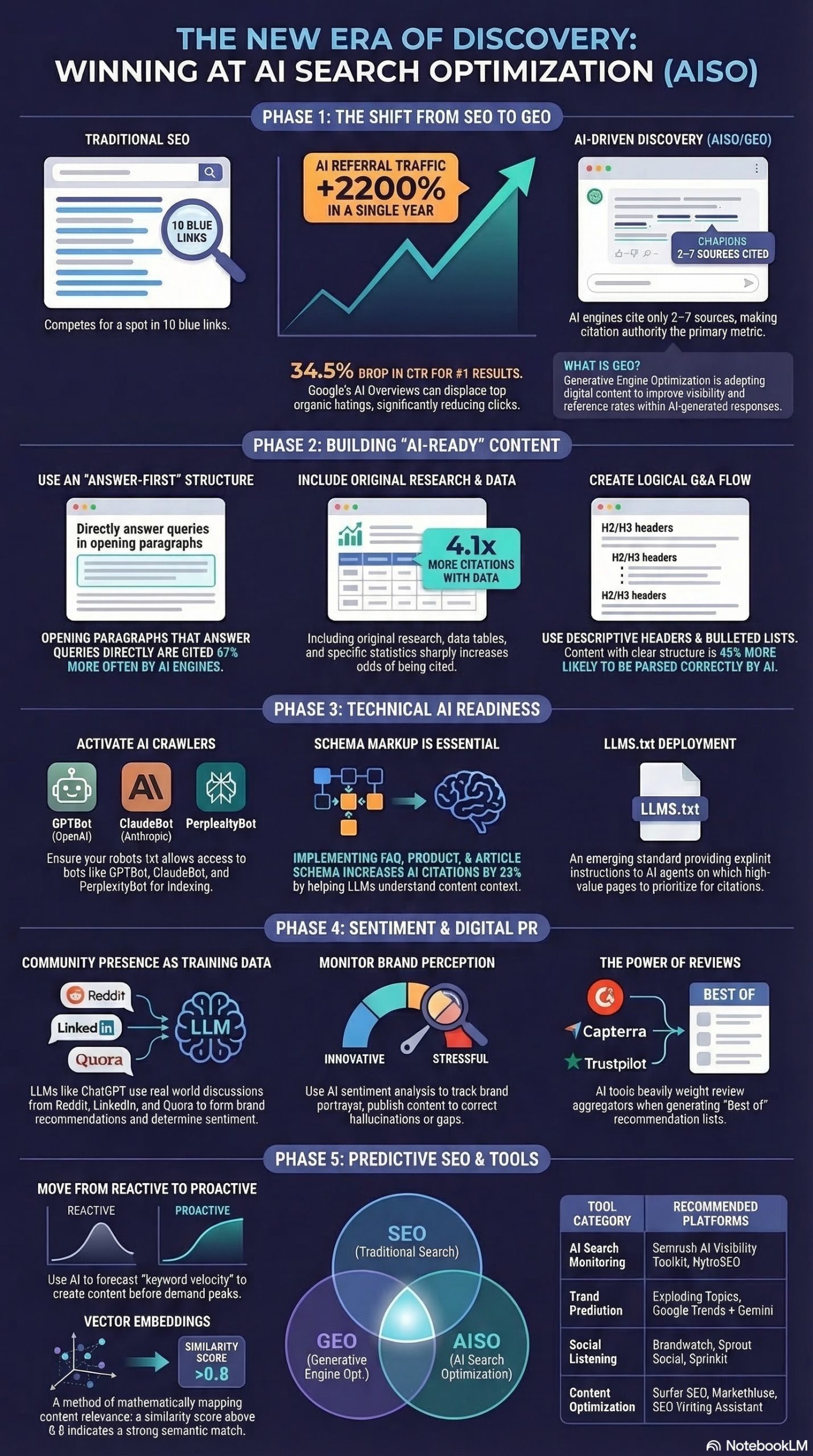
The shift to AI-powered search is structural, not incremental. According to the NotebookLM research report, LLMs typically cite only 2–7 domains per response. Compare that to a traditional Google SERP surfacing 10 blue links. The competitive field for AI-driven brand discovery is orders of magnitude more restricted — if your domain isn’t in those 2–7 citations for a relevant query, you effectively don’t exist for that search.
This dynamic matters differently for different practitioners:
For independent SEO consultants, the AI Visibility Toolkit creates a new category of billable deliverable: AI visibility audits, sentiment baseline assessments, and ongoing monitoring retainers. Fridrich’s case — a sentiment improvement from 67 to 82 correlated with a nearly 20x increase in ChatGPT traffic — gives you a concrete, reportable ROI story to present in new business proposals. Clients watching AI-driven referral traffic erode their organic numbers are actively looking for this work.
For in-house marketing teams at mid-market brands, the toolkit surfaces the AI narrative being built about your brand without your input or awareness. If an LLM has learned from third-party review sites that your SaaS is “too complex for small teams” or your service is “best for enterprises only,” that perception shapes how the model answers product comparison questions — costing you leads before any traditional marketing metric registers the damage.
For agencies, the My Reports PDF export solves a recurring client communication problem: how do you show AI search performance to a stakeholder who doesn’t have Semrush access? The export generates clean, visual, stakeholder-ready summaries of sentiment trends and visibility percentages, translating technical work into business language without requiring client tool literacy.
What makes AI visibility fundamentally different from traditional SEO is the feedback mechanism. In conventional SEO, content changes run through a crawl-index-rank cycle measured in weeks. In AI visibility work, you’re seeding factual, well-structured content into a system where AI crawlers will use it to update knowledge representations — a process measured in months, but one that compounds over time.
The NotebookLM research report also identifies an “inverse customer journey” now emerging in AI search: users first discover brands through AI recommendations, then use Google to validate. That means AI visibility is upstream of organic search in the funnel — a brand losing citations is losing discovery before it registers in any traditional analytics dashboard. As the research states directly: “The shift to AI-powered search isn’t coming. It’s already here… Generative engines are shaping how your audience discovers information right now, which means optimization can’t wait.”
The Data
The following table documents Fridrich’s WorkLounge client results over a five-month engagement from September to January, as reported in the Semrush case study:
| Metric | Before | After | Change |
|---|---|---|---|
| Sentiment Score | 67 | 82 | +22% |
| AI Overview Visibility | 17% | 34% | +100% relative |
| ChatGPT Referral Traffic | Baseline | ~20x baseline | +~1,900% |
| Pages Rewritten | 0 | 90 | Full content overhaul |
| Engagement Timeline | Month 0 | Month 5 | 5 months |
The NotebookLM research report adds broader industry benchmarks that contextualize how specific content and technical decisions drive AI citation rates:
| Optimization Factor | Documented Impact on AI Citations |
|---|---|
| Answer-first content formatting | 67% more citations |
| Pages using clear headings + Q&A format | 40% more likely to be cited |
| FAQ and HowTo schema markup | ~28% more citations |
| Original research with data tables | 4.1x more citations |
| Content refreshed within the last 30 days | 3.2x more citations |
| Citing statistics within content | 5.5% boost in citation rate |
These benchmarks are directional — LLM behavior varies by model, query context, and topic — but they provide a defensible prioritization framework for deciding which fixes to tackle first and which content investments to make.
Step-by-Step Tutorial: Fridrich’s Six-Step AI Visibility Workflow
This is the exact process Fridrich uses with clients, expanded with implementation detail and the reasoning behind each decision in the sequence.
Prerequisites
Before starting, you need:
– A Semrush subscription with AI Visibility Toolkit access (Business plan or add-on)
– Your target domain and 2–5 competitor domains identified
– Target location configured for the client’s primary market
– Working familiarity with Semrush Site Audit and Position Tracking
– Google Analytics 4 access for referral traffic monitoring
Phase 1: Establish Your Sentiment Baseline
Step 1: Analyze Sentiment in Brand Performance
Open the Brand Performance report inside the AI Visibility Toolkit. Configure it with your domain, up to five competitor domains, and your primary target location. This is your measurement starting point — record everything you find here because it’s the before-state your results will compare against.
The first number to capture is the AI Visibility Score. Fridrich’s WorkLounge client started at 67. Before you can improve it, you need to understand precisely what’s driving it down, because the corrective action differs entirely depending on root cause.
Navigate to the Business Drivers sub-report. This surfaces the key attributes and topic associations AI platforms use when describing the brand. You’re looking for two distinct problem types:
- Inaccurate associations: AI is connecting the brand with attributes that are factually wrong or outdated — wrong hours, wrong pricing tier, wrong target audience, obsolete product features
- Missing associations: Topics the brand should own but doesn’t surface for in AI responses — product capabilities that exist but are never cited, certifications the brand holds, markets served
Then open the Perception report. This shows the specific positive and negative perceptions AI models have absorbed — typically distilled from your own site, third-party review platforms, forums, and news coverage. Read every item in the negative perception column carefully. These are your highest-priority targets for content remediation.
Finally, review the AI-generated strategic recommendations Semrush surfaces at the bottom of the Brand Performance dashboard. These are produced by analyzing the sentiment and perception data and suggest specific content corrections or topic opportunities to pursue.
Output of Step 1: A prioritized list of perception problems — inaccurate AI associations and absorbed negative perceptions — ranked by estimated impact on AI Visibility Score.
Phase 2: Remediate Existing Content
Step 2: Rewrite Existing Website Content Before Creating Anything New
This is the most counterintuitive step in Fridrich’s workflow and the one most practitioners skip. His rule is unambiguous: “I never work on new content if I haven’t fixed the content already on the website.”
The logic is structural. AI models have already ingested some version of your existing content. If those pages contain ambiguous language, outdated specifications, or gaps that third-party sources have filled with negative associations, publishing new content on top doesn’t override the old signals — it layers on them. Fix the foundation first.
For WorkLounge, the problem was concrete: AI was conflating the coworking space’s 24/7 member access with standard 9-to-5 public drop-in hours, creating confusion that surfaced whenever users asked AI tools for coworking recommendations. The fix required rewriting 90 pages — not minor edits, but complete rewrites — to explicitly and unambiguously separate member and non-member experiences. Every page touching access hours, quiet zones, phone booths, and private offices received clear, specific, citable language.
How to execute this step for any brand:
- Take the perception problem list from Step 1
- Identify which existing pages are the authoritative source for each problematic topic
- Rewrite each page with language that directly and unambiguously addresses the identified misconception
- Add specifics that AI models cannot source from third parties: exact hours, feature specs, tier differences, access policies
- Format every clarification as an explicit Q&A where possible: “Is membership access available 24/7? Yes — all members have unrestricted keycard access around the clock, every day of the year.”
The Q&A formatting isn’t just usability improvement. According to the NotebookLM research report, pages structured with clear headings and Q&A formats are 40% more likely to be cited by AI systems. You’re simultaneously fixing accuracy and improving structural citability in a single edit pass.
Output of Step 2: Revised existing pages that proactively correct AI misconceptions with clear, explicit, citable language — before a single new page is published.
Phase 3: Technical Foundation
Step 3: Fix Technical Issues and Implement Structured Data
Run a Site Audit in Semrush with AI-specific checks enabled. The AI Search Site Audit module flags issues that specifically affect AI crawler access and content parseability:
- Robots.txt blockers: Directives that inadvertently block GPTBot, ClaudeBot, or Google-Extended from accessing high-value pages
- Content length issues: Pages too sparse to provide adequate signal — AI models have difficulty extracting reliable citations from thin content
- Metadata gaps: Missing or poorly written meta descriptions that reduce AI summarization clarity
- Internal link problems: Orphaned pages that AI crawlers can’t reach through standard site navigation
For structured data, prioritize schema types in this order based on citation impact:
- FAQPage schema — directly expands the “citable surface area” for AI Overviews; each Q&A pair becomes an independently citable unit
- HowTo schema — particularly effective for process and tutorial content; aligns with step-by-step query patterns that AI systems surface frequently
- Article schema — provides authorship signals, publication date, and category context that AI models use to assess source credibility
- Organization schema — establishes core brand entity facts at the domain level, reducing hallucination risk on company attributes
The NotebookLM research report documents that implementing FAQ, Article, Product, and HowTo schema increases AI citations by approximately 28%.
Fridrich also experiments with LLM.txt files — an emerging (not yet universally supported) standard for a plain-text file placed at a domain’s root that provides explicit content prioritization guidance to AI agents. Implementation is low-cost and the upside is real even if adoption is incomplete:
# LLM.txt — example.com
# Prioritization guidance for AI agents

## Priority content for summarization:
/about/          — Company overview, founding history, mission
/services/       — Service descriptions, pricing, differentiators
/faq/            — Frequently asked questions with verified answers
/case-studies/   — Documented client results with metrics

## Lower priority:
/press/          — Historical press releases (may contain outdated info)
/archive/        — Legacy blog content predating current product lineup
Think of LLM.txt as robots.txt for AI agents, but for guidance rather than access control. Even if only a subset of crawlers honor it today, it costs nothing to implement and positions you for broader adoption as the standard matures. As the NotebookLM research report notes, this is an “emerging (though not yet universal) standard” worth watching and implementing early.
Output of Step 3: A technically accessible site where AI crawlers can fully reach and parse high-value pages, with structured data that signals content type, authority, and publication currency.
Phase 4: Content Expansion
Step 4: Use AI Prompt Data to Build Your Content Calendar
Only after completing Steps 1–3 does Fridrich begin planning new content. Open the Narrative Drivers or Prompt Research tool in the AI Visibility Toolkit and pull the actual queries users are submitting to AI platforms related to your brand category.
Apply these filters to identify highest-value gaps:
– Prompts where your brand should logically appear but currently doesn’t
– Prompts where competitor domains receive citations and you’re absent
– Prompts that map directly to a product, service, or use case you offer
From this filtered list, select 20–30 of the most relevant prompts per project — a manageable scope for a 90-day content sprint. Convert the shortlisted prompts into concrete content briefs:
- FAQ sections added to existing service or product pages (lowest production cost, fastest to publish)
- Dedicated FAQ pages for high-volume prompt topics where no existing page addresses the question
- New long-form guides for multi-intent queries requiring comprehensive coverage
The NotebookLM research report recommends “answer-first” formatting as the single highest-impact structural principle: open each section with a direct answer to the heading’s question before any expansion or qualification. “Yes, our platform integrates natively with Salesforce and HubSpot” is a citable sentence. “Integration capabilities vary and depend on several factors” is not. Pages using answer-first structure are cited 67% more often per the research.
Original data is the content differentiator that earns outsized citation performance. The research documents that original research and data tables earn 4.1x more AI citations than content without original data. If you can field a customer survey, publish internal usage benchmarks, or compile an industry data table, build it into the content and present it in a clearly structured table with labeled columns.
Output of Step 4: A 90-day content calendar built around actual AI search prompt gaps, with each piece scoped to capture a specific visibility opportunity identified in the Narrative Drivers tool.
Phase 5: Track Performance
Step 5: Configure Tracking and Monitor Monthly
Configure Semrush’s Position Tracking tool for:
– The 20–30 prompts identified in Step 4
– Traditional keyword equivalents for each prompt topic
– AI Overview presence tracking for each monitored term
Set up a monthly measurement cadence covering these signals:
– AI Visibility Score trend in the Brand Performance dashboard
– ChatGPT and Perplexity referral traffic in Google Analytics 4 (filter by source: chatgpt.com, perplexity.ai)
– AI Overview visibility percentage month-over-month
– Sentiment score and sentiment volatility changes
For the GA4 side specifically, build a custom Exploration or segment that isolates sessions from chatgpt.com as a referral source. This is your most direct leading indicator that AI visibility work is translating into real audience delivery. Fridrich tracked this across all five months of the WorkLounge engagement — the nearly 20x growth in ChatGPT referral traffic was the metric that landed most powerfully with the client stakeholder and justified the full engagement.
Output of Step 5: A monthly reporting baseline with AI-specific KPIs tracked alongside traditional SEO metrics, giving a complete cross-channel view of search performance.
Phase 6: Report and Iterate
Step 6: Build Client Reports for Stakeholder Communication
Use Semrush’s My Reports feature to generate a clean, client-facing PDF each month. Include:
– AI Visibility Score with before/after milestone callouts
– Sentiment score trend line with improvement annotations
– Prompt visibility progress for the tracked set
– ChatGPT referral traffic chart pulled from GA4 data
Fridrich exports these monthly so clients can review progress without needing a Semrush login. The visual nature of sentiment scores and visibility percentages communicates the ROI story to non-technical stakeholders without requiring them to understand the underlying methodology. This is the deliverable that sustains the retainer relationship — concrete, visual evidence of a metric improving month-over-month, tied to specific content and technical interventions.
Expected Outcomes
A full execution of this six-step workflow over a 5–6 month engagement should produce, based on Fridrich’s documented results from the Semrush case study:
- AI Visibility Score improvement of 15–25 points (WorkLounge result: +22%, from 67 to 82)
- AI Overview visibility increase of 10–20 percentage points (WorkLounge result: +17 points, doubling from 17% to 34%)
- Measurable growth in referral traffic from ChatGPT and other AI platforms (WorkLounge result: ~20x in 5 months)
- Reduced sentiment volatility — more consistent brand representation across AI models
- A technical foundation (structured data, clean robots.txt, LLM.txt) that compounds citation performance as AI models update their knowledge
Real-World Use Cases
Use Case 1: Coworking Space Correcting AI Membership Confusion
Scenario: A coworking space in a mid-size city is losing membership leads because ChatGPT consistently describes it as a “casual drop-in workspace” rather than a private office provider with dedicated memberships. When prospects ask AI tools for coworking recommendations, the space appears — but with language that attracts the wrong audience and creates churn from day one.
Implementation: Run Brand Performance to confirm the sentiment issue and identify which AI-absorbed language is creating the confusion. Rewrite all service pages with explicit language distinguishing drop-in visitors from dedicated members, including specific details: 24/7 keycard access, dedicated desk inventory, private office floor plans, quiet zone locations, and phone booth availability. Add FAQPage schema to the membership FAQ. Per the Semrush case study, this is exactly the WorkLounge scenario — 90 pages rewritten with this approach produced a sentiment improvement from 67 to 82.
Expected Outcome: Sentiment score improvement over 60–90 days as AI crawlers re-index the corrected content. Reduction in disqualified leads who arrive with incorrect expectations. Improvement in qualified lead quality as AI models begin accurately representing the membership-first positioning.
Use Case 2: SaaS Platform Capturing a Category Prompt
Scenario: A project management SaaS wants to appear when users ask ChatGPT, “What’s the best project management tool for remote teams?” It currently has strong organic rankings but zero AI citations for this query.
Implementation: Use Prompt Research to identify the exact prompt variants driving AI traffic to competitors. Analyze which competitor pages are being cited — typically dedicated comparison guides, feature breakdowns, or third-party reviews on G2 or Capterra. Create a “Remote Team Project Management” guide structured with answer-first formatting, original data (an internal adoption survey), and a feature comparison table. Add FAQPage schema targeting remote-work-specific questions with direct, citable answers.
Expected Outcome: AI citations in the target prompt category within 3–6 months. Per the NotebookLM research report, original research earns 4.1x more citations than content without original data — the internal survey is the competitive differentiating asset here, as AI models cannot get that data from anywhere else.
Use Case 3: E-Commerce Brand Correcting an AI Product Hallucination
Scenario: A consumer electronics brand discovers that AI platforms consistently cite an outdated spec sheet, describing the flagship product’s battery life as 6 hours when the correct figure is 12 hours. This inaccuracy surfaces whenever users ask product-specific questions before purchase decisions.
Implementation: Publish a dedicated product FAQ page with FAQPage schema explicitly answering: “How long does [product] battery last? 12 hours under standard use, tested against [specific benchmark conditions].” Update the product page title, H1, and opening paragraph to include the correct specification. Submit an updated sitemap and request re-indexing for affected pages.
Expected Outcome: Correction of the AI hallucination within 1–3 months as models incorporate the corrected crawled content. The NotebookLM research report specifically recommends scheduling monthly AI hallucination audits — ask ChatGPT and Gemini your product specs directly each month and document whether the correction has propagated.
Use Case 4: B2B Agency Building Thought Leadership Citations
Scenario: A digital marketing agency wants to appear when CMOs ask AI tools for marketing strategy guidance. Strong organic rankings exist, but zero AI citations — no LLM mentions the agency when users ask for expert marketing advice.
Implementation: Commission an original survey of 200 marketing managers on AI tool adoption rates and budget allocation. Publish results as a dedicated research page with a structured data table, answer-first section summaries for each finding, and Article schema with author attribution. Distribute through LinkedIn thought leadership posts, pitch findings to industry publications for third-party coverage, and request inclusion in relevant G2 or Capterra category roundups.
Expected Outcome: Within 6 months, the research page generates AI citations in strategy-related prompts. The NotebookLM research report notes that community-driven sources like LinkedIn and review platforms are weighted heavily by AI models — third-party amplification of owned original research accelerates citation acquisition beyond what owned content alone achieves.
Use Case 5: Local Business Competing for Neighborhood AI Queries
Scenario: A restaurant wants to appear when users ask Google’s AI Overview, “What are the best Italian restaurants in [neighborhood]?” It has strong Google Maps ratings but no AI Overview presence.
Implementation: Complete the Google Business Profile with current hours, full menu, dietary options, and recent photos. Add LocalBusiness and Restaurant schema to the website with accurate NAP (name, address, phone) data. Create a simple FAQ page that directly answers: “What makes [restaurant name] the best Italian food in [neighborhood]?” with specific answers about signature dishes, sourcing, and atmosphere. Monitor AI Overview visibility for local restaurant prompts in Semrush Position Tracking.
Expected Outcome: Improved local AI visibility within 30–60 days, particularly in Google AI Overviews which weight LocalBusiness schema and accurate GBP data heavily. The combination of complete structured data, accurate third-party signals, and owned FAQ content creates a complete citation package for local AI responses.
Common Pitfalls
1. Publishing New Content Before Fixing Existing Content
The most common mistake is rushing to create new AI-optimized content while existing pages still carry the inaccurate or ambiguous information AI has already absorbed. New content doesn’t override old signals — it competes with them. Fridrich’s sequencing rule is non-negotiable per the Semrush case study: fix the existing foundation before you build anything new.
2. Inadvertently Blocking AI Crawlers in Robots.txt
Many brands added GPTBot and ClaudeBot blocks to robots.txt in 2023–2024 as a precaution against AI training data collection. The problem: those same crawlers now drive citation discovery, not just model training. Blocking them prevents your content from being cited regardless of how good it is. Audit your robots.txt against the current list of known AI crawler user agents before any other technical work. The NotebookLM research report explicitly flags this as a critical first check.
3. Running AI Visibility Work as a Separate Track from SEO
Practitioners who set up a standalone “AI SEO” retainer disconnected from a client’s existing SEO engagement frequently produce contradictory strategies and duplicated audits. The Site Audit, Position Tracking, and content workflows are shared infrastructure. As Fridrich demonstrates, AI visibility is an integrated extension of SEO strategy, not a parallel discipline.
4. Ignoring Sentiment Volatility
A high sentiment score with high volatility is more operationally dangerous than a stable moderate score. Volatility means a single review spike, social media incident, or news story can crash AI perception within days. Monitor volatility as a risk metric alongside raw score, and set up alerts for significant changes between monthly reporting cycles.
5. Setting Unrealistic Client Timelines
The WorkLounge engagement required five months to produce its headline results. AI systems don’t update on a daily crawl cycle. Content changes need to be crawled, processed, and incorporated into model knowledge — a timeline measured in months. Set this expectation explicitly at project kickoff with reference to documented case timelines, or you will face a credibility problem at the 30-day check-in.
Expert Tips
1. Weight AI Prompt Data More Heavily Than Keyword Data for New Content Investment
Keyword research surfaces historical search volume. Prompt Research in the AI Visibility Toolkit surfaces what people are asking AI right now — a different signal with different intent patterns and a different competitive landscape. For new content investment decisions in 2026, AI prompt data should be the primary brief input. The prompts showing up in the Narrative Drivers tool represent live demand with measurable visibility gaps — prioritize them before competitors identify the same opportunities.
2. Seed AI Models Through Third-Party Coverage
You control your own pages, but AI citation behavior is heavily influenced by third-party sources: review platforms, forums, industry publications, and community discussions. After correcting owned content, invest in third-party seeding. Per the NotebookLM research report, community-driven sources like LinkedIn and review platforms are weighted heavily by AI models — third-party signals are what break you into the 2–7 citation shortlist for competitive queries that already have established dominant citations.
3. Apply Answer-First Formatting as a Sitewide Standard, Not a New-Content Technique
The answer-first principle — opening every section with a direct response to the heading’s question before any expansion — should be a sitewide formatting requirement, applied retroactively to your top existing pages, not just reserved for new content. Audit your top 20 traffic pages and reformat every section so the heading is followed immediately by a one-sentence direct answer. Pages structured this way are 67% more likely to be cited per the NotebookLM research report.
4. Track ChatGPT Referral Traffic in GA4 as the Primary Leading Indicator
ChatGPT referral traffic appears in GA4 as sessions from chatgpt.com. Build a dedicated custom Exploration that isolates this source specifically, separate from your overall referral traffic view. This metric has a near-direct relationship with AI visibility work — when citation rate improves, chatgpt.com referrals grow with it. Monitoring it monthly gives you the fastest-feedback signal in the entire workflow, visible before sentiment score changes propagate through the toolkit’s dashboards.
5. Run Monthly AI Hallucination Audits Directly in the LLMs
Ask ChatGPT, Gemini, and Perplexity about your brand directly once a month: describe your product, quote your pricing, explain your key differentiators. Screenshot or log every response and compare month-over-month. When you find an inaccuracy, publish a dedicated factual correction page targeting the specific misperception and monitor whether it corrects over the following 60–90 days. This direct prompt-testing practice, recommended in the NotebookLM research report, surfaces inaccuracies that automated toolkit monitoring may not catch — particularly for smaller brands with limited citation volume.
FAQ
Q: Do I need a specific Semrush plan to access the AI Visibility Toolkit?
The AI Visibility Toolkit features are available on Semrush Business plans and as add-ons for Pro and Guru subscribers. Specific feature availability may vary by plan tier — check Semrush’s current plan comparison page for the most accurate breakdown. Fridrich’s workflow, as documented in the Semrush case study, references features that were available and in active practitioner use as of early 2026.
Q: How long does it realistically take to see meaningful AI visibility improvements?
Based on Fridrich’s documented engagement, meaningful results — a sentiment score improvement from 67 to 82 and AI Overview visibility doubling from 17% to 34% — materialized over five months. The NotebookLM research report notes that content refreshed within the last 30 days earns 3.2x more AI citations, suggesting freshness accelerates uptake at the margin. However, fundamental sentiment shifts tied to large-scale content rewrites take longer to propagate through AI model knowledge. Set client and stakeholder expectations at 4–6 months for material, reportable improvement.
Q: How is the AI Visibility Score calculated?
Semrush’s AI Visibility Score is a 0–100 index measuring citation frequency, sentiment positivity, and share of voice across the AI platforms tracked in the toolkit (ChatGPT, Gemini, Google AI). The precise weighting methodology is proprietary to Semrush. Use the score as a directional benchmark rather than a hard target, and prioritize tracking its trend over time. A score improving month-over-month signals the work is producing results, regardless of the absolute starting number.
Q: Can this workflow be applied if our brand has no current AI citations at all?
Yes — and in some ways a zero-citation baseline is easier to work with than a brand with established negative sentiment to overcome. Without existing perception problems to remediate, the primary work is citation acquisition: making content technically accessible, structurally optimized, and seeded into third-party sources AI models trust. Start with Steps 3 and 4 (technical cleanup and prompt-based content) before the Brand Performance dashboard has enough data to provide directional guidance on sentiment.
Q: Should we block AI crawlers to prevent our content from being used for model training?
This requires granular implementation rather than a blanket block. Blocking AI crawlers entirely via robots.txt prevents both training data collection and citation discovery — two different use cases that share some of the same user agents. For most brands prioritizing AI visibility, a blanket block is counterproductive. Some AI platforms offer separate opt-out mechanisms specifically for training data versus retrieval. If training data privacy is a legitimate concern, investigate those granular controls rather than disabling AI crawl access wholesale. The NotebookLM research report explicitly recommends auditing robots.txt to ensure high-value pages remain accessible to AI crawlers as the foundational technical check.
Bottom Line
Fridrich’s six-step workflow — sentiment baseline, content remediation, technical cleanup, prompt-aligned content, performance tracking, and stakeholder reporting — is a practical proof-of-concept that AI visibility is measurable, manageable, and improvable on a standard client engagement timeline. The Semrush case study demonstrates that a disciplined five-month effort on sentiment correction, technical accessibility, and prompt-aligned content can double AI Overview visibility and drive nearly 20x growth in ChatGPT referral traffic for a real client account, using tooling already available inside Semrush. The sequencing is the core insight: fix existing content before creating new content, fix technical access before worrying about content strategy, and treat AI visibility as integrated with traditional SEO rather than as a separate workstream. As LLMs become the primary discovery layer for an increasing share of commercial intent queries, the brands that invest in citation authority now will hold a compounding advantage that grows with every model update cycle. Start with the Brand Performance audit this week.


0 Comments