

Brooks Brothers has been selling dress shirts since 1818, but the technology driving its 2026 revival reads more like a startup pitch deck than a department store playbook. Under Catalyst Brands—formed from the January 2025 merger of JCPenney and SPARC Group—the brand is deploying no-code rapid application development, real-time AI demand forecasting, and a calculated storytelling reset to expand its customer base without erasing 208 years of heritage. This tutorial unpacks every layer of that transformation, with a step-by-step framework you can apply to your own retail or brand operation.
What This Is
Brooks Brothers is America’s oldest apparel retailer, founded in 1818. It’s the brand that dressed Abraham Lincoln for his second inaugural address, outfitted generations of Ivy League students, and defined the American prep aesthetic for two centuries. After a 2020 bankruptcy filing and subsequent acquisition by SPARC Group, the brand is now operating under Catalyst Brands, a newly formed entity created by the January 2025 merger of JCPenney and SPARC Group, with Marisa Thalberg serving as Chief Customer and Marketing Officer.
The transformation Brooks Brothers is executing is not a simple creative refresh or a logo update. According to the NotebookLM research report, it is a multi-layer modernization built on three interdependent pillars that span technology infrastructure, AI-driven operations, and narrative repositioning:
Pillar 1: No-Code Rapid Application Development
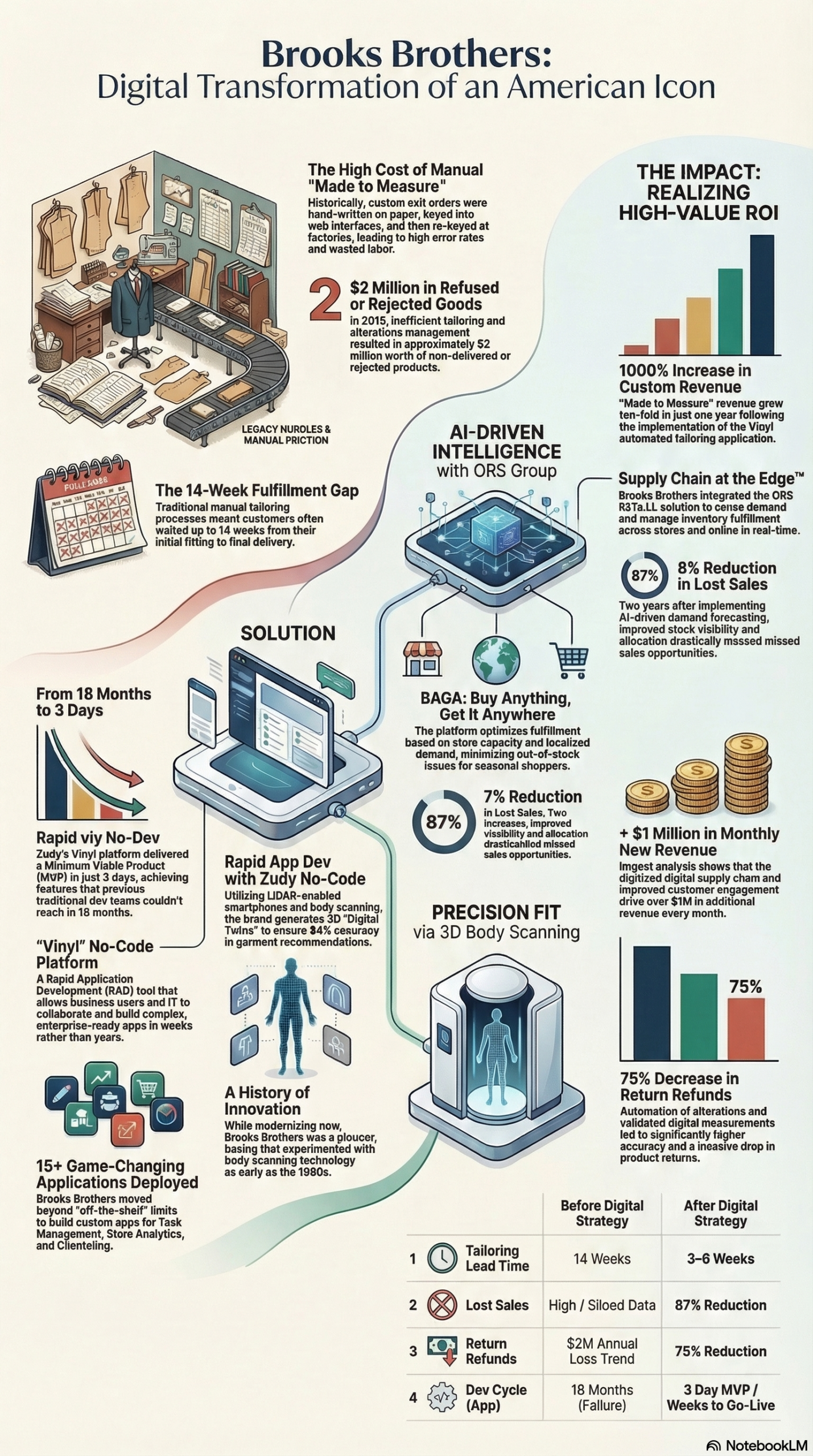
After an 18-month failed attempt using standard development tools, Brooks Brothers adopted Zudy’s Vinyl platform, a no-code RAD (Rapid Application Development) environment. The company used Vinyl to build a clienteling MVP—a minimum viable product for managing customer relationships on the floor—in just three days. The same outcome had eluded conventional development for a year and a half. Today, the company runs over 15 custom applications on the platform, covering alterations management, Made-to-Measure (MTM) orders, task management, and automated customer thank-you notes. More than 10 internal developers have been trained on the platform, reducing overall development effort by up to 80%, according to the research report.
Pillar 2: AI-Driven Demand Forecasting and Omnichannel Fulfillment
Brooks Brothers integrated the ORS RETa.i.L AI platform to manage supply chain operations in real-time, rebalancing its distribution network multiple times per day rather than relying on static weekly or monthly forecasts. Alongside this, the company deployed the BAGA (Buy Anything, Get it Anywhere) platform—a unified inventory visibility tool that gives store associates real-time stock awareness across all locations, enabling on-the-spot decisions about reserving product for direct shipment or in-store pickup.
Pillar 3: Storytelling-Led Brand Repositioning
Marisa Thalberg has been explicit about the scope of the brand shift: “This is not a transformation of the brand. This is a storytelling transformation,” as quoted in the research report. The current “Make It Yours” campaign and the 125th Anniversary Oxford shirt campaign are designed to shift consumer perception and attract new demographics—particularly affluent women (currently 30% of the customer base) and younger consumers—through ambassadors like actor Lee Jong-won and events featuring Selma Blair and Hasan Minhaj, without alienating the brand’s existing loyalists.
The critical insight here: the campaigns are the visible output of deep operational and data infrastructure changes. Understanding the distinction is what separates a strategic modernization from a superficial rebrand.
Why It Matters
Heritage brands face a specific and difficult challenge that newer DTC brands don’t: they carry 200 years of reputation as both an asset and a constraint. Every modernization decision risks alienating a core customer base that views the brand’s traditions as features, not bugs.
What Brooks Brothers is doing—and why practitioners should study it—is using technology to execute on an existing brand promise more effectively, rather than abandoning that promise to chase trends. The “White Glove Service” that Brooks Brothers has built its identity on is, fundamentally, a data and personalization problem in 2026. As CIO Sahal Laher stated in the research report: “If you’re our best customer in Tokyo and you come to our store on Madison Avenue, we need to know who you are.” That requires a 360-degree customer view integrated across SAP CRM and Customer Activity Repository (CAR) systems—infrastructure that doesn’t exist unless someone builds it deliberately.
For marketers, the repositioning strategy introduces a meaningful tactical shift: moving from age-based targeting to sensibility-based targeting. Instead of defining the Brooks Brothers customer by demographic bracket, the brand now targets by attitude and lifestyle orientation—the person who values quality, craft, and heritage, regardless of whether they’re 25 or 65. This opens the market aperture significantly while maintaining brand coherence. The campaigns can simultaneously resonate with a 30-year-old woman buying a gift and a 60-year-old executive restocking his wardrobe because the underlying appeal is values-based, not age-gated.
For e-commerce operators: the 75% reduction in return refunds and 1,000% MTM revenue increase don’t happen by accident. They happen because 3D body scanning and integrated data systems eliminate fit uncertainty—the primary driver of apparel returns. Every DTC brand with return rates above 20% should read the Brooks Brothers 3D scanning implementation as a roadmap.
For agencies managing legacy brand clients: this is the evidence you need to make the case for no-code operational tools as part of transformation engagements. The CIO’s statement—“Every CIO needs a RAD tool strategy to keep up with the growing demands of the evolving business and to build a more collaborative partnership with their business counterparts” (research report)—applies directly to marketing agencies where IT bottlenecks routinely slow campaign execution and custom tool deployments.
The Data
The metrics from Brooks Brothers’ digital transformation, as documented in the research report, tell a clear story about the ROI of operational modernization done right:
| Metric | Result After Digital Implementation |
|---|---|
| New Monthly Revenue (from custom apps) | $1,000,000 per month |
| Made-to-Measure Revenue Change | +1,000% within one year |
| Lost Sales Reduction | 87% |
| Return Refund Reduction | 75% |
| Total Inventory Reduction | 6% |
| App Development Effort Reduction | Up to 80% |
| 3D Scan Fitting Accuracy | 93–94% |
| Time to First MVP (Clienteling App) | 3 days (vs. 18 months previously) |
| Internal Developers Trained | 10+ |
| Custom Applications Built | 15+ |
These numbers are not typical of incremental software upgrades. A 1,000% MTM revenue increase within 12 months of an app launch indicates that the previous paper-based process was actively suppressing an existing demand signal—customers wanted custom tailoring, but the friction of the manual process was losing them before the sale closed. The 87% lost-sales reduction points to the same pattern: inventory existed but couldn’t be located, allocated, or committed in real-time without the AI layer. The 75% return refund reduction has compounding financial impact; in apparel e-commerce, return rates typically run 20–40%, and every percentage point of that cost carries reverse logistics, restocking, and markdown risk.
Step-by-Step Tutorial: How to Execute a Heritage Brand Digital Modernization
This is the framework Brooks Brothers executed, rewritten for practitioners who want to apply it to their own retail brand, agency client, or DTC operation. You don’t need to be a 208-year-old company to use this playbook. You need siloed data, a custom service promise, and the discipline to start with a one-week proof of concept before signing any long-term vendor contracts.
Prerequisites
Before starting, confirm you have:
- Access to your current ERP, CRM, and POS systems (or documentation of them)
- At least 2 business stakeholders who own the processes you want to automate
- Authority or direct access to IT/development resources
- A technology vendor shortlist (minimum 3) for the no-code RAD phase
Phase 1: Audit Your Current Technology Gaps
Step 1: Map every system in your current tech stack.
List every tool currently in operation: POS, ERP (SAP, NetSuite, Oracle Retail, etc.), CRM, e-commerce platform, warehouse management system, and any customer-facing tools. For each system, note: where data lives, who can access it, and whether store associates or customer-facing staff can reach it in real-time.
Step 2: Identify every paper-based and spreadsheet-based workflow.
These are your highest-ROI automation targets. At Brooks Brothers, the Made-to-Measure process was entirely paper-based before the Vinyl platform deployment. A paper-based alteration workflow means lost data, audit failures, and zero customer history across visits. Common equivalents at other brands: handwritten special orders, spreadsheet-based inventory allocation, manual clienteling notes taken on personal devices, and email-based task management for store operations.
Use this framework to prioritize:
AUDIT WORKSHEET: Current Process Map
┌────────────────────────────────────────────────────────────────────┐
│ Process             │ Current Tool  │ Data Accessible? │ Priority  │
├────────────────────────────────────────────────────────────────────┤
│ Alterations mgmt    │ Paper/manual  │ No               │ HIGH      │
│ MTM orders          │ Paper/manual  │ No               │ HIGH      │
│ Client follow-up    │ Email/manual  │ Partial          │ MEDIUM    │
│ Task management     │ Spreadsheet   │ Siloed           │ MEDIUM    │
│ Inventory lookup    │ ERP only      │ Store only       │ HIGH      │
│ Customer thank-you  │ Manual email  │ No               │ MEDIUM    │
└────────────────────────────────────────────────────────────────────┘
Step 3: Select your first three automation targets.
Prioritize processes that are: (a) high-frequency, (b) currently error-prone, and (c) directly customer-facing. Brooks Brothers started with clienteling—the highest-leverage starting point because it directly impacts revenue per associate interaction and customer lifetime value. Your equivalent is likely whichever process your best associates compensate for with personal effort and tribal knowledge that doesn’t survive staff turnover.
Phase 2: Select and Validate a No-Code RAD Platform
The central lesson from the Brooks Brothers case, per the research report, is that standard off-the-shelf software fails to capture the nuances of specialized “White Glove” retail workflows. No standard CRM captures the alteration notes, measurement records, and occasion context that defines high-end clienteling.
Step 4: Write a “perfect fit” requirements brief.
Before approaching any vendor, document what your first application must do that no off-the-shelf tool can accommodate. Aim for 10–15 specific requirements. This brief becomes your POC scope.
Step 5: Demand a one-week proof of concept from every vendor.
This is the single most actionable instruction in this case study. Brooks Brothers spent 18 months failing with traditional development. The Zudy Vinyl platform delivered a working MVP in three days. If a vendor can’t build you a functional prototype against your real requirements in five business days, they cannot meet your real-world pace of change. Require this in writing before any contract discussion begins. This filters out vendors immediately and surfaces the ones who are actually confident in their platform’s capability.
Step 6: Evaluate integration depth before anything else.
The Brooks Brothers MTM application integrates with 15+ data sources, including SAP and legacy ERPs, as documented in the research report. Your no-code platform must have native connectors to your core systems. In your vendor evaluation, verify: Can it connect to your ERP? Your CRM? Your e-commerce platform? What is the latency on data synchronization? Can it write back to source systems, or only read? A platform that can only display data but can’t trigger actions is a reporting tool, not an operational tool.
Step 7: Train internal developers immediately.
Target having 8–12 internal developers fluent in the chosen platform within 90 days of selection. This is how you achieve the 80% development effort reduction—not by eliminating developers, but by enabling business analysts with domain expertise to build and iterate without depending on an external development queue. Brooks Brothers trained over 10 internal developers on Vinyl, fundamentally shifting IT’s role from bottleneck to business partner, per the research report.
Step 8: Deploy and measure in 30-day cycles.
Your first application is not your final application. Plan a 30-day release cadence for the first three applications. Measure: time saved per associate per shift, error rate reduction on critical workflows, customer satisfaction scores related to the application’s process, and direct revenue impact per transaction where applicable.
Phase 3: Implement AI Demand Forecasting
Step 9: Build your AI layer on top of existing data systems—not adjacent to them.
The ORS RETa.i.L implementation at Brooks Brothers succeeds because it’s built on top of SAP Customer Activity Repository (CAR) data that was already trusted and maintained. Do not create a parallel data infrastructure that requires a separate team to maintain and reconcile. Your AI demand system must ingest data from where it already lives. If your source data requires cleaning before an AI system can use it, do that cleaning in your existing systems first.
Step 10: Configure real-time network rebalancing.
The target is network rebalancing multiple times per day—not weekly or monthly static allocation. This requires your AI system to have write access to inventory allocation rules, not just read access to dashboards. Start with your top 20% of SKUs by sales velocity. Establish a baseline out-of-stock frequency for those SKUs before you activate the AI layer, so you have a clean before/after measurement.
Step 11: Deploy omnichannel inventory visibility to store associates.
The BAGA (Buy Anything, Get it Anywhere) model gives associates a single interface showing real-time inventory across all locations. Implement a simplified version of this first: a single lookup tool available on associate devices that returns, for any SKU: (a) in-store stock, (b) nearest alternate store stock with estimated transfer time, and (c) warehouse stock with shipping time. This single capability reduces lost-sale events immediately and gives associates confidence in customer conversations about availability.
Step 12: Add price elasticity data to your merchandising workflow.
AI-driven price elasticity analysis was a documented component of the Brooks Brothers implementation, per the research report. At the SKU level, this means understanding how price changes affect conversion velocity—and using that data to protect premium positioning while optimizing margins on depth-of-line products. Configure your AI tool to surface elasticity alerts when seasonal promotions are being planned, so merchandising decisions are made with demand sensitivity data rather than gut intuition.
Phase 4: Execute the Storytelling Repositioning
Step 13: Build sensibility-based personas, not demographic profiles.
Construct a minimum of 3–5 distinct customer personas organized around values, occasions, and lifestyle orientation—not age brackets, income ranges, or ZIP codes. For Brooks Brothers, documented personas include graduates, wedding parties, and executives, each with distinct acquisition triggers and onsite UX needs, per the research report. Map each persona to: their primary entry point (organic search, paid social, in-store foot traffic), their purchase trigger (occasion, replacement, gift), and their primary product category.
Step 14: Identify one legacy asset to anchor your storytelling.
Every heritage brand has an equivalent of the Oxford shirt’s 125th anniversary. Find yours: a founding product, a signature fabrication technique, a historically significant customer relationship, or a production milestone. This becomes your storytelling anchor—a low-cost, high-authenticity campaign nucleus that requires no invented narrative. The 125th Anniversary Oxford campaign at Brooks Brothers extended across OOH, CTV, and social channels. As VP of Integrated Marketing Ecommerce Brian Schmidt noted in the research report: “A simple, authentic story turned into a major brand win—and we’re still seeing results months later.”
Step 15: Treat flagship stores as experience stages.
Physical retail investment should concentrate in flagship locations that function as brand amplification engines, not standard transaction processors. At Brooks Brothers’ 195 Broadway location, celebrity events and historic exhibitions run alongside the retail function. Plan 4–6 flagship events per year that are exclusively experiential—no immediate purchase required—and measure their impact on brand search lift, new-to-file customer acquisition, and social share of voice in the weeks following.
Step 16: Run controlled creative experiments through collaborations.
The Brooks Brothers approach—partnering with Brain Dead, Junya Watanabe, New Era, and Converse—is explicitly designed to let the brand experiment in modern cultural contexts without committing the core product line to a trend direction. Identify 2–3 creative partners who have credibility with your target demographic and an adjacent but non-overlapping audience. Produce limited runs, track new customer acquisition rate versus existing customer retention rate per collaboration, and use the data to calibrate future partnership investment.
Expected Outcomes by Timeline
| Milestone | Timeline | Target Metric |
|---|---|---|
| First no-code app live | Day 30 | Baseline metrics established |
| Three apps deployed | Day 90 | 30%+ time savings on automated processes |
| Return rate reduction visible | Month 6 | 30–50% fewer fit-related returns |
| AI demand data stabilized | Month 6 | Out-of-stock events down 40%+ |
| MTM revenue growth | Month 12 | 3–10x improvement from digitized workflow |
| Lost-sales reduction | Month 12 | 50%+ vs. pre-implementation baseline |
Real-World Use Cases
Use Case 1: Multi-Location Specialty Retailer Building Clienteling Apps
Scenario: A 40-location menswear chain where associates track customer preferences in personal notebooks and rely on memory. Customer history disappears when an associate leaves.
Implementation: Deploy a no-code RAD platform after running a one-week POC with at least two vendors. Build a clienteling application that pulls customer purchase history, sizing notes, and occasion preferences from the ERP and surfaces them on associate tablets at POS. Train 5–8 internal developers on the platform within 60 days. Automate post-visit thank-you notes and anniversary-of-purchase outreach as the second-phase build.
Expected Outcome: Associates increase average transaction value by 15–25% within 90 days through data-informed product recommendations. Customer return visit rate increases due to personalized, automated outreach that doesn’t depend on any individual associate’s memory or effort.
Use Case 2: E-Commerce Brand Reducing Returns via Fit Technology
Scenario: A DTC apparel brand with a 35% return rate driven by fit complaints across suits, dress shirts, and trousers.
Implementation: Partner with a 3D body scanning vendor for flagship or pop-up activation. Integrate scan data with a made-to-measure or AI-powered size-recommendation application. Per the research report, Brooks Brothers achieved 93–94% fitting accuracy with 3D scanning integration at its New York City flagship, using scans that feed directly into a proprietary custom patternmaking system.
Expected Outcome: Return rates drop 30–50% within 6 months of full integration. A new MTM or custom-size revenue channel opens as a separate revenue stream with higher average order value and stronger customer retention metrics.
Use Case 3: Wholesale Brand Needing Real-Time Inventory Intelligence
Scenario: A brand selling through department stores and its own DTC channel, frequently experiencing out-of-stock events because channel allocation is set monthly and can’t react to velocity spikes.
Implementation: Deploy an AI demand forecasting layer modeled on the ORS RETa.i.L approach—real-time ingestion of sell-through data from all channels, with automated rebalancing of allocation rules multiple times daily. Connect all channel data feeds to the AI layer before the first rebalancing cycle.
Expected Outcome: Lost sales from out-of-stock events drop 50%+ during high-velocity periods (seasonal launches, campaign spikes). Total inventory investment decreases 5–10% as allocation efficiency improves and safety stock requirements drop.
Use Case 4: Heritage Brand Repositioning for a Younger Demographic
Scenario: A premium brand with 70% of buyers aged 50+ that needs to attract buyers aged 30–45 without losing the existing customer base.
Implementation: Execute the sensibility-based persona framework. Build persona narratives for the target demographic that describe mindset and occasion—not age bracket. Identify one legacy product for a milestone campaign (a founding item, a 50th anniversary product, a signature fabrication technique). Partner with 2 creative collaborators with credibility in the target demographic. Activate across CTV and social channels alongside existing email and direct mail programs.
Expected Outcome: New demographic acquisition rate increases over a 12-month period without measurable decline in existing customer retention. Social share of voice and brand search volume grow via collaboration press coverage and earned media.
Use Case 5: Luxury Retailer Needing Global Customer Recognition
Scenario: A luxury retailer with international locations where VIP customers receive inconsistent service when traveling because store systems don’t communicate customer data across geographies.
Implementation: Deploy SAP CRM with Customer Activity Repository (CAR) integration, building the unified global customer profile infrastructure that CIO Sahal Laher described in the research report as essential to Brooks Brothers’ “White Glove Service” standard. Build the clienteling application on top of this global profile so any associate, in any location, has full customer history on first interaction.
Expected Outcome: VIP customer satisfaction scores improve measurably within 6 months. Repeat purchase rate increases as associates can provide proactive, informed service in any market. International VIP customers become brand advocates through consistent experience delivery.
Common Pitfalls
1. Treating IT as a vendor rather than a business partner.
The traditional retail IT model—where business teams submit requirements and wait months for delivery—is exactly what no-code RAD is designed to break. But deploying a new platform without restructuring the IT-business relationship replicates the bottleneck in new tooling. The shift is as cultural as it is technical: IT leadership needs to be embedded in business operations as a rapid-response partner, not a ticket queue manager. Measure this shift explicitly: track time from business request to working prototype, and make it a visible KPI.
2. Targeting by age instead of by sensibility.
Age-based targeting is a demographic shortcut that reliably fails heritage brands because their appeal has always spanned a wide age range. The more useful segmentation is values, occasion, and lifestyle orientation. Before launching any campaign, ask: could this message resonate equally with a 28-year-old and a 58-year-old? If it can’t, you’re using age as an inefficient proxy for something more precise and more powerful.
3. Building AI systems in data silos.
AI demand forecasting is only as accurate as the data it ingests. If your forecasting system can’t access POS data, e-commerce data, and wholesale channel data in near real-time, it’s producing estimates from an incomplete picture. Before selecting any AI forecasting tool, document every data source it needs to connect to—and validate those integrations during the POC phase, not after contract signature.
4. Signing long-term vendor contracts without proof of concepts.
The 18-month failed implementation documented in the research report is a common retail technology pattern. A vendor’s demo environment performs well; their system can’t handle your specific business logic at scale. Require any technology vendor to build a functional MVP against your actual requirements within one week before you negotiate terms. This standard filters out the wrong vendors immediately.
5. Measuring flagship stores only on in-store transaction volume.
If you’re investing in flagship real estate, you need a different performance metric than sales-per-square-foot. Flagship stores in the Brooks Brothers model function as brand amplification engines—their ROI includes earned media from events, brand perception lift in adjacent markets, and attribution for online purchases driven by in-store fitting experiences. Add brand search lift, new-to-file customer acquisition from events, and post-visit online conversion to your flagship performance scorecard.
Expert Tips
1. Start your RAD evaluation with your most embarrassing manual process.
The Made-to-Measure workflow at Brooks Brothers was paper-based. Start your no-code project with your equivalent—the process everyone knows is broken but has never been prioritized because it’s “too specific” for any off-the-shelf product. That specificity is precisely where no-code RAD provides its most asymmetric value. The more custom the workflow, the higher the competitive advantage from digitizing it.
2. Build your AI demand layer on your existing data infrastructure, not a greenfield parallel system.
Every successful AI deployment in this case study runs on top of data that was already maintained in SAP CAR and existing ERPs. A parallel data infrastructure creates maintenance debt, data quality drift, and reconciliation overhead. Your AI layer should be a logic and decision layer on top of data you already trust—not a new data warehouse that requires its own governance.
3. Measure fitting accuracy as a leading indicator, not return rate as a lagging one.
The 93–94% fitting accuracy metric is operationally more valuable than return rate because it identifies failure before the return happens. Instrument your 3D scanning or AI size-recommendation system to capture post-purchase accuracy data—through a short post-delivery survey or CRM tracking—so you can identify systematic fit failures by product category before they accumulate into return rate spikes.
4. Use creative collaborations as structured market tests.
Each Brooks Brothers collaboration—Brain Dead, Junya Watanabe, New Era—targets a specific adjacent audience segment. Treat each collaboration launch as a structured test: measure new-to-file customer acquisition rate, post-collaboration retention rate at 90 days, and social demographic data against your target persona. The data tells you whether the adjacent audience you’re targeting actually converts and retains at acceptable economics, before you invest in full acquisition campaigns targeting that segment.
5. Build associate app usage into performance metrics from day one.
A clienteling application that sits on a tablet but isn’t opened at POS is not an operational asset—it’s expensive shelf furniture. From the moment any associate-facing application launches, include usage rate and data quality (completeness of customer records entered) in the performance framework for store associates and their managers. Adoption is a management discipline, not a technology outcome.
FAQ
Q: What is Catalyst Brands and how does it affect Brooks Brothers’ strategy?
Catalyst Brands was formed in January 2025 through the merger of JCPenney and SPARC Group, as documented in the research report. SPARC Group had previously acquired Brooks Brothers following its 2020 bankruptcy. Under Catalyst Brands, Brooks Brothers operates alongside other SPARC portfolio brands, sharing infrastructure and leadership—including Marisa Thalberg as Chief Customer and Marketing Officer—while maintaining its distinct brand identity. The merger provides scale advantages for technology investment and shared retail expertise that Brooks Brothers would not have as a standalone entity.
Q: What is Zudy’s Vinyl platform and how does it compare to other no-code retail tools?
Zudy’s Vinyl is a no-code RAD (Rapid Application Development) platform that Brooks Brothers used to build over 15 custom retail applications, per the research report. The platform’s key differentiator, in the Brooks Brothers context, is its integration depth: the MTM application connects to 15+ data sources including SAP and legacy ERPs simultaneously. Other no-code platforms exist in the market, but the Brooks Brothers selection was validated specifically by the three-day MVP delivery that outperformed 18 months of conventional development. For any platform evaluation, apply the one-week POC standard regardless of which tool you’re testing.
Q: How long does it typically take to see measurable ROI from a no-code application deployment?
Based on the Brooks Brothers timeline documented in the research report, the first measurable revenue impact appeared within the first year: $1 million in new monthly revenue and a 1,000% MTM revenue increase within 12 months of deployment. The clienteling MVP was operational in three days. A realistic expectation for a first-time no-code deployment: a working prototype in under two weeks, measurable operational efficiency improvement within 60–90 days, and revenue impact within 6 months—assuming the first application targets a high-frequency, customer-facing process.
Q: How does sensibility-based targeting actually work in campaign execution?
Instead of defining a target audience as “men aged 35–55 with household income over $150K,” sensibility-based targeting defines them as “people who value craft, heritage, and quality presentation, across occasions from professional to personal.” At Brooks Brothers, this enables campaigns that simultaneously attract a 30-year-old woman buying a gift for a partner and a 60-year-old executive restocking his professional wardrobe—because the resonance is at the level of shared values, not shared demographics. In execution, this requires writing persona narratives that describe mindset, values, and purchase occasion first, and only use demographic data as a secondary signal for media targeting, not creative development.
Q: Is 3D body scanning a viable investment for brands without flagship retail locations?
Not yet at full scale for standalone e-commerce brands without physical retail, but the technology trajectory is clear. The Brooks Brothers implementation is flagship-specific, per the research report, and the 93–94% accuracy figure reflects a controlled, in-store environment with dedicated scanning hardware. For DTC brands without flagship locations, the current interim approach is AI-powered size-recommendation engines that learn from aggregated purchase and return data—these can achieve 70–80% accuracy without physical scanning infrastructure. The 3D scanning standard is worth building toward as the technology becomes more portable; the fit-accuracy business case from the Brooks Brothers results is compelling enough to justify the investment at flagship scale.
Bottom Line
Brooks Brothers’ modernization is not a marketing story—it’s an operations story that expresses itself through marketing. The $1 million in new monthly revenue, the 87% lost-sales reduction, and the 1,000% MTM revenue increase documented in the research report all came from fixing the operational and data infrastructure that enables great customer experience, not from better creative or a more clever campaign. The “Make It Yours” campaign and the Oxford shirt anniversary are visible because they’re designed to be visible. The no-code apps, AI forecasting, and 3D scanning systems are invisible because they work. Any brand serious about heritage modernization should start with its most embarrassing manual process, require a one-week vendor POC before signing anything, and measure operational accuracy before it measures brand perception. Fix the infrastructure; the storytelling follows naturally.


0 Comments