

Every successful content program starts with a handful of simple words—before any keyword tool gets opened, before any content calendar gets built. Seed keywords are those words: the raw material from which entire topic clusters, pillar pages, and long-tail keyword strategies grow. This tutorial teaches you exactly how to find them, validate them, and deploy them into a scalable SEO content plan.
What Seed Keywords Are
Seed keywords are broad, short phrases—typically one or two words—that represent the core topics your business operates in. They are not the final keywords you optimize pages around; they are the starting point that generates those final keywords. As Tristen Taylor on HubSpot puts it: “Think of them as the seeds you plant before a topic cluster grows around them.”
The agricultural metaphor is accurate. A single seed keyword like “email marketing” can generate dozens—sometimes hundreds—of specific, rankable long-tail queries: “best email marketing tools for ecommerce,” “how to segment email lists by behavior,” “email marketing automation for small business.” Each of those is a content page. The seed is the organizing concept; the long-tail keywords are the harvestable output.
Understanding what seed keywords are requires understanding what they are not:
-
Seed keywords are not target keywords. According to HubSpot’s analysis, “seed keywords are the raw material. Target keywords are the specific, refined phrases you actually optimize each page around.” A seed is “SEO tools.” A target keyword is “best SEO tools for small business content teams.”
-
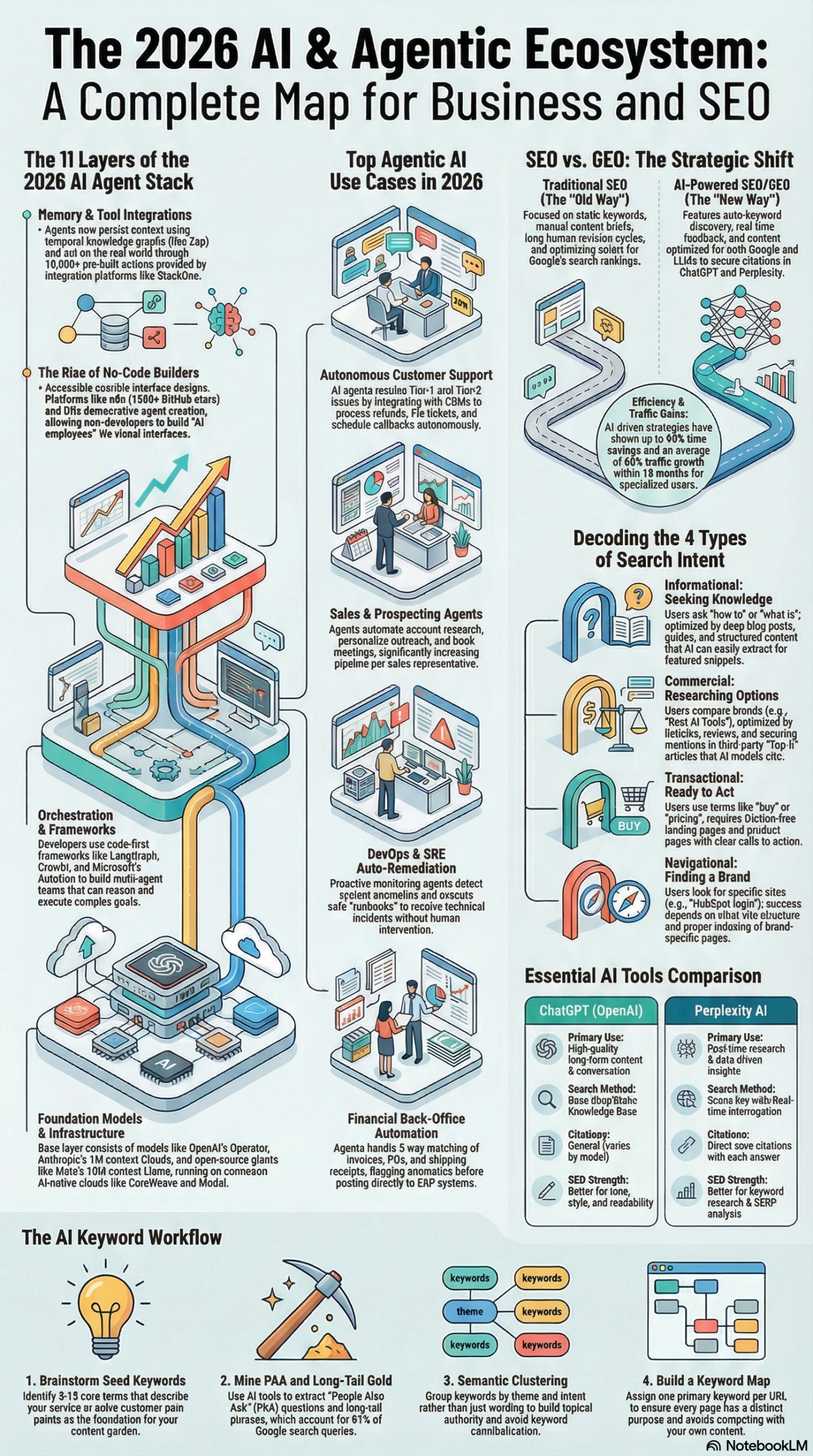
Seed keywords are not long-tail keywords. Long-tail keywords are the three-to-six-word phrases derived from seeds. They carry specific intent. The NotebookLM research report notes that nearly 91% of all Google search queries are long-tail, per Factors.ai research—and they convert better because the user’s intent is more precisely defined.
-
Seed keywords are not brand terms (usually). Branded seeds like “HubSpot” or “Ahrefs” have their place, but non-branded seeds typically provide more strategic value for capturing buyers who don’t yet know your product exists.
Structurally, seed keywords are the linchpin of the topic cluster model. A topic cluster consists of one pillar page targeting a broad theme and multiple supporting pages addressing related long-tail queries. Every cluster originates from a seed. Without a defined seed, topic clusters drift—writers chase trending topics, teams lose alignment, and the content program fragments.
The right seed set is typically small: HubSpot recommends starting with just three to five anchor seeds per content program. This constraint forces strategic prioritization and prevents the sprawl that kills most content operations before they gain momentum. The NotebookLM research report cites GrackerAI’s guidance of maintaining 5–15 core seed keywords per service category—giving you enough topical coverage without spreading resources thin.
In 2026, seed keyword selection has gotten more nuanced because search engines no longer just match keywords—they interpret intent. The research report documents that search engines now use Natural Language Processing (NLP) to decode the “why” behind a query using context, location, and search history. Your seed keywords must map to real buyer intent categories, not just business jargon.
Why Seed Keywords Matter
The practical impact of a well-built seed keyword list is measurable at every stage of a content operation—from initial ideation to quarterly traffic review.
For content teams, seed keywords eliminate the blank-page problem. When a writer knows the seed cluster they’re working within, the long-tail keyword targets become obvious. The HubSpot article identifies this as seed keywords’ first core benefit: providing a defined universe for writers and strategists to work within. Without that definition, writers default to guessing what to cover—and guessing generates content with no strategic coherence.
For SEO managers, seeds provide the organizational scaffolding for keyword mapping. The research report describes a critical guardrail in keyword strategy: assigning one primary keyword per URL to prevent cannibalization—where multiple pages on the same site compete for the same query. Seed keywords make that mapping systematic. When every page in a cluster traces back to a single seed, cannibalization is structurally prevented because each seed occupies a distinct topical territory.
For marketers and agencies, seeds connect content production to buyer intent stages. The research report documents four distinct search intent types: informational, navigational, transactional, and commercial investigation. A seed keyword like “CRM software” generates queries at every intent stage. Mapping those queries correctly means the right content meets the buyer at the right moment—discovery, research, comparison, and purchase.
For enterprises in 2026, the stakes are higher because search visibility now extends beyond Google rankings. The research report notes that visibility is increasingly measured by citation frequency in Large Language Model (LLM) responses—ChatGPT, Perplexity, and Gemini answers. Brands cited in those responses win traffic that never touches a traditional SERP. Topical authority—built by owning entire seed clusters rather than chasing individual keywords—is the mechanism that drives those LLM citations.
What differentiates seed-based strategy from keyword spray-and-pray tactics is compounding returns. Once a pillar page gains authority in a seed cluster, supporting long-tail pages inherit trust signals. New pages rank faster. The site accumulates topical authority recognized by both search algorithms and AI crawlers. The research report describes this as winning “entire topical areas via clusters and topical maps rather than individual keywords.”
The Data: Seed Keyword Tools Compared
Not every keyword tool is equally useful for seed discovery versus validation. Here is how the leading tools map to different stages of the seed keyword workflow, based on HubSpot’s tool analysis and the research report:
| Tool | Best Stage | Primary Strength | Cost |
|---|---|---|---|
| Google Search Console | Validation & discovery | Shows queries already driving traffic to your site | Free |
| Ahrefs Keywords Explorer | Validation & clustering | Seed validation, cluster size estimation, parent topic grouping | Paid |
| Semrush Keyword Magic Tool | Clustering & intent | Strong clustering; intent filtering (informational vs. transactional) | Paid |
| AnswerThePublic | Ideation | Visualizes questions and prepositions around a seed | Freemium |
| Google Keyword Planner | Validation | Free search volume data; sufficient for bootstrapped teams | Free |
| HubSpot SEO & Content Tools | Planning & execution | Integrates keyword research directly with content production | Paid (HubSpot) |
| Perplexity | Real-time research | Live web scanning; surfaces trending queries and SERP patterns | Freemium |
Per the research report, a hybrid tool strategy works best in 2026: use Perplexity for real-time research and trend identification, then use ChatGPT or Claude for long-tail query generation from validated seeds, then validate volume and difficulty in Ahrefs or Semrush.
Step-by-Step Tutorial: Building a Seed Keyword List from Scratch
This tutorial walks through the complete process of identifying, validating, and deploying seed keywords for a new content program. The approach combines the seven-step process documented by HubSpot with the AI-era keyword workflow from the NotebookLM research report.
Prerequisites
- Access to at least one keyword research tool (Google Keyword Planner is free; Ahrefs or Semrush preferred)
- Google Search Console connected to your domain (if your site has existing traffic)
- A clear Ideal Customer Profile (ICP)—you need to know who you’re writing for before you know what to write about
Phase 1: Internal Discovery (Before Opening Any Tool)
Step 1: Write what you know.
Open a blank document. Write 5–10 phrases describing your business from the customer’s perspective—not your internal jargon. If you sell project management software, your instinct might be “project management platform.” But customers might search “how to keep projects on track” or “team task organization tools.”
Then take it further: ask your sales team what phrases prospects use in discovery calls. Talk to customer success about support ticket language. Every term a customer uses to describe their problem is a potential seed keyword. According to HubSpot, this first-person discovery step grounds your entire strategy in buyer vocabulary—not marketing vocabulary.
Step 2: Mine first-party data.
If your site has existing traffic, this is the most valuable step. Pull your Google Search Console query data for the last 12 months. Look for patterns—short, two-word phrases that appear in dozens of longer queries. Those patterns are often unmined seeds. The HubSpot article frames every search query as “a data point about what visitors could not find”—meaning your site search logs, CRM notes, chat transcripts, and support tickets are all seed keyword sources.
Specifically look at:
– On-site search queries (if you have internal search enabled)
– Chat support transcripts for recurring question themes
– Sales call recordings or CRM notes for prospect language
– Social media comments and DMs where customers describe problems
Phase 2: Competitive and SERP Research
Step 3: Analyze competitor topics.
Load a competitor’s domain into Ahrefs or Semrush. Look for the broad topic categories driving their organic traffic—not individual keywords, but themes. If a competitor ranks for 200 articles about “email deliverability,” that’s a seed. You want to identify topic territories where competitors have authority that you haven’t entered yet.
The goal here is not to copy; it’s to identify the seed landscape in your market and find gaps. According to the research report, competitor mining is step three in the validated keyword workflow—specifically described as “systematically harvesting content gaps from high-ranking competitors.”
Step 4: Use Google’s own suggestions.
Search each candidate seed phrase in Google and capture:
– Autocomplete suggestions (what Google suggests as you type)
– “People Also Ask” (PAA) boxes—these surface the questions people actually ask
– Related searches at the bottom of the page
– Featured snippets and knowledge panels—these signal strong informational intent
AnswerThePublic automates this process at scale, generating a visual map of questions, prepositions, and comparisons around any seed term. It’s particularly useful for ideation sessions when you’re building out a new content vertical.
Phase 3: Validation and Prioritization
Step 5: Validate with search volume data.
Take your candidate list of 15–30 potential seeds into a volume validation tool. For each seed, look at:
– Monthly search volume: Is there real demand? (For seeds, you’re looking at broad volume; the long-tail keywords you derive from them will have lower individual volume but combine to significant total traffic)
– Keyword difficulty (KD): Can you realistically compete? HubSpot is clear on this: the goal is finding terms “where you can realistically compete”—not simply the highest-volume options
– Trend direction: Is volume growing, stable, or declining? Use Google Trends to verify
The research report recommends using tools like Semrush or Ahrefs to verify US-specific volume and keyword difficulty, while supplementing with Google Trends for recency—since AI models may have knowledge cutoffs that make trend data stale.
Step 6: Group seeds into themes.
With your validated list, identify patterns. Group related seeds that address the same buyer problem or product category. For example, “CRM software,” “sales pipeline management,” and “contact management system” might all cluster into a single thematic group targeting the same buyer problem. When seeds overlap that significantly, choose the one with the best balance of volume, difficulty, and strategic relevance—and treat the others as secondary.
According to HubSpot’s process, the output of this step should be three to five distinct anchor seeds, each representing a unique buyer problem or product category.
Step 7: Pressure-test with AI.
Before finalizing your seed list, run each shortlisted seed through a large language model—Claude, ChatGPT, or Gemini. Prompt: “Generate 20 long-tail keyword variations of ‘[seed keyword]’ that a [describe your ICP] would search for when [describe the buyer problem].”
This step surfaces angles you haven’t considered and reveals whether a seed is actually broad enough to generate a full content cluster. If a seed only generates five or six variations, it may be too narrow to anchor an entire cluster. If it generates 40+ meaningful variations, it’s a strong seed with substantial content potential.
The research report describes this as “AI-driven discovery and clustering”—using LLMs to augment traditional keyword research rather than replace it.
Phase 4: Building the Content Plan
Step 8: Build cluster maps.
For each confirmed anchor seed, generate 10–20 related long-tail keywords that will become supporting pages. Categorize them by intent:
- Informational: “how to [seed topic],” “what is [seed topic],” “guide to [seed topic]”
- Commercial investigation: “best [seed topic] tools,” “[seed topic] software comparison,” “[seed topic] for [specific use case]”
- Transactional: “[seed topic] pricing,” “buy [seed topic] software,” “[seed topic] free trial”
Each intent category maps to a different stage in the buyer’s journey. HubSpot’s cluster building guide recommends assigning intent to each cluster page explicitly during planning—not as an afterthought.
Step 9: Map internal links.
Pillar pages link to their supporting cluster pages. Supporting cluster pages link back to the pillar. This internal link architecture signals topical authority to search engines. Without it, the cluster is just a collection of loosely related pages.
The research report documents keyword mapping as the final step in the validated workflow: “assign one primary keyword per URL to prevent cannibalization.” This mapping exercise happens at the cluster level—ensuring no two pages in your content program compete for the same query.
Expected Outcome
After completing this process, you should have:
– 3–5 confirmed anchor seed keywords
– 10–20 long-tail keyword targets per seed (30–100 total content page targets)
– Intent assignments for each target keyword
– A publishing cadence and page-ownership map for execution
– A quarterly audit schedule to refresh seeds as market language evolves
Real-World Use Cases
Use Case 1: SaaS Marketing Team Building a Content Program from Scratch
Scenario: A B2B SaaS company launching a project management tool has no existing organic traffic and needs to build a content program from zero.
Implementation: The team starts with Step 1—interviewing sales about prospect language in discovery calls. They identify five recurring phrases: “task management,” “team collaboration,” “project tracking,” “workflow automation,” and “remote work tools.” They validate all five in Semrush, find that “workflow automation” has high difficulty due to dominant competitors, and deprioritize it. The remaining four become anchor seeds. Each generates a 15-page cluster map with informational, commercial, and transactional targets assigned.
Expected Outcome: Within six to nine months, the site builds topical authority in four content clusters, earning featured snippet placements for informational queries and commercial comparison rankings that drive trial signups.
Use Case 2: Agency Running Seed Keyword Audits for Clients
Scenario: A content marketing agency needs a repeatable process for onboarding new clients and building their keyword strategy.
Implementation: The agency builds a standardized intake process using the seven-step workflow. They mine client CRM data and chat transcripts as part of onboarding. Competitor analysis in Ahrefs surfaces seeds the client hasn’t targeted. AI pressure-testing with Claude generates long-tail variations at scale. The agency delivers a seed map and cluster outline within the first two weeks of engagement.
Expected Outcome: The repeatable process reduces strategy time from four weeks to two and produces measurable improvements in keyword coverage within the first quarter. The research report notes that well-mapped seed clusters—with pillar-to-support internal linking—accelerate ranking timelines for new pages.
Use Case 3: E-Commerce Brand Targeting Regional Markets
Scenario: A global e-commerce brand expanding into new regional markets needs market-specific keyword strategies, not just translated copies of existing content.
Implementation: Following the HubSpot guidance on international SEO, the brand builds separate seed lists by target market—conducting discovery interviews with local sales teams and mining region-specific search query data from Google Search Console. Buyer language varies significantly by market; what converts in the US may not resonate in Germany or Brazil.
Expected Outcome: Region-specific seed lists produce content that matches local search behavior rather than forcing localized audiences into US-centric keyword frameworks. Organic visibility increases in target markets without cannibalization between regional content variants.
Use Case 4: Individual Creator or Blogger Building a Niche Authority Site
Scenario: A solo creator building a personal finance blog needs to define their topical niche and build a seed list that allows them to grow authority without competing against major publishers.
Implementation: Using only free tools (Google Search Console, Google Keyword Planner, AnswerThePublic), the creator identifies three to four seeds in underserved sub-niches—focusing on seeds where keyword difficulty allows realistic competition. The AI pressure-test step (using free-tier ChatGPT) generates long-tail variations that expose high-intent, low-competition queries the creator targets first to build authority before pursuing competitive terms.
Expected Outcome: Ranking for long-tail informational queries in years one through two builds authority that unlocks commercial and transactional rankings in years two through three. The research report confirms that long-tail keywords “convert better because you’re answering specific questions”—making them the right starting point for any new authority site.
Common Pitfalls
Pitfall 1: Chasing volume over intent.
The most common mistake is selecting seeds based on raw search volume rather than intent alignment. A seed with 100,000 monthly searches is worthless if the underlying intent is informational and your goal is transactional. The research report explicitly flags this as a critical mistake: “optimizing for 10k searches that are informational when the goal is transactional.” Fix: always map your seeds to a primary intent category before investing in cluster development.
Pitfall 2: Using too many seeds at launch.
Spreading resources across 10 or 15 seeds simultaneously means no cluster ever gets enough content to establish topical authority. HubSpot recommends starting with three to five anchor seeds. The constraint is strategic: depth beats breadth in the early stages of content program development. Build authority in fewer clusters first, then expand.
Pitfall 3: Skipping first-party data mining.
Many content teams jump straight to keyword tools and skip the discovery work in CRM notes, support transcripts, and sales call recordings. This produces seeds rooted in tool-suggested jargon rather than actual buyer language. The result is content that ranks for terms buyers don’t actually search. Fix: run Step 1 and Step 2 before opening any keyword tool.
Pitfall 4: Ignoring keyword cannibalization.
Publishing multiple pages targeting the same or closely overlapping seeds causes the site to compete against itself. Search engines get confused about which page to rank. The research report describes keyword cannibalization as one of the most damaging—and most common—keyword strategy errors. Fix: assign one primary keyword per URL during cluster mapping and audit for cannibalization quarterly.
Pitfall 5: Treating seeds as static.
Market language evolves. New terms emerge; old ones fade. A seed keyword that accurately captured buyer language two years ago may have been superseded by new terminology. HubSpot recommends quarterly reviews aligned with market shifts and product evolution. Set a calendar reminder and actually run the audit—don’t let it slide.
Expert Tips
Tip 1: Use Google Search Console regex filtering to find hidden long-tail seeds.
In Google Search Console, navigate to the Performance report, filter queries with the regex .{25,} (which matches queries 25 characters or longer). This surfaces the long, high-intent queries already driving traffic to your site—often revealing seed clusters you haven’t deliberately targeted but are naturally ranking for. The research report includes this as a documented advanced tactic.
Tip 2: Treat “People Also Ask” boxes as a seed validation signal.
When a Google SERP for your candidate seed shows a large PAA box with five or more questions, that’s a strong signal: (a) the seed has clear informational intent and (b) there’s enough demand for multiple supporting pages. Seeds without PAA boxes may be too narrow or too ambiguous to anchor a full cluster.
Tip 3: Validate seeds against SERP competition quality—not just volume.
A seed with 5,000 monthly searches where the first page is dominated by thin, outdated content is more valuable than a seed with 50,000 monthly searches where the first page is dominated by enterprise-level publishers. Manual SERP review takes five minutes per seed and dramatically improves your selection quality.
Tip 4: Build separate seed lists for each buyer persona.
If your ICP includes multiple distinct buyer types—say, individual practitioners and enterprise buyers—build separate seed lists for each. The buyer language, intent, and content needs differ significantly. Mixing personas into a single seed list produces content that tries to speak to everyone and persuades no one.
Tip 5: Run your seed list through an LLM to identify topical authority gaps.
Prompt Claude or ChatGPT: “I’m building content authority around [seed keyword]. What related sub-topics would a comprehensive resource site cover that would demonstrate deep expertise to both readers and search engines?” The LLM’s response will often surface sub-topics you haven’t mapped—representing content gaps you can close to strengthen your cluster’s topical authority. The research report explicitly recommends this approach as part of the AI-era keyword workflow.
FAQ
Q: How many seed keywords should I start with?
Start with three to five anchor seeds. HubSpot’s guidance is firm on this: fewer seeds with full cluster development outperforms many seeds with shallow coverage. The research report cites GrackerAI’s recommendation of 5–15 seeds per service category as the upper bound for established programs. For new content programs, start with three and expand once those clusters have traction.
Q: What’s the difference between a seed keyword and a focus keyword?
A seed keyword is a broad, foundational term used for research and cluster planning—it generates other keywords but may never be directly targeted on a page. A focus keyword (or target keyword) is the specific phrase you optimize an individual page around. Seeds live at the strategy layer; focus keywords live at the execution layer. Per HubSpot: “seed keywords are the raw material. Target keywords are the specific, refined phrases you actually optimize each page around.”
Q: Can I use AI tools to generate seed keywords automatically?
Yes, but with caveats. AI tools like ChatGPT and Claude are excellent for generating variations and surfacing angles you haven’t considered. However, the research report warns that AI models have knowledge cutoffs and must be supplemented with real-time data from Google Trends and live SERP analysis. AI-generated seeds still need human validation against search volume data, keyword difficulty, and actual SERP competition.
Q: How often should I refresh my seed keyword list?
HubSpot recommends quarterly reviews. This cadence aligns with typical market shifts, product updates, and seasonal search pattern changes. At minimum, run an annual audit. The most common trigger for an unscheduled seed refresh is a significant change in your product, your ICP, or your competitive landscape.
Q: Are branded terms worth using as seeds?
Branded seeds (your company name, product name) have value for navigational queries—content targeting users already familiar with your brand. However, HubSpot notes that non-branded seeds typically hold more strategic value for capturing buyers in the awareness and consideration phases who don’t yet know your product exists. For most content programs, non-branded seeds should dominate the anchor list, with branded seeds handled separately through brand-specific content.
Bottom Line
Seed keywords are the structural foundation of any content program built for long-term SEO performance. The three-to-five anchor seeds you define today determine what content clusters you can build, what long-tail queries you rank for, and ultimately what topical authority your site accumulates with both search algorithms and AI systems. As the research report documents, 2026 search optimization has expanded beyond Google rankings to include LLM citation frequency—and topical authority built through disciplined seed cluster development is the mechanism that drives both. The process is not complicated: start with buyer language, validate with data, map to intent, build clusters, and audit quarterly. The teams that execute this systematically will compound content returns that teams chasing individual keywords never achieve.


0 Comments