

AI sourcing agents have moved procurement teams from drowning in fragmented supplier data to executing autonomous, simultaneous negotiations across thousands of vendors — all without human fatigue. This post breaks down exactly how agentic AI works in supplier discovery, which platforms lead the market in 2026, and how to run your first pilot in under 90 days. If your team still relies on manual RFQ processes and spreadsheet-based supplier scorecards, this tutorial will show you a faster path.
What This Is
AI sourcing agents are purpose-built software systems that autonomously identify, evaluate, qualify, and negotiate with suppliers on behalf of procurement teams. Unlike earlier-generation procurement tools that required humans to trigger and approve every action, modern sourcing agents — built on large language models and reinforcement learning — can intake sourcing requirements, scan customs trade records and public supplier databases, shortlist qualified vendors, and open negotiations, all with minimal human touchpoints.
The category crystallized around 2024–2025 as procurement teams felt the compounding pressure of two opposing forces: an explosion of available supplier data and a shrinking capacity to process it. According to a NotebookLM strategic briefing on AI-ERP integration, the challenge facing modern procurement is no longer a lack of information but an overwhelming surplus — thousands of fragmented data points, unverified supplier claims, and the manual labor of cross-border outreach. AI sourcing agents are the answer to that overload.
How the technology stack actually works:
At the core, an AI sourcing agent integrates with your existing ERP (SAP, Oracle, NetSuite, or similar) and pulls structured spend data, category definitions, and approved supplier lists. It then connects outward to external intelligence layers — customs trade records, commercial databases like Dun & Bradstreet, ESG rating services, and commodity pricing feeds. The agent applies machine learning models to match your requirement profile against this external data, generating a ranked shortlist of viable suppliers with associated risk scores.
From there, depending on platform, the agent either surfaces recommendations to a human buyer or — in fully agentic deployments like Pactum — proceeds to open negotiation threads with vendors via email or platform messaging. Pactum, for example, programs its agents to be “endlessly polite and collaborative” while enforcing strict mathematical guardrails: a reservation price (walk-away point), target price, concession steps, and required contract clauses including GDPR compliance and indemnification language.
EaseSourcing takes a different entry point, specifically using customs trade records — import/export filings — to surface suppliers that are actually shipping goods in your category, rather than just claiming capability in a supplier portal. This distinction matters: a supplier who appears on a B2B directory is not the same as one with an active 12-month export record to your target market.
The 2026 vendor landscape as documented in the strategic briefing also distinguishes clearly between “AI-Native” platforms, built with AI at the architectural core, and legacy Source-to-Pay systems that have layered AI features onto existing code. This isn’t a marketing distinction — it determines whether the AI has coherent access to your full data model or operates in isolated modules that can’t share context.
Why It Matters
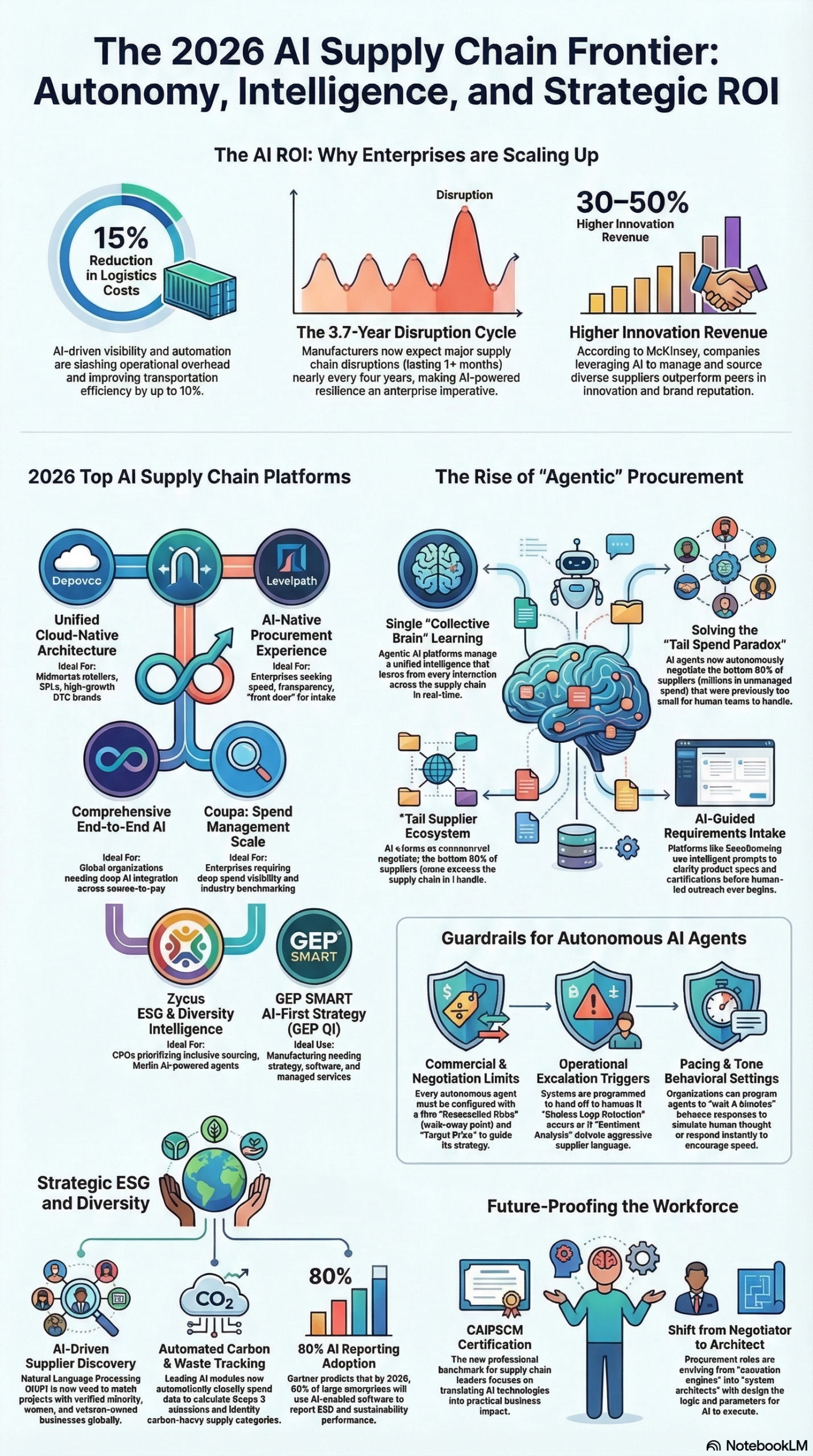
The financial case for AI sourcing agents is direct. The strategic briefing cites 1–7% procurement cost reductions for organizations that have moved beyond checkbox AI into genuine architectural integration. For a company spending $500M annually with suppliers, a 3% reduction represents $15M returned to the business — without headcount reductions or renegotiating strategic contracts.
But the more compelling opportunity is in what practitioners call the tail spend paradox. Procurement teams historically focus on the top 20% of suppliers that account for 80% of spend — the strategic accounts where human relationship management justifies the time investment. That leaves the remaining 80% of suppliers (by count) largely unmanaged. Payment terms are inconsistent. Pricing hasn’t been benchmarked in years. Contract clauses are outdated or missing entirely. This is the “unmanaged middle,” and it is where AI agents generate disproportionate value.
As the strategic briefing notes, “The inherent value of an AI agent is its ability to conduct simultaneous, high-quality negotiations with zero fatigue. This opens up a previously inaccessible layer of value: found money from the unmanaged middle.” A human negotiator can run four to six active negotiation threads at once. An AI agent can run four thousand. That scale change unlocks categories that were simply not worth the labor cost before.
Beyond cost, supplier diversity and ESG reporting represent a second wave of AI sourcing value. According to McKinsey research cited in the briefing, companies with diverse suppliers generate 30–50% higher innovation revenue than peers. By 2026, the briefing projects that 80% of large enterprises will use AI-enabled supplier diversity software specifically to report ESG performance — moving diversity tracking from compliance checkbox to strategic capability tied to Scope 3 emissions data and audit-ready Responsible Spend Scorecards.
For B2B marketing and growth teams specifically: your procurement stack is now a competitive intelligence layer. Who you source from, at what terms, and with what ESG profile increasingly shapes enterprise customer decisions. Procurement AI is no longer just a back-office efficiency play.
The Data: AI Sourcing Platforms Compared
The following table maps the primary platforms in the 2026 AI sourcing landscape by type, primary strength, and best-fit use case. Source: NotebookLM Strategic Briefing, 2026.
| Platform | Type | Primary Strength | Best Fit |
|---|---|---|---|
| Levelpath | AI-Native | Unified intake, sourcing, and risk management built for speed | Mid-market to enterprise new deployments |
| Pactum | Agentic AI | Autonomous negotiations for tail spend at scale | Enterprises with large unmanaged supplier base |
| Zycus | Full-Suite S2P | Cognitive spend analysis across full source-to-pay cycle | Organizations needing end-to-end S2P consolidation |
| Coupa | Spend Management | Predictive benchmarking via global transaction dataset | Enterprises prioritizing market benchmarking |
| EaseSourcing | Sourcing Agent | Supplier discovery via customs trade records | Teams sourcing cross-border, especially from Asia-Pacific |
| Ironclad | CLM (Contract) | AI-powered drafting, redlining, and lifecycle management | Legal and procurement teams managing contract volume |
Key distinction to understand: Levelpath and Pactum are AI-native — the AI is not a bolt-on module. Zycus and Coupa are mature platforms where AI has been layered over existing architecture. Neither approach is wrong, but they produce different integration experiences and data coherence levels.
| Metric | Manual Procurement | AI Sourcing Agent |
|---|---|---|
| Simultaneous negotiation threads | 4–6 per buyer | Thousands (unlimited scale) |
| Tail spend coverage | ~20% of supplier base | Up to 100% |
| Time to shortlist (new category) | 2–3 weeks | 24–72 hours |
| ESG data integration | Manual spreadsheet | Automated Scope 3 linkage |
| ROI realization window | 6–18 months | 60–90 days (pilot) |
Source: NotebookLM Strategic Briefing, 2026; Martech Zone, March 2026.
Step-by-Step Tutorial: Deploying an AI Sourcing Agent for Your B2B Team
This walkthrough follows a realistic 90-day pilot deployment for a procurement team of 5–15 people running a mid-to-large ERP (SAP, Oracle, or NetSuite). The goal: deploy an AI sourcing agent on a defined tail-spend category and achieve measurable cost or compliance improvement within the first 90 days.
Phase 1: AI Readiness Assessment (Days 1–14)
Before selecting a vendor or spinning up a demo, you need to know what your data actually looks like. The strategic briefing is explicit that “legacy data often requires significant transformation before it can be used for predictive modeling.” Skipping this step is the single most common reason AI procurement pilots fail.
Step 1: Audit your supplier master data.
Pull your current vendor list from your ERP. For each supplier record, check for: complete legal name, tax ID, active/inactive status, spend category classification, primary contact, and contract expiration. In most mid-market ERPs, 30–50% of records will have at least one critical field missing or inconsistent. Flag these — you’ll need to remediate before ingesting into an AI tool.
Step 2: Map your spend categories.
Identify your top 10 spend categories by total annual spend. Then identify which of those categories have more than 20 active suppliers in your vendor master. These are your tail-spend candidates — categories where human negotiators have historically deprioritized relationship management due to volume. For most companies, this means IT peripherals, office consumables, facilities maintenance, logistics subcontractors, and professional services.
Step 3: Define your pilot category.
Choose one category for the pilot. Optimal characteristics: 30–100 active suppliers, $2M–$15M annual spend, no single-source dependencies, and no active strategic negotiations in flight. This gives the AI room to operate and you a clean measurement window.
Step 4: Establish your baseline metrics.
Before the AI agent touches anything, document: current average payment terms, average price per unit or rate card, number of suppliers under active contract vs. on purchase order only, and time-to-sourcing for the last three new supplier additions in this category. You’ll need these numbers to measure ROI at Day 90.
Phase 2: Platform Selection and Configuration (Days 15–30)
Step 5: Evaluate platforms against your use case.
If cross-border supplier discovery is your primary need, evaluate EaseSourcing — its customs trade record approach surfaces active shippers rather than directory listings. If your primary need is negotiating better terms with existing tail-spend suppliers, evaluate Pactum. If you need a full-stack replacement for your sourcing workflow, Levelpath is worth a serious look for its AI-native architecture. Request demos from two to three vendors and ask specifically: how does the AI access my ERP data, and what does the data pipeline look like?
Step 6: Configure your negotiation guardrails.
This is the step most teams underinvest in. According to the strategic briefing, the guardrails that govern an AI negotiation agent fall into four categories:
- Commercial Limits: Set your reservation price (the price above which the agent walks away), your target price, and the concession steps the agent is authorized to make between target and reservation. Pull these numbers from your last manual negotiation outcomes and benchmarks from Coupa or your platform’s market data.
- Trade-off Rules: Define which variables the agent can trade off against price — payment terms (Net 30 vs. Net 60), contract length, and volume commitments are the most common levers. If extending payment terms to Net 60 is worth 2% on price, program that explicitly.
- Compliance Requirements: Specify mandatory contract clauses — GDPR data processing agreements, indemnification caps, governing law, and insurance minimums. The agent must not execute an agreement that is missing these.
- Behavioral Parameters: Set the tone (collaborative vs. fact-based) and pacing (including deliberate response delays to simulate human review). Pacing matters for supplier relationships — an agent that responds in 11 seconds to every offer signals automation and may generate pushback.
Step 7: Codify your top negotiator’s strategy.
The strategic briefing recommends a specific tactic: take your best human negotiator’s historical deals in this category and reverse-engineer their playbook. What concession patterns did they use? What counter-arguments worked? What payment term structure did they typically land on? Feed this pattern into the AI agent’s parameters. This ensures expert-level consistency across the hundreds of deals your human team would never have time to touch.
Phase 3: Pilot Launch and Monitoring (Days 31–60)
Step 8: Select your first supplier cohort.
From your pilot category, identify 20–40 suppliers who are due for contract renewal or whose last price review is more than 18 months old. These are your first negotiation targets. Import their records, spend history, and any existing contract data into the platform.
Step 9: Run a shadow mode first.
Before letting the agent send real communications, run it in shadow mode for one week — where it generates negotiation responses you review but don’t send. This lets you catch guardrail misconfiguration before it reaches a supplier. Check: are the reservation prices triggering correctly? Is the agent proposing trade-offs you’d actually accept? Is the tone right for your supplier relationships?
Step 10: Go live and monitor KPIs.
Launch the live negotiation threads. Track weekly: response rate from suppliers, average time-to-resolution per negotiation, price vs. target achieved, payment term outcomes, and any escalations the agent flagged for human review. Set an escalation threshold — any deal where the supplier counters outside the agent’s defined parameters should route to a human buyer immediately.
Phase 4: ESG and Diversity Layer (Days 61–90)
Step 11: Connect spend data to ESG classification.
The strategic briefing documents that AI now links procurement data directly to Scope 3 emissions and diversity status, generating “Responsible Spend Scorecards.” In your pilot category, begin classifying suppliers by: diversity status (minority-owned, women-owned, veteran-owned), estimated carbon intensity of their product/service category, and geographic risk score. Most enterprise platforms in 2026 have these classification layers built in or available as add-ons.
Step 12: Build your first Responsible Spend Scorecard.
Export a simple report showing: total spend in pilot category, percentage flowing to certified diverse suppliers, estimated Scope 3 carbon attribution, and contract compliance rate. This becomes the baseline for your ESG reporting in this category going forward — and the proof of concept for expanding the model.
Expected Outcomes at Day 90
A well-configured pilot in a mid-size procurement environment should deliver: 2–5% cost reduction in the pilot category, improved payment term consistency (typically a 15–35 day extension), 30–50% increase in supplier contracts under active terms vs. purchase-order-only, and a repeatable ESG classification workflow. The strategic briefing projects that tail-spend negotiation and invoice automation pilots typically materialize meaningful ROI within this 60–90 day window.
Real-World Use Cases
Use Case 1: IT Hardware Tail Spend for a 3,000-Person Enterprise
Scenario: A technology company with 3,000 employees spends approximately $8M annually across 60 IT peripheral suppliers — monitors, keyboards, cables, docking stations. No single supplier exceeds $400K. A procurement team of three has never negotiated with 45 of these vendors because the deal sizes don’t justify the time.
Implementation: Deploy Pactum on the IT peripherals category. Configure reservation prices at current average rates, target prices at 5% below current, and offer Net 45 payment terms (up from Net 30) as a trade-off lever. Set the agent to initiate renewal conversations with all 45 unmanaged vendors simultaneously.
Expected Outcome: Based on the scale capabilities documented in the strategic briefing, the agent runs 45 parallel negotiation threads, achieves 3–4% average price reduction, and standardizes payment terms across the cohort — in the same time a human buyer would have completed two deals.
Use Case 2: Cross-Border Sourcing for a Consumer Goods Brand
Scenario: A mid-size consumer goods brand needs to add 8–12 new packaging suppliers in Southeast Asia to reduce single-source dependency. Their current supplier discovery process takes 6–8 weeks per new vendor — RFQ distribution, capability statements, sample requests, and reference checks.
Implementation: Use EaseSourcing to query customs trade records for packaging suppliers actively shipping into North America from Vietnam, Thailand, and Indonesia. Filter for suppliers with at least 24 months of active export history and no sanctions flags. Generate a shortlist of 25 qualified candidates with active shipping profiles.
Expected Outcome: Shortlist generation time compresses from 6–8 weeks to 3–5 days. Human buyers focus only on the final qualification calls and sample evaluation — the discovery and initial screening is handled by the agent.
Use Case 3: Supplier Diversity Reporting for an Enterprise Under ESG Scrutiny
Scenario: A Fortune 500 manufacturer faces investor ESG reporting requirements and needs to demonstrate progress on Scope 3 emissions and supplier diversity. Current reporting is manual, spreadsheet-based, and takes the procurement team three weeks every quarter.
Implementation: Integrate the AI platform’s ESG classification layer with the existing ERP spend data. Map all active suppliers to diversity certifications (using third-party certification databases) and carbon intensity estimates by category. Generate automated Responsible Spend Scorecards quarterly.
Expected Outcome: Quarterly reporting time drops from three weeks to under 48 hours. Per McKinsey data cited in the strategic briefing, the underlying investment in diverse supplier relationships is also associated with 30–50% higher innovation revenue — making this a commercial argument, not just a compliance one.
Use Case 4: Supply Chain Disruption Simulation with a Digital Twin
Scenario: A global electronics manufacturer needs to model the procurement impact of a potential port closure affecting components from three key suppliers. Current scenario planning takes two analysts two weeks to model in spreadsheets.
Implementation: Deploy a Supply Chain Digital Twin — a virtual replica of the physical supply chain — that ingests ERP data, supplier lead times, inventory positions, and external signals like weather data and shipping route updates. The strategic briefing documents this capability as enabling real-time “What-If” simulations across millions of SKUs and thousands of supplier relationships.
Expected Outcome: Scenario modeling time drops from two weeks to hours. The team can run 10 disruption scenarios in the time it previously took to model one — and respond proactively rather than reactively when the disruption materializes.
Common Pitfalls
1. Treating AI procurement as a software install, not an architectural project.
The most expensive mistake is buying a platform and expecting results without a data readiness phase. The strategic briefing is clear: “Integrating AI with ERP systems requires more than enabling built-in features.” If your supplier master data is incomplete, your AI will generate recommendations based on garbage inputs. Budget two to four weeks for data remediation before platform onboarding.
2. Setting guardrails too narrow or not at all.
Guardrails without proper calibration produce one of two failure modes: an agent that agrees to every counter-offer because the reservation price is set too high, or an agent that walks away from every negotiation because the target price is unrealistic. Pull historical deal data to calibrate — don’t guess at reservation prices.
3. Skipping the shadow mode phase.
Teams eager to show early results skip the shadow mode monitoring step and go straight to live negotiations. The result is often off-tone supplier communications or misconfigured trade-off rules that surface in live deals. One bad supplier interaction can undermine the entire rollout. Shadow mode costs one week and prevents that scenario.
4. Deploying on strategic suppliers first.
Your largest, most relationship-sensitive suppliers are the wrong starting point for an AI agent pilot. The risk/reward is inverted: you’re risking a strategic relationship for marginal AI learning. Start with tail spend, prove the model, then expand scope based on documented results.
5. Ignoring the workforce change management piece.
The strategic briefing notes that organizations succeeding with procurement AI frame the message as “Augmentation vs. Automation” — the AI handles tactical execution so humans can do the higher-value system architecture work. Teams that frame it as “the AI is doing your job” see adoption resistance that derails deployments. Get your procurement team involved in configuring guardrails early — it builds ownership and improves the model.
Expert Tips
1. Clone your best negotiator’s playbook into the agent parameters. Per the strategic briefing, the most effective AI negotiation configurations are reverse-engineered from top-performing human negotiators. Pull their last 20 deals, identify the patterns, and encode those as concession steps and trade-off preferences in the agent.
2. Use payment terms as your primary trade-off lever, not price alone. Extending payment terms from Net 30 to Net 60 improves your working capital position significantly and is often more achievable than price reductions with smaller suppliers who have thin margins. Configure your agent to reach for payment term improvements as aggressively as price.
3. Run your pilot in a category with clean benchmark data. Categories like IT peripherals, office consumables, and logistics have extensive market pricing data available through platforms like Coupa’s benchmarking database. This gives your AI agent external reference points that make its negotiation positions defensible. Avoid piloting in highly specialized or engineered categories where market benchmarks don’t exist.
4. Track escalation rate as your primary quality signal. The percentage of negotiations the AI escalates to a human buyer is your real-time signal of guardrail quality. An escalation rate above 20% means your parameters are misconfigured or your supplier base is more adversarial than expected. Below 5% may mean the agent is accepting deals it should be walking away from. Target 8–15%.
5. Don’t wait for a perfect digital twin before deploying. Organizations often delay AI sourcing pilots because their ERP data “isn’t ready for a full digital twin.” Start with the narrowest possible data model — one category, one region, current spend data — and expand iteratively. The strategic briefing’s recommended 60–90 day ROI window assumes a narrow, focused pilot, not a full enterprise deployment.
FAQ
Q1: What is the difference between an AI sourcing tool and an agentic AI system?
An AI sourcing tool surfaces recommendations — shortlisted suppliers, risk scores, spend analysis — that a human buyer then acts on. An agentic AI system, like Pactum, takes autonomous actions: it opens negotiation threads, sends and receives messages, and closes deals within defined parameters without requiring human approval at each step. The distinction matters for resource planning. An AI tool still requires human execution capacity. An agent frees that capacity for higher-value work.
Q2: How long does it realistically take to see ROI from an AI sourcing deployment?
For a well-scoped tail-spend pilot, the strategic briefing cites a 60–90 day window as typical for first measurable results — a 3% cost gain or a 35-day payment term extension. Full-suite S2P deployments covering strategic sourcing, contract management, and ESG reporting typically see meaningful ROI in 6–12 months. The speed of ROI is directly correlated with how narrow and well-defined the initial pilot is.
Q3: Does using AI sourcing agents create compliance risk — for example, if the agent agrees to unfavorable contract terms?
Only if you configure it incorrectly. Properly configured agents operate within compliance guardrails that require specific legal clauses — GDPR, indemnification, governing law — to be present in any executed agreement. Per the guardrail framework in the strategic briefing, the agent is programmed to flag or walk away from any deal that violates these requirements. The risk is in insufficient guardrail definition during setup, not in the technology itself.
Q4: Can small procurement teams (fewer than 5 people) benefit from AI sourcing agents?
Yes — and the relative benefit is often higher for small teams precisely because they have the least capacity to manage tail spend manually. A three-person procurement team using an AI agent effectively operates with the negotiation throughput of a team three to five times its size. The critical factor is data readiness: small teams often have less structured supplier data, so the readiness assessment phase (Phase 1 in this tutorial) is especially important.
Q5: How does AI sourcing integrate with existing ERP systems like SAP or Oracle?
Modern AI-native platforms connect to ERP systems via API integrations or pre-built connectors. Most enterprise-grade procurement AI platforms in 2026 have certified connectors for SAP S/4HANA, Oracle Fusion, and major mid-market ERPs. The integration depth varies: some tools pull read-only spend and vendor data; more advanced integrations write outcomes (new contract terms, updated vendor records, purchase order triggers) back to the ERP. Ask vendors specifically about bidirectional write capability during your evaluation — it determines how much manual reconciliation your team will do after each AI negotiation cycle.
Bottom Line
AI sourcing agents are no longer experimental — they are production-grade tools that procurement teams at the Fortune 500 level are deploying to recover millions in tail-spend value, accelerate supplier discovery, and automate ESG reporting. The technology works best when you invest in data readiness first, configure guardrails from real negotiator data, and start with a narrow tail-spend pilot that can show results in 60–90 days. As the strategic briefing frames it: procurement leaders who succeed with this technology stop thinking of themselves as “execution engines” and start thinking like “system architects” — designing the logic and parameters that govern thousands of autonomous decisions. The teams that make this mindset shift first will have a structural cost and intelligence advantage that compounds every quarter.


0 Comments