

Structured peer networking consistently delivers measurable returns for marketers—accelerating learning, fostering collaboration, and generating opportunities that often yield higher ROI than isolated strategy execution. Industry studies show that active participation in professional networks can improve business growth rates by over 30%.
Problem Identification
While marketers invest heavily in tools, training, and campaigns, peer networks remain an underutilized growth lever. Many professionals operate in competitive silos, missing the strategic, creative, and operational advantages of shared knowledge and resources.
Three core issues limit networking impact:
- Transactional Networking – Many marketers treat networking as event-based rather than building ongoing, mutually beneficial relationships.
- Information Asymmetry – Without access to diverse peer perspectives, teams may make decisions based on incomplete or outdated market intelligence.
- Missed Collaboration Opportunities – Solo marketing efforts often fail to leverage partnerships, joint campaigns, or shared audience pools.
Comprehensive Solution Framework
1. Join Industry Masterminds
- Focused Groups – Participate in small, curated communities for your specific niche (e.g., SaaS marketers, B2B content strategists).
- Structured Meetings – Regular calls or forums with clear agendas ensure value exchange.
- Example – A growth marketing manager in a LinkedIn mastermind shares a winning ad format, which others adapt, leading to measurable CTR lifts across multiple businesses.
2. Co-Develop AI Strategies
- Shared Experimentation – Pool resources to test new AI marketing tools and share results, reducing trial costs.
- Knowledge Acceleration – Members stay ahead of trends by learning from peers’ direct experiments instead of relying on vendor claims.
- Example – Two e-commerce brands co-invest in testing an AI product recommendation engine, halving costs and doubling insights.
3. Shared Tool Testing
- License Pooling – Groups negotiate bulk AI tool subscriptions to reduce per-user cost.
- Beta Access – Networking circles often gain early access to new platforms via vendor relationships.
- Example – A peer group secures a joint enterprise license for a GEO optimization platform, giving all members early visibility in AI search results.
Authority Building
- Harvard Business Review – Peer networking improves business growth rates by 33% compared to isolated marketing strategies [1].
- CMO Council Survey (2025) – 68% of marketers in active professional networks reported faster adoption of new technologies [2].
- Forbes Insights – Companies engaged in cross-industry peer groups reported innovation cycles 23% faster than average [3].
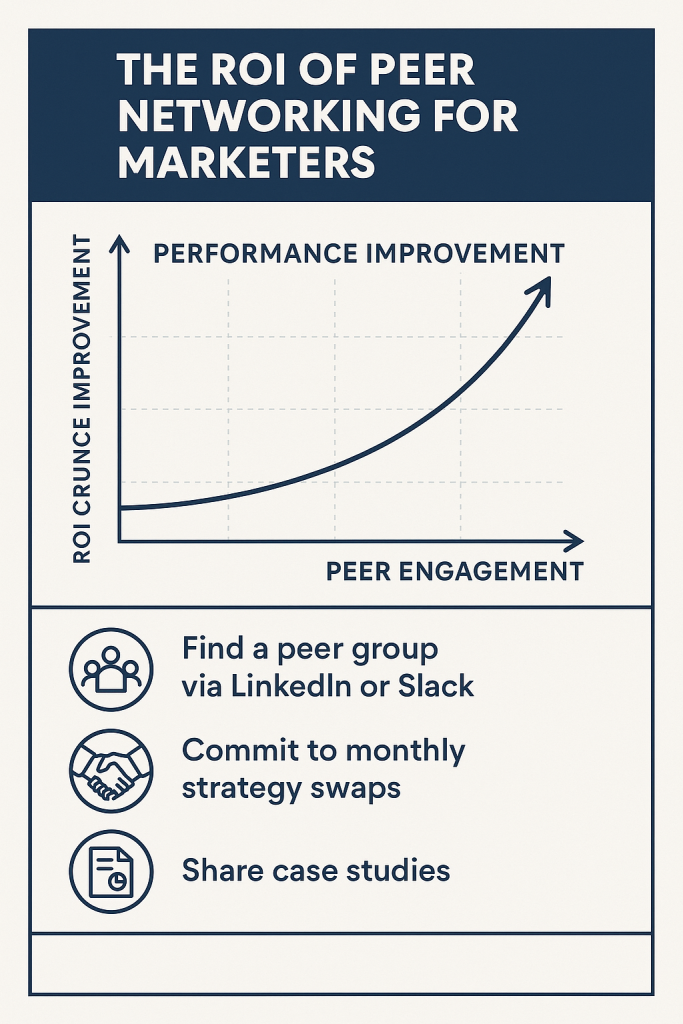
Practical Implementation — Fast-Start Checklist
Step 1: Identify and join at least one niche-specific mastermind or Slack/Discord community.
Step 2: Commit to monthly strategy swaps with peers in similar roles or markets.
Step 3: Propose a shared tool or experiment that reduces cost for all members.
Step 4: Document and share your own experiments to build reciprocity and authority.
Step 5: Maintain a rolling contact list with notes on each peer’s strengths, focus areas, and current projects.
References
- Harvard Business Review. “The Business Impact of Peer Networking.” HBR. April 2025.
- CMO Council. “Marketer Networking and Technology Adoption Report 2025.” CMO Council Research. June 2025.
- Forbes Insights. “Peer Collaboration as a Catalyst for Marketing Innovation.” Forbes. May 2025.


0 Comments