

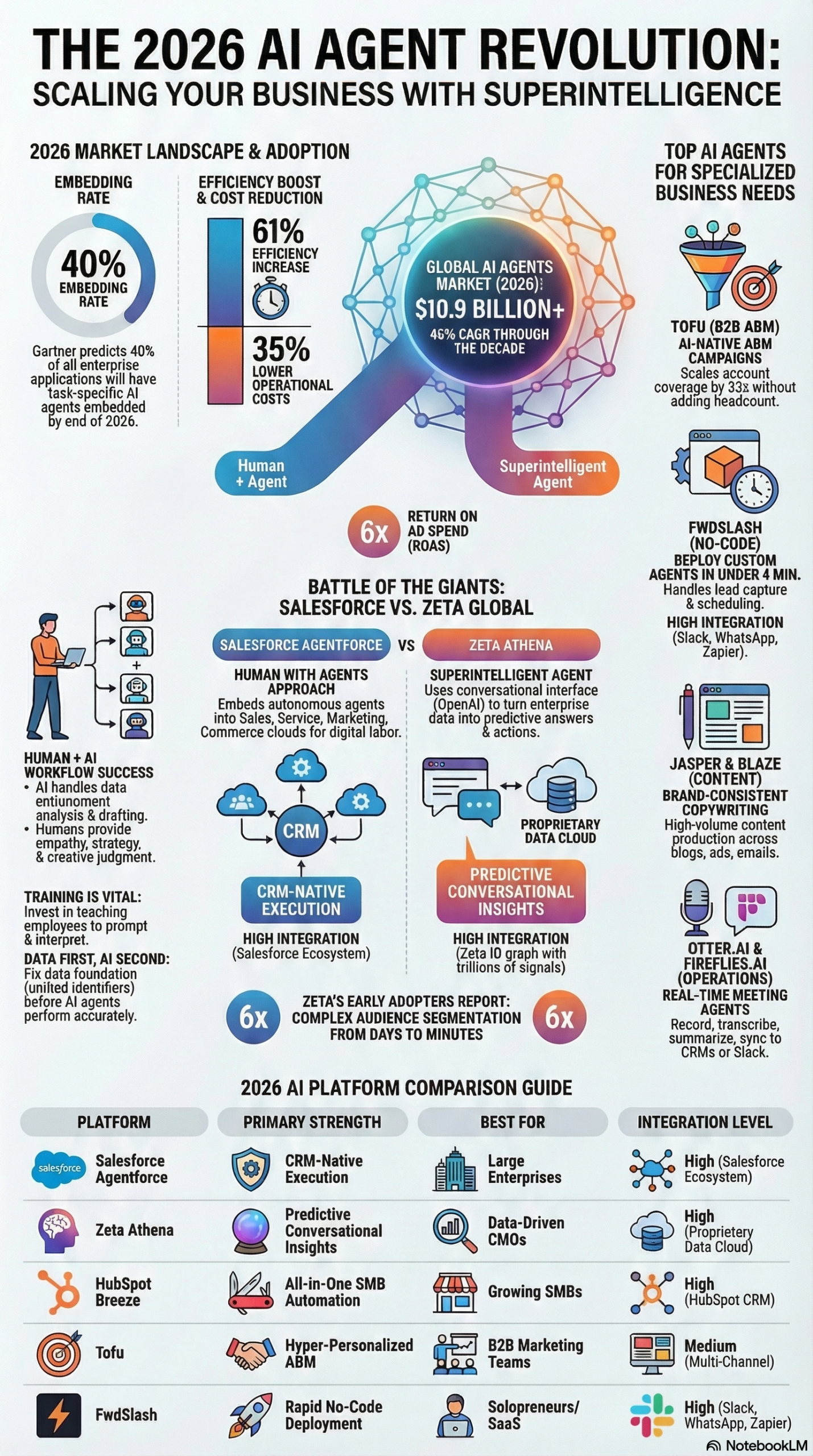
Zeta Global’s Athena platform is not another AI add-on bolted onto a legacy marketing stack — it is a ground-up redesign of how enterprise marketing systems ingest data, reason about customers, and fire coordinated actions across channels. As of March 2026, the global AI agents market is projected to exceed $10.9 billion with a compound annual growth rate of approximately 46%, and platforms like Athena represent exactly where that capital is flowing. This tutorial breaks down what Athena is, how it works architecturally, and how to deploy a comparable agentic marketing workflow — whether you are running Zeta or building a similar system on another stack.
What This Is
Zeta Global launched Athena as the core intelligence layer of its marketing cloud, positioning it as the engine behind what the company calls “superintelligent marketing.” The label is deliberate: Athena is designed to move beyond the static, rules-based automation that has defined marketing technology for the past decade and replace it with a system of coordinated AI agents that reason, adapt, and execute in real time.
The platform’s architecture rests on three integrated pillars: Zeta ID, Zeta Data Cloud, and the Athena agent layer.
Zeta ID is a unified identity graph that links a customer’s interactions across mobile, web, email, and other touchpoints into a single persistent profile. Historically, stitching identity across channels was a multi-vendor, multi-quarter implementation project. Zeta has integrated this stitching into the system architecture itself, making it a pre-built capability rather than a custom engineering effort. As Zeta Global CTO Christian Monberg put it: “The shift now is toward a fully customer-centric model, where every signal feeds a single intelligence layer.”
Zeta Data Cloud is the behavioral, transactional, and engagement data layer that feeds Athena. Instead of pulling reports reactively, the Data Cloud continuously ingests signals and pipes them into the agent layer for real-time analysis. This is the component that enables Athena to anticipate customer behavior rather than respond to it after the fact. Zack Gharib, President of Red Roof and an early Athena adopter, described the operational difference clearly: “Instead of reacting to what already happened, we now have predictive insight that helps us anticipate opportunities.”
The Athena agent layer is a suite of specialized AI agents that operate through coordinated workflows rather than as isolated tools. According to Martech.org, these agents include:
- Audience Builder Agent — Constructs customer segments based on behavioral signals and predictive models
- RFM Reporting Agent — Analyzes recency, frequency, and monetary value across the customer base
- Email QA Agent — Tests campaigns for deliverability, rendering, and compliance issues before launch
- Insight Studio Agent — Enables natural-language, conversational queries against campaign and customer data
- Narrative Slide Agent — Converts raw campaign performance data into formatted, presentation-ready materials
The critical distinction from traditional automation is that these agents do not operate on static “if-then” logic. They use large language model (LLM) reasoning to handle judgment calls — tasks that previously required a human analyst to review a report, decide on a segment adjustment, and manually update a campaign. In Athena’s model, the agent layer handles that loop autonomously, triggering messages across email, SMS, push, and in-app channels based on anticipated customer actions rather than past behavior.
This represents the architectural shift the research report identifies as the defining characteristic of 2026 marketing platforms: the transition from AI automation (predefined, rigid workflows) to AI agents (autonomous systems that adapt to new inputs and coordinate across channels in real time).
Why It Matters
The gap between where AI marketing capability sits and where most organizations are actually deploying it is staggering. According to the 2026 AI Agent and Marketing Automation Briefing, 70% of e-commerce brands say optimizing marketing spend is a top priority — yet only 8% currently use AI for campaign optimization. The bottleneck is not ambition; it is fragmented data infrastructure.
Athena matters because it addresses the structural problem rather than adding another point solution. Most enterprise marketing stacks in 2025 and early 2026 were a patchwork of specialized tools: a CDP here, an email service provider there, a separate analytics platform, a bid management tool, and an attribution model that never quite agreed with the rest of the stack. Every transition between tools was a point of context loss — a place where a customer signal got dropped, a decision got delayed, or a human had to manually reconcile outputs.
Athena’s design philosophy eliminates those handoff points. By keeping customer data (Zeta Data Cloud), decision logic (Athena agents), and message execution (cross-channel delivery) inside a single system, the platform solves what practitioners know as the “last mile” problem: the delay between generating an insight and acting on it. For enterprise CMOs running omnichannel programs at scale, that delay is measured in campaign cycles, missed moments, and budget waste.
For practitioners evaluating platforms, the implications are specific:
- For marketing operations teams: Agentic workflows reduce manual campaign QA, reporting assembly, and segment creation — tasks that typically consume 30–50% of a marketing ops analyst’s week.
- For data and analytics teams: A unified identity graph means no more cross-referencing three different customer ID schemas to build a cohort. The stitching is pre-done.
- For CMOs and marketing leadership: Predictive modeling that runs continuously against live behavioral data replaces the quarterly analysis cycle. Decisions get made on current signals, not last quarter’s data.
- For agencies managing enterprise accounts: A single system with native agent orchestration reduces the coordination overhead of managing multi-channel programs across disconnected tools.
What makes Athena distinct from alternatives like Salesforce Agentforce or HubSpot Breeze AI is the depth of the underlying data asset. Zeta’s Data Cloud is the foundation, and it is what justifies the “superintelligent” positioning — the agents are only as good as the data they reason over.
The Data
The 2026 AI marketing agent landscape has stratified quickly into platform tiers based on target audience, data depth, and deployment complexity. Here is how the major platforms compare based on research from the 2026 AI Agent and Marketing Automation Briefing:
| Platform | Primary Use Case | Key Differentiator | Deployment Speed | Target Audience |
|---|---|---|---|---|
| Zeta Global (Athena) | Omnichannel Marketing | Unified Zeta ID + Data Cloud; predictive agentic decisions | Enterprise implementation timeline | Enterprise CMOs |
| Salesforce (Agentforce) | CRM-Integrated Customer Experience | Deep Salesforce ecosystem integration; handles sales outreach and service autonomously | Weeks–months; $50K–$200K implementation | Salesforce-invested Enterprises |
| FwdSlash | Fast No-Code Agent Deployment | Connects to PDFs, Google Docs, and knowledge bases in under 4 minutes | Under 4 minutes | SMBs and Startups |
| Tofu | B2B/ABM Campaign Orchestration | Content generation + multi-channel orchestration; 8x faster execution | Days | B2B Marketing Teams |
| HubSpot (Breeze AI) | SMB Automation | Built-in social, content, and prospecting agents inside HubSpot CRM | Hours | HubSpot Users |
| SuperAGI | Omnichannel Personalization | Multi-channel customer experience focus; personalized content at scale | Days–weeks | Enterprise Brands |
Key market context from the research briefing:
– Global AI agents market: projected to exceed $10.9 billion in 2026
– Market CAGR: approximately 46%
– Brands citing insufficient technical infrastructure as a barrier to AI adoption: 30%
– Brands using AI for campaign optimization despite it being a priority: 8%
– Salesforce Marketing Cloud full implementation cost range: $50,000–$200,000
Step-by-Step Tutorial: Deploying an Agentic Marketing Workflow
This tutorial covers how to architect and activate an agentic marketing system modeled on the Athena approach. If you are a Zeta Global customer, the steps map directly to platform configuration. If you are building on an alternative stack, the same logical sequence applies — substitute your data layer, identity graph, and agent orchestration tools accordingly.
Phase 1: Prerequisites — Audit Your Data Foundation
Before a single agent runs, your data layer has to be functional. This is the step most teams skip, and it is why 30% of brands cite insufficient technical infrastructure as their primary barrier to AI adoption. No agent — not Athena, not Agentforce, not anything else — can compensate for fragmented or dirty customer data.
Step 1: Map your customer data sources.
List every system that holds customer data: your CRM, email platform, web analytics, ad platforms, e-commerce backend, support desk, and loyalty systems. For each source, document:
– What customer identifier it uses (email, phone, cookie ID, internal customer ID)
– How frequently data is updated (real-time, daily batch, weekly batch)
– Whether it has an API or export capability
Step 2: Identify your identity resolution gaps.
In most stacks, the same customer exists under three to five different identifiers across tools. A customer who purchases on desktop might be tracked under a cookie ID in your analytics platform, an email address in your ESP, and a loyalty ID in your CRM — with no automated link between them. Document every gap. This map becomes your data engineering backlog.
Step 3: Choose or validate your unified data layer.
For Zeta users, this is the Zeta Data Cloud with Zeta ID doing the stitching. For non-Zeta implementations, your options include customer data platforms (CDPs) like Segment, mParticle, or Tealium, combined with an identity resolution service. The goal is a single customer profile that aggregates signals from all sources into one record with a persistent ID.
Step 4: Clean and validate the unified dataset.
Run data quality checks: deduplication, email/phone validation, recency scoring. Segments built on stale or duplicate records produce incorrect predictions and waste budget. This is not glamorous work, but it is the precondition for everything that follows.
Phase 2: Define Your Agent Use Cases
Agents should be scoped to specific, high-value workflows — not deployed as general-purpose chatbots. Athena’s agent architecture illustrates the right approach: each agent (Audience Builder, RFM Reporting, Email QA, Insight Studio, Narrative Slide) has a defined scope and a specific trigger condition.
Step 5: Audit your repetitive marketing workflows.
Walk through your team’s weekly task list and flag every task that is:
– Rules-based (if this happens, do that)
– Repetitive (done weekly or more frequently)
– Data-dependent (requires pulling a report before making a decision)
– Low-judgment (the decision criteria are well understood and consistent)
These are your prime agent candidates. Common examples include: lead scoring updates, list segmentation refreshes, A/B test result analysis, campaign performance summaries, and pre-send QA checklists.
Step 6: Prioritize by ROI impact.
Not all repetitive tasks are equally valuable to automate. Rank your candidates by:
– Time currently spent (hours per week)
– Error rate under manual execution
– Revenue impact of faster or more accurate execution
Start with the highest-ranked three workflows. Do not try to automate everything in the first deployment.
Phase 3: Configure Your Agents
Step 7: For Zeta Athena users — activate and configure agents.
Inside the Athena interface, each specialized agent is configurable through workflow definitions. For the Audience Builder Agent:
– Define segment logic (behavioral triggers, RFM thresholds, predictive propensity scores)
– Set refresh frequency (real-time, hourly, daily)
– Connect segment output to downstream execution channels (email, SMS, push)
For the Email QA Agent:
– Define your QA checklist (rendering tests across clients, link validation, subject line compliance, unsubscribe link verification)
– Configure pre-send gate logic (campaigns cannot deploy without QA agent sign-off)
– Set escalation rules for failed checks (notify the campaign manager, hold for manual review)
Step 8: For non-Zeta implementations — select your agent orchestration layer.
If you are not running Zeta, you have several options depending on your existing stack:
- Salesforce Agentforce if you are Salesforce-native and want deeply integrated CRM agents
- HubSpot Breeze AI if you are a HubSpot user who needs built-in social, content, and prospecting agents without a separate implementation
- Tofu if you run B2B/ABM campaigns and need content generation plus multi-channel orchestration — the platform delivers 8x faster campaign execution compared to manual processes
- FwdSlash if you are an SMB that needs an agent deployed in under four minutes and needs to connect it to existing knowledge bases (PDFs, Google Docs) without technical overhead
Step 9: Define triggers and handoff logic.
Every agent needs clear trigger conditions (what event activates it) and handoff logic (what happens when the agent completes its task). For example:
TRIGGER: Customer makes a purchase AND has not received a cross-sell email in 30 days
AGENT ACTION: Audience Builder Agent creates micro-segment; Insight Studio Agent pulls top cross-sell SKUs based on purchase history
HANDOFF: Auto-populate campaign template with personalized product recommendations; route to Email QA Agent
QA GATE: Email QA Agent validates rendering, links, unsubscribe functionality
EXECUTION: On QA pass, deploy within 2-hour send window
Document this logic in plain language before touching any platform configuration. The clearer the workflow spec, the cleaner the implementation.
Phase 4: Connect to Execution Channels
Step 10: Map agents to channel execution.
Athena triggers messages across email, SMS, push, and in-app channels. For each agent workflow you have configured, explicitly connect the output to a channel execution layer. This means:
– Verifying API connections between your agent orchestration layer and your ESP, SMS gateway, and push notification service
– Testing message passing in a staging environment before production deployment
– Confirming suppression lists are respected by the agent (do not let an autonomous agent mail opted-out contacts)
Step 11: Set frequency caps and guardrails.
Autonomous agents that fire without guardrails will over-message customers. Set hard limits:
– Maximum contact frequency per customer per channel per week
– Exclusion rules for customers in active service escalations or recent purchasers
– Revenue floor for triggered spend (do not fire an expensive SMS on a $2 product conversion)
Phase 5: Measure and Iterate
Step 12: Define your measurement framework before launch.
Zeta emphasizes deterministic cross-channel measurement — linking AI decisions directly to revenue rather than relying on probabilistic attribution. Set up:
– Control groups (customers who receive agent-triggered communications vs. those who do not)
– Revenue attribution windows aligned to your sales cycle
– Agent-specific KPIs: time to segment creation, QA pass rate, open rates on predictive vs. static segments
Step 13: Run a pilot before full-scale deployment.
The research briefing recommends starting with pilot programs on high-impact use cases — 1:1 ABM campaigns, automated event follow-ups, or post-purchase cross-sell sequences — before replacing your entire marketing workflow with agent automation. A pilot lets you validate agent output quality, catch edge cases, and build internal confidence before expanding scope.
Expected Outcomes:
When configured correctly, agentic marketing workflows produce: faster time-to-segment (hours instead of days), higher campaign personalization at scale, reduced manual QA time, and measurable lift in engagement and conversion rates on agent-triggered campaigns versus static, batch-send alternatives.
Real-World Use Cases
Use Case 1: Hotel Chain Predictive Revenue Optimization
Scenario: A hotel brand with dozens of properties wants to shift from post-stay email campaigns to predictive pre-stay upsell sequences.
Implementation: Using Zeta Athena, the brand deploys the Audience Builder Agent to identify guests with high upgrade propensity based on past booking behavior, check-in timing, and room type history. The agent creates micro-segments 72 hours before check-in and triggers personalized upgrade offers via email and push. Red Roof’s experience with Athena demonstrates this model: President Zack Gharib noted the shift from “reacting to what already happened” to having “predictive insight that helps us anticipate opportunities”.
Expected Outcome: Higher ancillary revenue per stay, reduced reliance on manual segment builds, and real-time adjustment of offer thresholds based on occupancy signals.
Use Case 2: B2B SaaS ABM at Scale Using Tofu
Scenario: A B2B software company with a 5-person marketing team needs to run account-based marketing campaigns across 200 target accounts without adding headcount.
Implementation: The team deploys Tofu for content generation and multi-channel orchestration. Tofu’s agent layer auto-generates personalized landing pages, email sequences, and LinkedIn ad variants for each target account, pulling from a central content brief and account intelligence data. Campaign execution runs 8x faster than the manual equivalent.
Expected Outcome: Full ABM coverage across all 200 accounts with a team that previously could only manage 25–30 accounts manually, with consistent messaging fidelity across channels.
Use Case 3: SMB Retail Agent Deployment via FwdSlash
Scenario: A specialty e-commerce retailer with two marketing staff members wants AI-powered customer service and product recommendation capabilities without hiring a developer.
Implementation: The team deploys FwdSlash by connecting the platform to their product catalog (PDF), FAQ document (Google Docs), and Shopify order data. The agent is live in under four minutes, handling customer inquiries, generating personalized product recommendations, and routing complex issues to the human team.
Expected Outcome: Reduced customer service response time, higher average order value through recommendation-driven upsells, and human staff freed to focus on merchandising and supplier relationships.
Use Case 4: Enterprise CRM Agent Deployment via Salesforce Agentforce
Scenario: A financial services firm running Salesforce CRM needs to automate lead qualification and initial outreach for a 50-person sales team.
Implementation: Salesforce Agentforce is deployed within the existing Salesforce environment. The agent automatically scores incoming leads against a trained propensity model, drafts personalized initial outreach emails based on lead attributes, and schedules follow-up tasks for sales reps. Implementation costs range from $50,000 to $200,000 depending on customization depth, but the TCO is offset by reduced SDR headcount and faster pipeline velocity.
Expected Outcome: Faster lead response times, consistent outreach quality across the sales team, and sales reps focused on high-propensity accounts rather than manual triage.
Use Case 5: Generative Engine Optimization (GEO) Content Strategy
Scenario: A marketing agency wants to ensure its clients’ content is being discovered by AI agents and LLMs that are increasingly mediating search, not just by traditional search crawlers.
Implementation: The agency restructures content production around Generative Engine Optimization (GEO) principles — writing content in formats that LLMs can easily parse and cite, including structured data markup, clear definitional sections, and direct answers to long-tail queries. AI agents are used to generate content briefs, draft structured FAQ sections, and audit existing content for GEO compliance.
Expected Outcome: Improved discoverability in AI-generated search summaries, higher organic visibility as LLM-mediated discovery grows, and a content production workflow that is 40–60% faster than traditional editorial processes.
Common Pitfalls
Pitfall 1: Deploying Agents Before Fixing the Data Layer
This is the most expensive mistake teams make. An AI agent reasoning over fragmented, duplicated, or stale customer data will produce confident-sounding outputs that are factually wrong. The research briefing is explicit: 30% of brands cite insufficient technical infrastructure as the primary barrier. Audit and unify your data layer before activating agents — not after.
Pitfall 2: Automating Everything at Once
Full-stack automation before you understand how agents behave in your specific environment is a recipe for a customer experience incident. An autonomous agent that over-messages customers or fires on a bad segment will damage email reputation, trigger unsubscribes, and erode customer trust. Start with one or two high-value, lower-risk workflows in a controlled pilot. The research briefing recommends piloting on ABM or event follow-up workflows first.
Pitfall 3: Ignoring Total Cost of Ownership
The subscription fee is the smallest part of the cost. Salesforce Marketing Cloud implementations can run $50,000 to $200,000 when you factor in professional services, data migration, custom development, and team training. Budget for the full implementation, including the potential need to add data science or marketing operations roles to manage the system post-deployment.
Pitfall 4: Skipping Frequency Cap and Guardrail Configuration
Autonomous agents do not have common sense. If you do not explicitly configure suppression rules, frequency caps, and exclusion logic, the agent will maximize for the objective function you gave it — which often means over-contacting customers. Build guardrails into the configuration before any agent touches a production list.
Pitfall 5: Measuring Agents on Vanity Metrics
If you measure an AI agent purely on volume — emails sent, segments created, messages triggered — you will optimize for activity, not outcomes. Set measurement frameworks that connect agent actions to revenue, using the deterministic attribution approach that Zeta Global emphasizes. Control groups are your most honest measurement instrument.
Expert Tips
1. Use the RFM Agent as Your Segmentation Baseline
Before deploying any predictive model, run an RFM (Recency, Frequency, Monetary) analysis on your full customer database. Athena’s RFM Reporting Agent does this automatically, but even if you are not on Zeta, RFM is the fastest way to identify your highest-value segments and your highest-risk churn segments. Use those outputs to prioritize which agent workflows to build first.
2. Treat the Insight Studio Agent as Your Analyst On-Call
Athena’s Insight Studio Agent supports conversational, natural-language queries against your campaign and customer data. The practical implication: when a campaign manager asks “why did our Monday send underperform last week,” they should get an immediate, data-backed answer without waiting for an analyst to pull a report. Train your team to use conversational querying as their default interface — it dramatically shortens the insight-to-action loop.
3. Build a Parallel Control Group Into Every Agent Campaign
Never run agent-triggered campaigns without a holdout group. A 10–15% holdout receiving the standard, non-agent treatment gives you a clean baseline to measure lift. Without it, you cannot distinguish agent performance from external factors like seasonality or product changes.
4. Optimize Content for GEO, Not Just SEO
As the research briefing notes, traditional keyword strategies are becoming obsolete as LLMs mediate more search discovery. Structured your content with explicit definitional sections (what is X?), step-by-step procedural blocks, and FAQ formats. These formats are more likely to be cited by AI-generated answers — your new “rank one.”
5. Evaluate Platform Fit on Data Depth, Not Feature Count
Every platform in the comparison table has a long feature list. The differentiator is data depth. Zeta’s advantage is its Data Cloud — the breadth and quality of the behavioral and identity data the agents reason over. When evaluating any agentic marketing platform, ask: what data does the agent have access to, and how fresh is it? A weak data layer cannot be compensated for by a sophisticated agent layer.
FAQ
Q: What makes Athena different from standard marketing automation platforms?
Standard marketing automation executes predefined “if-then” rules. Athena’s agents use LLM reasoning to handle judgment calls — dynamic segmentation adjustments, predictive message timing, and multi-channel coordination — without requiring a human to review and approve every decision. The key structural difference is autonomy: agents adapt to new inputs in real time rather than executing static logic. (Martech.org, research briefing)
Q: Do you need to be an enterprise with a massive data team to use Athena?
Athena is positioned for enterprise CMOs and requires enterprise-level implementation. However, the broader shift toward agentic marketing is accessible at every business size. Platforms like FwdSlash allow SMBs to deploy functional AI agents in under four minutes with no technical overhead. The right platform depends on your data maturity, team size, and budget — not just your ambition.
Q: How long does it take to deploy Zeta Athena?
Zeta has not published a standard implementation timeline, which reflects the reality that enterprise martech deployments are highly dependent on data complexity, integration depth, and organizational readiness. By contrast, Salesforce Agentforce implementations typically run weeks to months and cost $50,000–$200,000. Factor in data unification work, which often takes longer than the platform implementation itself.
Q: What happens if the AI agent makes a wrong prediction?
This is why control groups, frequency caps, and escalation rules are non-negotiable configuration steps. An agent that fires on a bad prediction will send an irrelevant message to a segment that should not have received it. The revenue damage from a single misfired campaign is usually recoverable. The reputational damage from systematically over-messaging customers — because guardrails were not configured — is significantly harder to recover from. Build the safety rails before you turn the agents loose.
Q: Is Zeta Athena the right choice if we are already in the Salesforce ecosystem?
Probably not your first choice. The research briefing is clear that ecosystem fit is a primary selection criterion: Salesforce Agentforce is the logical choice for Salesforce-invested enterprises because the integration depth reduces implementation friction and keeps customer data inside the existing stack. The switching costs of moving data and workflows out of Salesforce to a different platform usually outweigh Athena’s feature advantages for teams that are deeply embedded in the Salesforce ecosystem.
Bottom Line
Zeta’s Athena platform represents one of the clearest examples of where enterprise marketing infrastructure is heading: unified data, unified identity, and a coordinated agent layer that reduces the gap between insight and execution to near-zero. The 10.9 billion dollar AI agents market and its 46% CAGR are not driven by hype — they reflect real operational demand from marketing teams that are drowning in data and starving for autonomous decision-making capability. The organizations that will win in this environment are not the ones with the most sophisticated agents; they are the ones who built the cleanest data foundation before they deployed them. Start there, run controlled pilots on your highest-impact workflows, measure with deterministic attribution, and expand only when you have evidence of lift. The technology is ready — the question is whether your data layer is.


0 Comments