

Keyword cannibalization is one of the most common—and most quietly damaging—SEO mistakes you can make on a growing site. When multiple pages on your domain compete for the same keyword and the same search intent, you split ranking power, confuse crawlers, and hand your competitors the authority you should be consolidating. This tutorial walks you through exactly how to detect, diagnose, and fix cannibalization using manual GSC methods, purpose-built AI tools, and a prevention workflow that stops recurrence before it starts.
What Keyword Cannibalization Actually Is
According to Neil Patel, keyword cannibalization occurs when multiple pages on a single domain target the same keyword and—critically—the same search intent. That second part is what most definitions miss, and it’s the distinction that determines whether you actually have a problem or just healthy SERP coverage.
You can have two pages both optimized for “email marketing software” without cannibalization, if one targets informational intent (a comparison guide for buyers evaluating options) and the other targets transactional intent (a product landing page for users ready to sign up). The problem emerges when both pages try to answer the same question for the same type of searcher. At that point, they stop cooperating and start competing.
The MarketingAgent research report frames it this way: “Keyword cannibalization is like a soccer team where players are fighting to score with the same ball instead of working together to win against the opponent.” Instead of your pages collaborating to dominate more SERP positions, they compete against each other—and both lose ground.
Here’s what is happening under the hood when two pages cannibalize:
Crawl budget fragmentation: Google’s Googlebot has a finite crawl budget for every site. When it encounters multiple pages with similar content and signals, it has to decide which one to prioritize. Often, neither gets a full, high-frequency crawl, which means slower indexing of updates and missed ranking opportunities.
Backlink equity dilution: If you’ve earned 15 backlinks to your “best project management software” guide and another 10 to a redundant listicle targeting the same term, that combined link authority is diluted across two underperforming pages instead of concentrated in one dominant one. You could be ranking in the top three with a single consolidated page, but instead you’re holding positions 7 and 11 with two fragmented ones.
Ranking instability: Search engines rotate between cannibalized pages in the SERPs, which makes your rankings fluctuate unpredictably. Positions that appear to be an algorithm sensitivity issue are often just Google’s indecision about which page deserves to be shown. The volatility resolves once you eliminate the internal competition.
Click-through fragmentation: Even when two cannibalized pages both appear in the top ten, they split CTR between them. Neither accumulates the engagement signals—dwell time, click-through rate, return visits—needed to rise further. Both pages get penalized by their own performance data.
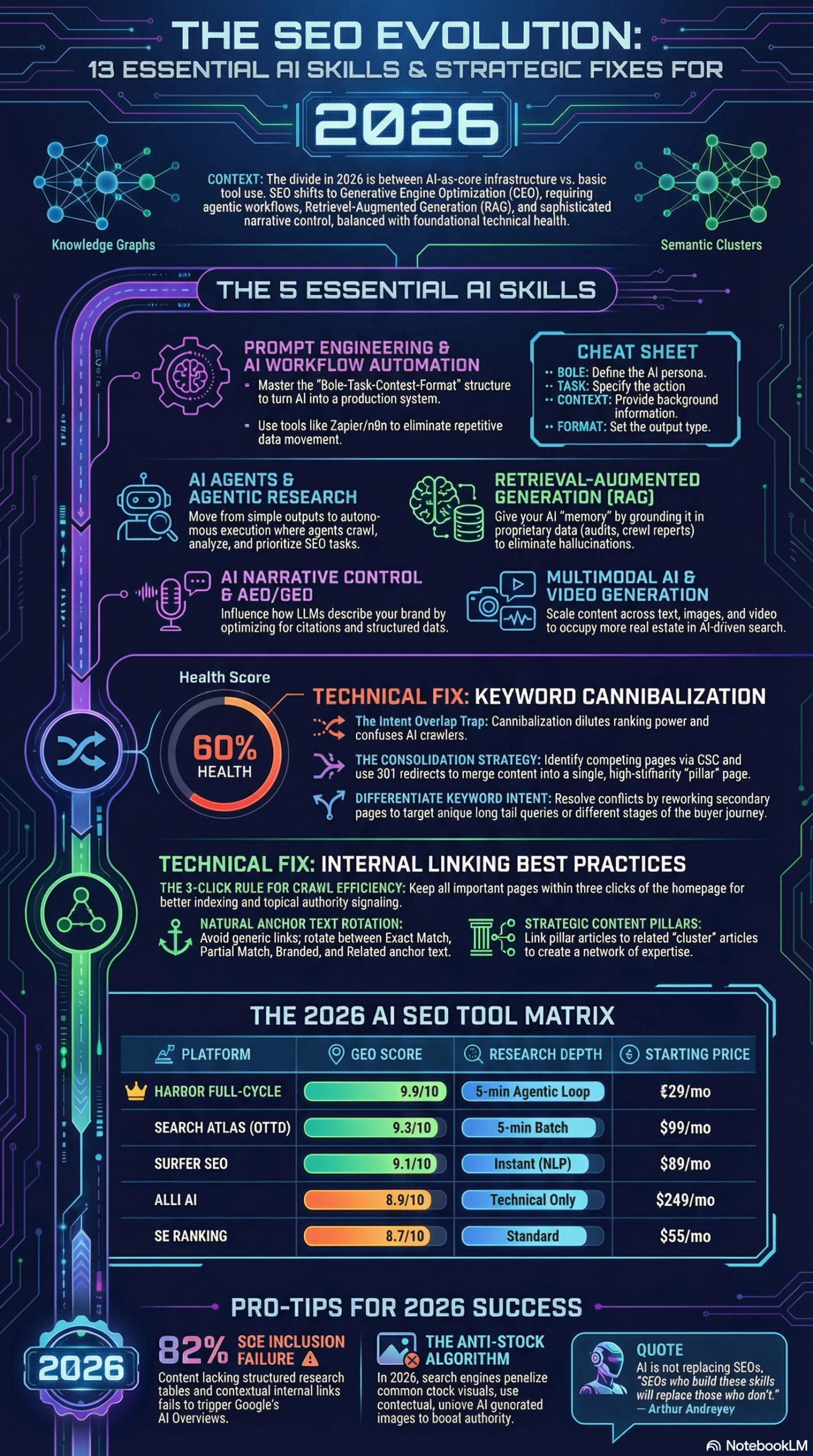
The 2026 shift to Generative Engine Optimization (GEO) dramatically raises the cost of ignoring this problem. According to the MarketingAgent research report, content that lacks structured research tables and contextual internal links fails to trigger AI Overviews 82% of the time. When your topical authority is diluted across competing pages, AI systems like Google AI Overviews, ChatGPT search, and Perplexity cannot identify your canonical source on a subject—which means you get excluded from the citation economy entirely, regardless of the quality of your individual posts.
Cannibalization typically surfaces in five recognizable patterns:
- Duplicate targeting: Multiple blog posts all optimized for the exact same keyword and intent (e.g., three separate “Mailchimp tutorial” posts published over three years)
- Blog vs. landing page conflict: A product page and a blog post both fighting for the same transactional term
- Category/post overlap: A category archive page absorbing impressions that should belong to a specific pillar post
- Tag page competition: WordPress tag archives indexing and ranking against their parent posts
- Outdated vs. updated content: A 2022 post and a 2025 update targeting identical queries with no redirect or consolidation in place
Understanding which pattern you are dealing with determines which resolution strategy applies—and getting that diagnosis right is the entire difference between a fix that compounds over time and one that creates new problems.
Why It Matters for Practitioners in 2026
Keyword cannibalization has always been a technical SEO concern, but the stakes have materially increased in 2026 for two specific reasons that practitioners need to understand.
First, the transition from traditional SEO to GEO and AEO means that AI search systems—not just traditional ranking algorithms—now make citation decisions about your site. If you have three pages competing for “marketing automation workflows,” an AI engine can only select one to reference as its source. The others disappear from the answer entirely, regardless of traffic history or domain authority. You are no longer just competing for SERP positions; you are competing to be the single page on your domain that AI systems associate with each topic.
Second, AI-assisted content production has accelerated the rate at which cannibalization accumulates. Organizations using AI writing pipelines can publish dozens of posts per week, each slightly adjacent to existing content. Without systematic monitoring, you can rapidly build a large site where a significant portion of your published content is actively suppressing your rankings rather than reinforcing them. The research report notes that “shallow research equals generic content,” while “agentic research equals authoritative content”—the same principle applies to structural hygiene. Shallow keyword planning creates cannibalization; systematic planning prevents it.
The practitioners who face the highest exposure are:
- Content-heavy B2B sites with large archives that have accumulated similar posts across multiple years and writing teams
- E-commerce platforms where product, category, and editorial content all converge on purchase-intent queries
- Digital agencies managing multi-client portfolios who need repeatable auditing processes that scale across accounts
- AI-assisted publishing operations producing high content volume without integrated deduplication workflows
What distinguishes cannibalization fixes from standard on-page SEO is that the solution is architectural, not cosmetic. You are not just updating a title tag or adding a paragraph—you are restructuring page relationships, redirecting URL equity, and sometimes merging years of content history into a single authoritative resource. Done correctly, the payoff compounds: the consolidated page accumulates signals that neither fragmented version could achieve alone.
The Data: Detection Methods and Resolution Strategies Compared
The research report documents three primary identification methods and five resolution strategies. The choice between them depends on the severity of the cannibalization and the value of the competing pages.
Detection Methods
| Detection Method | What It Reveals | Best For |
|---|---|---|
| Google Search Console Performance Report | Multiple URLs receiving impressions for the same query | Confirmed cannibalization with real traffic and impression data |
site:domain.com "keyword" Search |
All indexed pages that mention a specific keyword phrase | Quick spot-checks; finding forgotten pages and tag archives |
&filter=0 URL Parameter Trick |
Unfiltered Google results showing all your competing pages | Identifying pages Google is actively suppressing from main results |
| Unclash AI GSC Audit | Automated cannibalization flags across all queries at scale | Large sites and agencies needing ongoing systematic monitoring |
| TrueRanker Daily Tracking | “Target URL” logic flagging when the wrong page ranks for a keyword | Sites with specific required landing pages (e.g., product pages) |
Resolution Strategies
| Resolution Strategy | When to Use It | Complexity | Risk to Existing Rankings |
|---|---|---|---|
| 301 Redirect | Clear winner exists; weaker page has limited unique value | Low | Minimal — preserves external link equity |
| Content Merging | Both pages have valuable content, backlinks, and traffic | High | Medium — requires careful consolidation and quality review |
| Canonical Tags | Must keep both URLs; want to designate a single primary | Low | Low — non-destructive; Google may override if pages differ significantly |
| Intent Differentiation | Same keyword, different buyer stages are identifiable | Medium | Low — editorial work only; no URL changes |
| Deletion + Redirect | True duplicates with no unique content or backlink value | Low | None — clean removal with redirect preserves any residual equity |
AI SEO Tools for Cannibalization Monitoring (2026)
| Tool | Core Strength | Best Platform Fit |
|---|---|---|
| Unclash AI | Specialized GSC-based cannibalization audits with automated flagging | Any GSC-connected site |
| TrueRanker | Daily rank tracking with “Target URL” cannibalization logic | Sites with defined landing page requirements |
| eesel AI | Proactive internal linking during content generation to prevent gaps | Any CMS-based workflow |
| Link Whisper | In-editor link suggestions and orphan page detection | WordPress and Shopify |
| Harbor | Autonomous “full-cycle” SEO with sitemap-aware research loops | Enterprise and agency workflows |
Source: MarketingAgent Research Report
Step-by-Step Tutorial: Auditing and Fixing Keyword Cannibalization
Prerequisites
Before you start, gather the following:
- Google Search Console access verified for your domain (at minimum, Read & Analyze permissions)
- A spreadsheet tool — Google Sheets is sufficient; Airtable works if you prefer a database view
- A crawl tool (Screaming Frog free tier handles up to 500 URLs; Sitebulb for larger sites)
- Optional: Unclash AI or TrueRanker subscription for automated flagging on large sites
Estimated time: 2-4 hours for an initial audit on a site with under 200 pages. Scale proportionally for larger sites, or use an automated tool.
Phase 1: Extract GSC Query-to-URL Data
The fastest path to confirmed cannibalization evidence starts in Google Search Console’s Performance report, where you can see exactly which URLs are receiving impressions for each query.
Step 1: Log into GSC. Navigate to Performance → Search Results. Set your date range to the past 90 days. Enable all four metric columns: Total Clicks, Total Impressions, Average CTR, Average Position.
Step 2: Click the Pages tab. Click the export button and download all page data as a CSV.
Step 3: Switch to the Queries tab. Export all query data as a separate CSV.
Step 4: Open Google Sheets. Create a new workbook. Paste your Queries data into Sheet 1. Paste Pages data into Sheet 2.
Step 5: Back in GSC, click on any high-impression query you want to investigate. Once the view is filtered to that single query, click the Pages tab in the filtered view. This reveals every URL receiving impressions for that specific query. If you see two or more URLs, you have a cannibalization signal for that query.
Step 6: Repeat for your top 50-100 queries by impression volume. Document every instance where a single query shows multiple pages. You now have your cannibalization hit list.
Phase 2: Classify Each Instance by Pattern and Severity
Finding multi-URL queries is the detection step. Classification is where you determine the right fix. Not every multi-URL query is a problem—some represent healthy SERP coverage across different intents.
Step 7: For each flagged query, open both competing URLs in separate browser tabs. Run through this diagnostic checklist:
- Do both pages target the same primary keyword in
<h1>and title tag? - Do both pages answer the same searcher question (same intent)?
- Does one page have significantly more referring domains than the other?
- Which URL holds a higher average position for the cannibalized query?
- When did each page publish? Is one a newer update meant to replace the older?
Step 8: Assign each instance to one of three action buckets:
- True Cannibalization (same keyword + same intent) → requires a structural fix
- Intent Differentiation Opportunity (same keyword + different audiences) → editorial differentiation may resolve it
- Technical Indexation Problem (tag pages, category archives stealing impressions) → technical noindex or redirect fix
Step 9: Use the &filter=0 trick to verify suppression. Search your target keyword in Google. Copy the result page URL. Append &filter=0 to the end of the URL and press Enter. Per the research report, this disables Google’s duplicate content filter and shows every page from your domain that Google is considering for that query—including ones it’s actively hiding from normal results. A second page appearing here confirms Google is aware of the competition and choosing to suppress one.
Phase 3: Run the site: Spot-Check
Step 10: For any keyword where you need a broader picture of indexed competition, run this directly in Google:
site:yourdomain.com "your target keyword phrase"
Review every result. Make note of pages you didn’t know were targeting this term—old blog posts, thin pillar drafts, archived campaign pages. These forgotten pages are often the source of persistent cannibalization that GSC data alone doesn’t surface clearly.
Step 11: For WordPress sites, specifically check tag archives:
site:yourdomain.com/tag/ "keyword"
WordPress tag pages index by default and frequently cannibalize their parent posts. If you find tag page results here, the fix is a global noindex on tag archives via your SEO plugin (Yoast, Rank Math, or All in One SEO). Navigate to SEO Settings → Taxonomies → Tags and set to noindex. This single change can resolve dozens of cannibalization instances on a tag-heavy blog.
Phase 4: Build and Prioritize Your Fix Queue
Step 12: With your classified list in hand, sort by business impact. Prioritize in this order:
- Transactional queries (commercial intent) where a blog post is outranking the intended product or service page
- High-impression queries (500+ monthly impressions) where two pages split traffic roughly evenly
- Pages with multiple referring domains where diluted link equity is provably costing rankings
- Category and tag page conflicts where technical fixes will resolve many instances simultaneously
Low-priority: queries with under 50 combined monthly impressions, or instances where one URL holds 90%+ of impressions and the second is negligible.
Phase 5: Execute the Right Fix for Each Instance
Step 13 — 301 Redirect (most common)
Use when one page clearly wins on content quality, referring domains, and relevance, and the other offers no unique value worth preserving.
In WordPress with Yoast SEO: navigate to the weaker page, go to Yoast SEO → Advanced, and use the Redirect Manager to set up a 301. Alternatively, implement directly in .htaccess:
Redirect 301 /weaker-page/ https://yourdomain.com/canonical-page/
Verify with curl:
curl -I https://yourdomain.com/weaker-page/
You should receive a 301 Moved Permanently response with the Location header pointing to your canonical URL. Update your sitemap and submit the canonical URL for re-indexing in GSC via URL Inspection.
Step 14 — Content Merging
Use when both pages have genuine unique value—original examples, data, backlinks, or traffic—that would be lost in a simple redirect.
- Identify the stronger page by referring domain count and average GSC position.
- Export all content from the weaker page into a working document.
- Review the weaker page for sections, statistics, examples, or formats not present in the stronger page.
- Integrate those unique elements into the stronger page, improving its comprehensiveness.
- Expand the merged page to be the single most thorough resource on the topic.
- 301 redirect the weaker page URL to the now-expanded canonical.
- Optionally, reach out to any referring domains linking to the old URL and request a link update to the new canonical.
Step 15 — Canonical Tags
Use when you must keep both URLs live—for example, e-commerce product variant pages (different colors, sizes, configurations)—but want to designate a primary for ranking purposes.
Add this to the <head> of all secondary variant pages:
<link rel="canonical" href="https://yourdomain.com/product/primary-version/" />
Important caveat: canonical tags are suggestions, not directives. If the secondary page differs substantially in content from the primary, Google may override the canonical and treat both as independent pages. Use content merging when the pages are meaningfully different; use canonicals only for near-identical variants.
Step 16 — Intent Differentiation
Use when two pages share a keyword but can legitimately serve different stages of the buyer journey.
- Rework the informational page to explicitly target “how to,” “what is,” and “beginner’s guide” language. Update the
<h1>, title tag, meta description, and opening paragraph to signal informational intent clearly. - Rework the transactional page to target “buy,” “pricing,” “best,” and “review” language. Make the conversion action immediately visible.
- Add a prominent internal link from the informational page to the transactional page with direct anchor text like “compare pricing” or “see all plans.” This both differentiates the pages and channels link flow from the informational resource to the conversion page.
Phase 6: Monitor and Prevent Recurrence
Step 17: Set up ongoing monitoring. TrueRanker offers daily rank tracking with “Target URL” logic: you define which page should rank for each keyword, and it alerts you when a different page hijacks that position. This makes cannibalization detection proactive rather than reactive.
Step 18: Build a keyword-to-URL canonical map as a shared document. This is a simple spreadsheet: Column A is the primary keyword, Column B is the canonical URL assigned to that keyword, Column C is the intent type (informational/transactional/navigational). Before publishing any new content, every writer and AI system must check this map first. It takes ten seconds and prevents months of cleanup.
Step 19: For AI-assisted content pipelines, integrate the canonical map as a required pre-publish check. Before any generated post goes live, cross-reference its target keyword against the canonical map and against GSC query data. If the keyword already has an assigned canonical URL, either update that existing page or deliberately differentiate the intent of the new piece and document it.
Expected Outcomes: Within 4-8 weeks of implementing 301 redirects and content merges, surviving pages typically consolidate the ranking signals previously split across two competing URLs. Pages consistently stuck at positions 8-12 often move into positions 3-6 once internal competition is eliminated and diluted link equity is concentrated. The timeline extends to 8-12 weeks on slower-crawled domains.
Real-World Use Cases
Use Case 1: The B2B SaaS Company With Years of Content Debt
Scenario: A marketing manager at a project management SaaS discovers that four separate blog posts—published in 2020, 2022, 2023, and 2025—all target “how to manage remote teams.” None rank in the top five despite the domain authority that should support it. All four split impressions nearly evenly in GSC.
Implementation: Export GSC query performance filtered to “how to manage remote teams.” Confirm all four pages appear as competing URLs. Identify the 2025 post as the structural winner: most comprehensive content, strongest internal linking, most recent publish date. Review 2020–2023 posts for unique statistics, case studies, or frameworks not covered in the 2025 piece. Integrate those unique elements into the 2025 post with proper attribution. 301 redirect the three older URLs to the 2025 post. Update the canonical map. Add the 2025 post URL to the site’s pillar page for remote work content.
Expected Outcome: Within six weeks, the 2025 post consolidates combined link equity from all four pages and moves from position 9 to position 3-4 for the target keyword. The broader cluster of remote work content gains authority by association.
Use Case 2: E-Commerce Category Page Cannibalization
Scenario: An online sporting goods retailer has both a /trail-running-shoes/ category page and a /best-trail-running-shoes-guide/ blog post competing for “best trail running shoes.” The category page should rank for transactional queries (shoppers ready to buy), but the blog post keeps absorbing those impressions instead.
Implementation: Rework the blog post’s <h1>, title tag, and opening paragraph to explicitly signal informational intent: “How to Choose Trail Running Shoes: A Fit and Terrain Guide.” Add an explicit comparison table of criteria rather than product links. Place a prominent CTA button and internal link pointing to the /trail-running-shoes/ category page with anchor text “Shop trail running shoes.” Simultaneously, enrich the category page with structured product data markup (Schema.org Product type) to reinforce its transactional purpose to Google.
Expected Outcome: Within three to six weeks, the category page reclaims transactional SERP positions for purchase-intent queries. The blog post begins ranking for informational variants it was previously losing to the category page’s weaker informational signals.
Use Case 3: The Agency Running AI Content at Scale
Scenario: A digital marketing agency deploys an AI content pipeline to publish 25-30 posts per month for a midsize client. After four months, cannibalization is widespread—dozens of posts overlap on adjacent subtopics. Organic traffic has plateaued despite substantial content investment.
Implementation: Connect the client’s GSC account to Unclash AI for an automated audit. Export the complete list of flagged cannibalization pairs, sort by impression volume, and create a tiered fix queue. Implement 301 redirects for clear-winner situations (the majority). Flag complex merges for manual review. Update the agency’s content brief workflow to include a mandatory canonical map check before any AI prompt is generated. Assign the AI pipeline a step that cross-references proposed topics against the existing canonical map before generating any draft.
Expected Outcome: Cannibalization rate drops from approximately 40% of published URLs to under 5% within two months. The consolidated authority of merged pages produces measurable ranking gains for the client’s primary commercial terms within one content cycle.
Use Case 4: WordPress Tag Pages Undermining Pillar Posts
Scenario: A popular B2B marketing blog uses WordPress with 80+ active tags. Tag archive pages for terms like “content marketing,” “social media strategy,” and “email automation” are indexing in Google and appearing ahead of the site’s actual pillar posts for those topics. The tag pages have no original content—they are just archives of posts with that tag.
Implementation: In Rank Math: navigate to Rank Math SEO → Titles & Meta → Tags. Set “Robots Meta” to noindex. Save. Submit the main pillar post URLs for re-indexing in GSC via URL Inspection. Update internal links throughout the site to point directly to pillar posts rather than linking through tag archives.
Expected Outcome: Within two GSC crawl cycles (typically 2-4 weeks), tag archive pages de-index. SERP impressions previously split between tag pages and pillar posts consolidate onto the pillar posts. CTR increases because users are landing on pages with actual content.
Common Pitfalls
Pitfall 1: Fixing Keywords Without Verifying Intent
The most expensive mistake is redirecting pages based purely on keyword overlap without confirming that both pages target identical intent. Two pages can legitimately share a keyword while serving different audiences. Merging them destroys specificity and can degrade performance for both intents. Always load both URLs, read the opening paragraph, and confirm the target searcher before choosing a resolution strategy.
Pitfall 2: Redirecting Without Updating Internal Links
A 301 redirect preserves external link equity but wastes a crawl step on every internal link still pointing to the old URL. After any redirect implementation, run a Screaming Frog crawl and use the “Inlinks” report to find all pages still linking to redirected URLs. Update those links to point directly to the canonical destination. The research report specifically notes that high-authority pages should be no more than three clicks from the homepage—redirect chains add unnecessary crawl depth.
Pitfall 3: Implementing Dozens of Redirects Simultaneously on a Large Site
Batch redirect implementations on large sites can overwhelm Googlebot’s processing queue. Stagger large redirect batches—implement the highest-priority fixes first, allow 2-3 weeks for GSC to reflect the changes, then proceed with the next tier. Monitor the GSC Coverage report for any crawl errors that emerge during implementation.
Pitfall 4: Using Canonical Tags on Substantially Different Pages
Canonical tags are intended for near-duplicate pages. If two pages share a keyword but have substantially different content, structured data, or backlink profiles, Google will frequently ignore the canonical and treat both pages as independent—which means the cannibalization continues unresolved. In those cases, intent differentiation or content merging is the appropriate fix, not a canonical tag.
Pitfall 5: Treating Cannibalization as a One-Time Audit
Auditing once and fixing once without changing the underlying content creation process guarantees the problem returns. New content published without a canonical map check will regenerate cannibalization steadily. The durable fix is a process change: mandatory pre-publish keyword deduplication for every contributor, human or AI.
Expert Tips
Tip 1: Build the Canonical Map Before You Need It
Do not wait for a cannibalization crisis to build your keyword-to-URL map. Start the map now with your existing content. A simple Google Sheet with three columns—target keyword, canonical URL, intent type—is sufficient. Populate it from your current GSC query data. From this point forward, every new content brief must reference this map before a topic is assigned. This single process change prevents most future cannibalization.
Tip 2: Use GSC’s Date Comparison to Measure Fix ROI
After implementing redirects or merges, use GSC’s built-in date comparison feature to measure the impact precisely. Set the comparison period to the 28 days before versus the 28 days after your fix. Filter to the cannibalized query. You should see clicks and impressions consolidating onto the surviving canonical page with a measurable position improvement. This data is compelling for client reporting and internal stakeholder justifications.
Tip 3: Always Prioritize Transactional Keyword Conflicts First
Informational cannibalization costs you traffic and authority. Transactional cannibalization costs you revenue. When a blog post is outranking your product page for a purchase-intent query, that fix should be at the top of your queue regardless of impression volume. Even a small improvement in transactional query rankings has direct revenue impact.
Tip 4: Use eesel AI for Proactive Internal Linking
The research report highlights that “proactive linking—building links during the content creation phase—is now a 2026 SEO best practice.” Tools like eesel AI suggest contextually relevant internal links as you write, ensuring that new posts are immediately connected to existing pillar content. Connected content is inherently less likely to cannibalize because it is structurally positioned relative to existing pages from the moment it is drafted.
Tip 5: Structure Every New Page for AI Extraction
The research report notes that content lacking structured research tables and contextual internal links fails to trigger AI Overviews 82% of the time. Starting every new page with a clear definition, a direct answer to the target query, and at least one structured data table both satisfies AI extraction requirements and naturally differentiates each page’s purpose—making accidental cannibalization far less likely because each page has a distinct structural identity.
FAQ
Q: Does keyword cannibalization affect every keyword equally?
A: No. High-competition, high-intent keywords suffer most when cannibalized because every fraction of accumulated authority matters at the top of the SERP. For low-competition, long-tail terms with minimal search volume, split authority between two pages may still be sufficient to rank both—though consolidation remains the cleaner strategy. Per Neil Patel, focus your audit energy on commercial and high-traffic queries first, then address long-tail overlaps in a second pass.
Q: Can two pages rank simultaneously for the same keyword without it being a problem?
A: Yes. When two pages from the same domain rank for the same query while serving genuinely different intents—one informational, one transactional—that is healthy SERP coverage. The problem is when Google cannot decide which page to show and ranks neither strongly. The diagnostic test is intent: if you can clearly define different target audiences or buyer stages for each page, they can coexist. If both pages are targeting the same question for the same searcher, that is cannibalization.
Q: How long does it take for Google to process a 301 redirect fix?
A: Typically 2-8 weeks depending on your domain’s crawl frequency and domain authority. High-authority sites with frequent crawling see ranking changes in 2-3 weeks. For slower-crawled sites, 6-8 weeks is more realistic. Use the GSC URL Inspection tool immediately after implementing the redirect to request indexing of the canonical URL—this accelerates the process. Do not measure results until at least 28 days have passed.
Q: What if both of my cannibalized pages have strong, distinct backlink profiles?
A: Content merging is almost always the right call. By consolidating both pages’ content and 301 redirecting the weaker URL to the merged canonical, you aggregate both backlink profiles onto a single page—which becomes dramatically stronger than either was independently. Reach out to sites linking to the old URL to request a direct link update where possible; even if only a fraction respond, the direct link equity is marginally more powerful than redirected equity.
Q: Are AI SEO tools like Unclash AI and TrueRanker actually reliable for cannibalization detection?
A: For GSC-connected sites, yes—they are more reliable than manual audits at scale because they analyze actual ranking and impression data rather than content similarity heuristics. Per the research report, Unclash AI is specifically designed for GSC-based cannibalization audits, while TrueRanker’s “Target URL” logic catches instances where the wrong page ranks rather than just where multiple pages rank. Generic AI writing tools are not cannibalization detection tools—use purpose-built products for this function.
Bottom Line
Keyword cannibalization is not a minor SEO nuisance—it is a structural issue that actively fragments your authority, destabilizes your rankings, and makes your site invisible in the AI citation economy that defines search visibility in 2026. The fix framework is direct: pull GSC data, identify multi-URL queries, classify by intent pattern, and apply the right resolution—redirect, merge, canonical, or differentiation. As the research report makes clear, AI search systems can only cite one source per topic per domain, which means sites with unresolved cannibalization are structurally excluded from AI Overviews and LLM citations regardless of content quality. Build your canonical keyword map now, integrate a pre-publish deduplication check into every content workflow, and treat cannibalization prevention as a standing operational requirement rather than a periodic cleanup task. The sites that compound authority fastest in 2026 are the ones that treat every published URL as a deliberate strategic asset with a defined role—not a piece of content competing against its own siblings.


0 Comments