

Instagram has completed its transformation from a photo-sharing app into what Sprout Social describes as “a fully functional revenue engine, a customer care hub and the modern equivalent of a storefront window.” With over 3 billion users and a global social commerce market valued at $2.11 trillion, the platform is now the primary battleground for small businesses competing for Gen Z and Millennial buyers—where direct purchase rates have climbed to 49%. This guide breaks down exactly how to build a sustainable Instagram strategy that generates measurable revenue, not just likes.
What This Is: Instagram in 2026 Is an AI-First Recommendation Engine
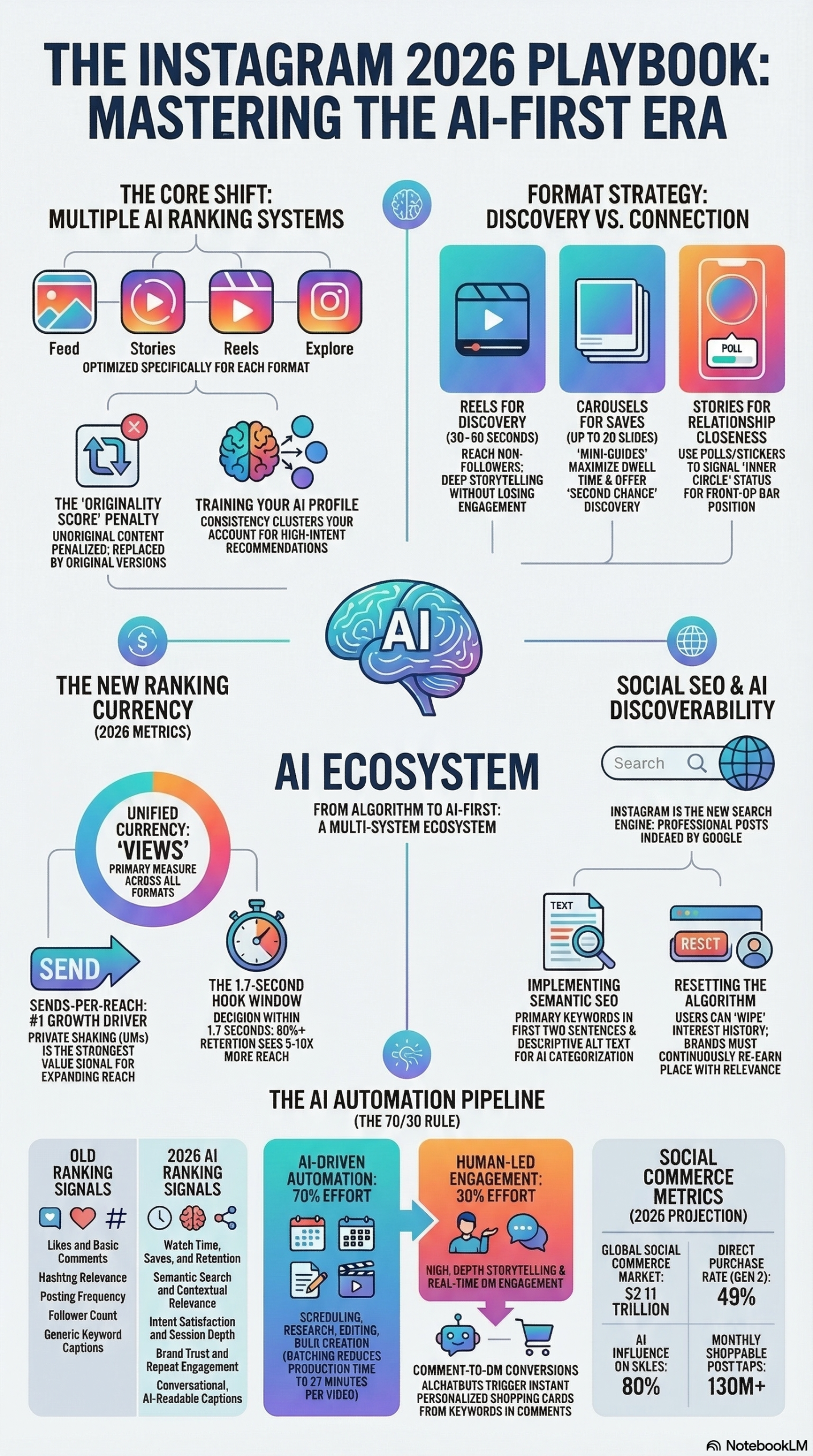
The Instagram you learned to use in 2020 no longer exists. According to the NotebookLM research briefing, the platform now operates as an AI-first recommendation engine functioning as a “personal superintelligence”—a system that no longer simply shows users content from accounts they already follow. Instead, it actively predicts and surfaces content from anywhere on the platform that matches a user’s inferred interests, behavior patterns, and purchase intent.
This architectural shift has three major implications for small business operators.
First: the algorithm is now multi-system, not monolithic. Instagram runs separate AI ranking systems for each surface—Feed, Stories, Explore, and Reels—each optimized for different user behaviors and relationships. Your content doesn’t compete on one playing field; it competes across four distinct environments, each with its own ranking logic. According to the research report:
- Feed prioritizes content from close connections, ranking by interaction history, relevance, and recency
- Stories emphasizes relationship strength, fast-tracking accounts in a user’s “inner circle” or those they DM frequently
- Explore surfaces content from non-followed accounts by analyzing past engagement and similar-user behavior patterns
- Reels focuses purely on entertainment value, predicted watch time, and completion rates
Second: the primary metric has unified to “Views.” All content formats now compete under the same primary metric. This sounds like a simplification, but what it actually means is that reach is now directly tied to whether people watch—not whether they tap a heart. Engagement still matters, but watch-based signals carry substantially more weight than reaction counts.
Third: you are now teaching the AI, not hacking an algorithm. The old playbook of chasing virality through trending audio or optimal posting windows alone is largely obsolete. The 2026 approach, per the research briefing, is to train the platform’s recommendation systems to understand exactly who your audience is—by consistently producing content that earns the signals the AI weights most: watch time, DM shares, and saves.
For a small business, this means Instagram is no longer a distribution channel you optimize for—it’s a system you build a relationship with over time. Your content is essentially a training dataset for an AI that decides whether your next post reaches 400 people or 40,000. Understanding this reframe is the prerequisite for everything else in this guide.
Sprout Social documents this clearly: the “5 Whys” framework connects social activity to bottom-line impact—followers grow → visibility increases → brand trust builds → conversion rates rise → revenue grows. That chain only holds if each link is deliberately constructed, which is what this tutorial teaches you to do.
Why It Matters: Revenue Engine, Not Mood Board
The stakes for getting this right—or wrong—are higher than most small business owners recognize. The global social commerce market is currently valued at $2.11 trillion, and Instagram sits at the center of that spending. Among Gen Z and Millennial consumers, direct purchase rates on the platform have surged to 49%, per the research report. Nearly half of the most commercially valuable consumer demographic now buys directly through Instagram without ever leaving the app.
For practitioners, this creates a concrete opportunity that didn’t exist a few years ago: you can run a complete acquisition funnel—awareness, consideration, purchase, and post-purchase nurture—entirely inside one platform. Sprout Social documents real brands that have already built exactly this:
- Glossier scaled their beauty brand by systematically prioritizing user-generated content (UGC), turning customers into a distributed content creation network
- Frank Body built a cult following through a distinctive brand voice and direct-response copy—not ad spend
- Fishwife (premium seafood) used bold visuals and culture-first positioning to dominate their category on Instagram before their category was even well-defined
- Partake Foods (allergen-free snacks) built community trust through mission-driven content, converting a dietary restriction into a brand identity
What makes 2026 different from prior years is the accessibility of the tooling. AI-powered scheduling, caption generation, auto-publishing, and intent-based DM automation are now available to solo operators and small teams. The research report frames this as the 70:30 rule: operate 70% AI-driven (mechanical tasks, scheduling, hashtag research, bulk content production) and 30% human-led (storytelling, community engagement, and editorial judgment). This balance lets a two-person team produce content at a volume and consistency that previously required a full agency retainer.
The cost of inaction is concrete. The research report identifies 3–5 Reels per week as the minimum effective posting frequency. Falling below that threshold limits algorithmic distribution before audience size or engagement history even factor in. Inconsistency signals to the AI that your account is low-priority—and the AI responds by deprioritizing your distribution accordingly.
The Data: 2026 Instagram Engagement Benchmarks
Understanding which content format actually performs is the foundation of smart resource allocation. The research report documents clear performance differentiation across Instagram’s primary content formats:
| Content Format | Avg. Engagement Rate | Discovery Potential | Primary Algorithmic Signal | Best Use Case |
|---|---|---|---|---|
| Carousels | 10.15% | Medium | Saves, dwell time | Education, tutorials, product showcases |
| Single Images | 7.00% | Low | Likes, comments | Brand aesthetic, announcements |
| Reels | 6.00% | Highest | Watch time, DM shares | Discovery, trends, entertainment |
| Stories | Variable | Low (followers only) | Replies, reactions | Relationship building, flash offers |
Source: NotebookLM Research Briefing
The deeper signal data matters even more for tactical decision-making:
| Engagement Signal | Weight in Algorithm | What It Tells the AI |
|---|---|---|
| Watch Time (>110% avg.) | Highest | Reels receive 3x distribution when viewers rewatch |
| DM Shares | High | Strongest signal for expanded reach to new audiences |
| Saves | High | Indicates high-utility content worth returning to |
| Content Retention (past 3 sec.) | High | Filters out weak hooks; impacts future post distribution |
| Likes / Comments | Low–Medium | Still counted but significantly de-weighted vs. prior years |
Source: NotebookLM Research Briefing
The key strategic insight from this data: Carousels win on engagement rate—10.15% vs. Reels’ 6%—but Reels win on discovery reach. A rational small business strategy uses both in tandem: Reels bring in new audiences, Carousels convert that attention into deep engagement and saves. Neither format alone is sufficient.
One more data point worth anchoring your entire Reels strategy around: 85% of Reels are watched without sound. On-screen text and captions are not a nice-to-have—they are structural requirements for any Reel that expects to perform.
Step-by-Step Tutorial: Building a Sustainable Instagram System for Small Business
Prerequisites
Before executing any tactics, confirm the following are in place:
– An Instagram Business or Creator account (required for analytics, API scheduling access, and Instagram Shopping)
– A one-sentence description of what your account stands for and who it serves
– Access to a scheduling tool (Sprout Social, Later, Buffer, or Meta Business Suite)
– A batch-production mindset: you’re building a monthly content system, not responding to daily inspiration
Phase 1: Optimize Your Profile for Social SEO
Instagram profiles are now indexed by Google and Bing, and Meta AI surfaces them directly in conversational search results. Profile optimization is no longer just about first impressions—it’s a discoverability infrastructure layer that operates 24/7 without any additional effort once it’s set up.
Step 1: Keyword-load your Name field.
Your Instagram Name field (distinct from your username/handle) is one of the highest-weight fields for search indexing. Per the research report and Sprout Social, add your niche or location keyword directly into the Name field alongside your brand name. The jewelry brand Chupi uses “Chupi | Fine Jewellery” rather than just “Chupi”—capturing every search query that includes the category term. Apply the same logic to your account.
Step 2: Write a bio that converts.
Your bio has one job: move the visitor to the next action. Sprout Social recommends a structure of: (1) clear mission statement, (2) differentiator or social proof, (3) friction-free CTA. Avoid vague language. “Allergen-free snacks. No nuts, no gluten, full flavor. Shop below ↓” works because it answers the visitor’s three implicit questions: What is this? Why should I care? What do I do next?
Step 3: Set up a single, high-intent link destination.
Per the research briefing, your primary conversion mechanism should shift to Direct-to-DM automation (covered in Phase 4). Your bio link should point to a high-intent landing page—not your homepage. A product collection, a quiz, or a lead capture page outperforms a general homepage by removing unnecessary navigation steps.
Step 4: Write custom alt-text for every image.
Custom alt-text is simultaneously an accessibility feature and an algorithmic ranking signal. According to the research report, Instagram’s visual search algorithms use alt-text to categorize and index content. Write natural, keyword-rich descriptions rather than relying on auto-generated text. “Handmade sterling silver stacking rings on white marble” beats Instagram’s auto-generated “Image may contain: jewelry” for both search relevance and accessibility.
Phase 2: Build Your Content Matrix
A content matrix prevents the two most common small business Instagram failures: inconsistency and topic drift.
Step 5: Define your three content pillars.
Every post should serve one of three strategic purposes:
1. Discovery — reach new audiences who don’t follow you yet
2. Trust — deepen the relationship with existing followers
3. Conversion — drive a specific purchase behavior or lead action
Most small businesses default to Trust content because it feels comfortable and familiar. Sustainable growth requires a deliberate Discovery allocation. Reels are the primary Discovery format; carousels and long-form captions serve Trust; DM automation handles Conversion.
Step 6: Allocate your format mix.
Based on the engagement benchmarks documented in the research report:
– 3–5 Reels per week — minimum effective frequency for algorithmic distribution
– 2–3 Carousels per week — for Trust-building and saving behavior
– Daily Stories — for relationship maintenance and flash commerce moments
Step 7: Apply the 70:30 AI-Human rule.
Per the research report: 70% of your workflow should be handled by AI tools—caption drafts, hashtag research, scheduling, analytics reporting, bulk editing. The remaining 30% is irreducibly human: your brand voice on final copy review, real-time community responses, and editorial judgment on what gets published. This is not a license to automate everything; it’s a calibration tool. The moment your content stops sounding like a person, your DM share rate collapses.
Phase 3: Execute the Bulk Creation Pipeline
This phase is the operational core of a sustainable Instagram presence. The goal is to produce a full month of content in two focused work sessions, then let automation handle distribution.
Step 8: Batch ideation — 30 minutes, once per month.
Use an AI writing tool to generate 30+ content ideas based on your content pillars and current niche trends. Input your product category, your audience’s most common pain points, and any upcoming seasons, launches, or events. Discard anything that doesn’t map to a specific pillar. You should finish this session with a prioritized list of 20 executable concepts.
Step 9: Batch filming — 2 hours, once per month.
Designate one filming day. Set up your location, lighting, and props once, then film all raw Reel clips back-to-back. Per the research report, optimal Reel lengths are 30–90 seconds for educational content and 7–15 seconds for trend-based content. Film both formats in the same session. Shoot 20–25% more clips than you think you need—some won’t cut well in editing.
Step 10: Automated editing with captions and branding.
Since 85% of Reels are watched without sound, auto-captions are non-negotiable. Use AI video tools to apply auto-captions to every Reel as a batch process, then apply branded templates for visual consistency. This eliminates per-video design work while maintaining a cohesive aesthetic. Most modern editing tools (CapCut, Descript, Adobe Express) handle both auto-captioning and template application with minimal manual input.
Step 11: Write captions with SEO baked in from the start.
Per the research report, Instagram’s AI indexes caption semantics to understand topical authority—which topics your account is credible on, and therefore which searches and recommended feeds to surface your content in. Place primary keywords in the first two sentences of every caption—this is where algorithmic indexing weight is highest. Use direct-response structure: hook → value → CTA. End every caption with a clear, specific next action.
Step 12: Apply the Rule of 5 for hashtags.
The era of 30-hashtag caption stacks is over. Per the research report, the current effective standard is the “Rule of 5”: use only 3–5 highly relevant hashtags per post. Hashtags now function as categorization signals, not distribution levers. Choose tags that accurately label the content’s topic, not broad popularity tags like #SmallBusiness or #Entrepreneur, which provide zero categorization signal and potentially flag spam behavior.
Step 13: Schedule content at scale with optimal timing.
Use a scheduling tool to queue your entire month of content in one session. Per the research report, peak activity windows that correlate with highest average view counts are typically 10 PM – 12 AM. Pre-schedule product tags for shoppable posts, first-comment hashtag supplements if desired, and Stories sequences that support each Reel publish date. The consistency of predictable publishing itself becomes a ranking signal over time.
Step 14: Test new content with Trial Reels before publishing.
Instagram’s Trial Reels feature allows you to expose content to non-followers before committing it to your main feed. Per the research report, this feature is specifically valuable for testing new formats, hooks, or topics without risking your Originality Score—the platform’s content freshness rating that penalizes recycled or low-quality content. Use it for experimental Reels before you run them to your established audience.
Phase 4: Set Up Direct-to-DM Commerce Automation
This is the highest-leverage conversion mechanism available on Instagram in 2026—and the one most small businesses haven’t set up yet.
Step 15: Configure comment-triggered DM automation.
Every high-performing post should have an automated DM sequence triggered by specific comment keywords. The structure: post a Reel showcasing a product or service, include in the caption “Comment ‘INFO’ to get full details sent directly to you.” When a user comments the trigger word, automation delivers a personalized DM with a shoppable product card, direct link, or conversation starter.
Per the research report, this eliminates “navigation tax”—the drop-off that occurs when users have to click away from the app to find purchasing information—and captures purchase intent at its highest moment. The user is already engaged and actively expressed interest; automation closes the loop instantly.
Step 16: Add NLP-powered intent recognition.
Modern DM automation tools use Natural Language Processing to recognize sentiment and informal language. Per the research report, this ensures that casual or misspelled inquiries (“do u ship to canada??”, “how much is this thing”) receive accurate, brand-aligned responses rather than missed triggers or generic error messages. Configure your automation for common variants and typos of your trigger keywords.
Step 17: Build DM chat flows for first-party data capture.
Per the research report, the most durable Instagram strategy is one that builds an owned audience independent of the algorithm. DM chat flows that collect email addresses or phone numbers—framed as value exchanges like a style quiz, preference survey, or exclusive discount—create a first-party data asset that survives any future algorithm change. Every email subscriber captured through Instagram DM is a contact you control.
Expected Outcomes After 60–90 Days
Running this system consistently produces measurable results:
– Follower growth driven by Reel discovery, not paid promotion
– Measurable improvement in saves and DM shares per post (the algorithm’s primary distribution signals)
– A growing first-party data asset from DM automation flows
– Content production time reduced to approximately 6–8 hours of focused work per month
Real-World Use Cases
Use Case 1: The Solo Product Brand (Specialty Food)
Scenario: A solo founder selling small-batch hot sauce online, posting sporadically with minimal engagement and no clear conversion path.
Implementation: Apply the batch production pipeline: one filming day per month capturing 12–16 Reels showing recipes, flavor pairings, and behind-the-scenes production. Carousels cover “5 Dishes to Transform With [Product]” and run as Trust content that earns saves. Comment-to-DM automation triggers a shoppable link when users comment “RECIPE” on cooking Reels, capturing purchase intent at peak.
Expected Outcome: Reels drive Explore discovery to non-followers; carousels deepen engagement and saves from the warm audience. Per Sprout Social’s Fishwife case study, bold visual identity combined with culture-led content is the proven template for exactly this type of specialty food brand.
Use Case 2: The Local Service Business (Jewelry Studio)
Scenario: A fine jewelry maker with high Instagram aesthetic quality but poor discoverability—primarily reaching existing followers with minimal new-audience growth.
Implementation: Immediate profile optimization: add “Fine Jewellery” to the Name field (the Chupi approach), write keyword-dense custom alt-text for every product image, and build a 20-slide Carousel format that explains craftsmanship, materials, and care. Reels of the jewelry-making process—set to appropriate trend audio—target Explore and Reels discovery surfaces for non-followers.
Expected Outcome: Name field SEO improvement generates search-based discovery from users already looking for fine jewelry. Process Reels drive new-audience reach. Carousels with high save rates signal utility to the algorithm and build purchase consideration for high-ticket items.
Use Case 3: The Mission-Driven CPG Brand (Allergen-Free Foods)
Scenario: A brand like Partake Foods building community trust for a specific dietary-need audience where credibility is a prerequisite to purchase.
Implementation: Content pillars built around community education (ingredient transparency carousels), social proof (UGC spotlights from parents and allergy communities), and conversion (limited-time product launches with comment-triggered DM automation). Stories run daily wellness or recipe content to maintain inner-circle algorithmic status with the most engaged followers.
Expected Outcome: Saves on educational carousels signal high utility to the algorithm, increasing distribution to similar audiences. Community trust converts to customer advocacy and UGC, progressively reducing content production burden while compounding reach.
Use Case 4: The Product Demo Brand (Travel Accessories)
Scenario: A product brand like Beis needing to demonstrate product functionality at scale without the luxury of in-store try-ons.
Implementation: Product-in-use Reels showing packing capacity, organizational features, and real-world travel scenarios. Each Reel ends with a verbal CTA and comment-to-DM trigger for the product link. Carousels deliver packing guides and carry-on vs. checked bag comparisons—utilitarian content that earns saves from active travelers.
Expected Outcome: Product demonstration Reels satisfy the algorithm’s entertainment and utility signals simultaneously. High save rates on packing guides build topical authority around travel content, improving distribution to Explore audiences who engage with travel-related content.
Use Case 5: The Expert Consultant / Personal Brand
Scenario: A marketing consultant using Instagram to generate B2B leads from small business owner audiences, currently underutilizing the platform as an acquisition channel.
Implementation: Educational Reels under 60 seconds each, built from a monthly batch of 15+ clips covering specific, tactical topics. Carousels provide deeper how-to breakdowns that earn saves and shares within professional communities. DM automation runs a “free audit” offer triggered by comments on high-performing posts, feeding qualified prospects into an email sequence.
Expected Outcome: Educational content builds topical authority in the AI’s semantic clustering system. High saves and DM shares signal expertise-level content to similar audiences. The DM funnel converts followers into email subscribers independent of future algorithm changes.
Common Pitfalls
Pitfall 1: The Autopilot Trap.
Total AI automation without human oversight produces content that lacks brand authenticity. The research report specifically warns: “Efficiency is for machines; connection is for humans. 2026 is the year we finally stop confusing the two.” Fully automated accounts may hit volume requirements but fail catastrophically on DM shares—people don’t privately send sanitized, brand-templated content to their friends. Maintain the 30% human editorial layer on every post, and never publish anything you haven’t read aloud.
Pitfall 2: The Recycled Content Penalty.
Posting TikTok-watermarked videos or content repurposed from other platforms triggers Instagram’s Originality Score penalty, which reduces algorithmic distribution. Per the research report, use the Trial Reels feature to test content before committing it to the main feed, and check the Account Status dashboard regularly to ensure your content remains eligible for recommendations. Remove watermarks before cross-posting—always.
Pitfall 3: Chasing Follower Count Over Engagement Quality.
High follower counts built on unrelated viral content dilute your account’s semantic signal. If your specialty food account goes viral from a trending dance Reel, the new followers are interested in dances—not your product. The algorithm learns from your audience’s behavior; a mismatched audience trains it to distribute your content to the wrong people. Per Sprout Social, track metrics directly tied to business outcomes—saves, profile visits, link clicks, DM conversations—not raw follower counts.
Pitfall 4: Ignoring the First Three Seconds.
Content retention past the first 3 seconds is a high-weight ranking signal per the research report. A Reel that loses viewers immediately doesn’t just perform poorly on its own—it signals low quality to the algorithm, which depresses distribution on future content from the same account. Every Reel requires a tested hook frame: an opening that creates a pattern interrupt, states a compelling promise, or asks a question the viewer wants answered.
Pitfall 5: Keeping the “Link in Bio” as Your Primary CTA.
Directing users to a “link in bio” adds two or three navigation steps between intent and purchase. Per the research report, Direct-to-DM commerce eliminates this friction entirely by delivering a shoppable link directly to the user at the moment of expressed interest. Every post with commercial intent should have a DM automation layer as the primary conversion path. The link in bio is for users who have already decided to explore your full catalog.
Expert Tips
Tip 1: Engineer Your Reels to Hit >110% Watch Time.
According to the research report, Reels that earn average watch times above 110%—meaning viewers rewatch them—receive 3x distribution from the algorithm. Build Reels that reward rewatching: dense information delivered at high speed, visually satisfying loops where the ending connects back to the opening, or a punch line that lands differently the second time through. Rewatch is the highest signal available to you on the platform.
Tip 2: Build Semantic Clusters, Not Random Content.
The research report notes that Instagram’s AI analyzes caption semantics, on-screen text, and audio themes to determine topical authority—which subjects an account is credibly associated with. Accounts strongly associated with 2–3 specific themes receive better distribution to relevant audiences than accounts posting across 10 different topics. Commit to your pillars and execute them at depth.
Tip 3: Treat Carousel Slide 2 as a Standalone Hook.
Per the research report, Instagram’s “second chance” algorithm shows slide 2 of a carousel to users who swiped past slide 1 without engaging. Design slide 2 to function as a standalone hook—a compelling standalone statement, question, or visual—not a continuation of slide 1’s narrative. This structural decision doubles your chances of stopping a user who initially scrolled past.
Tip 4: Build Algorithmic Independence Through First-Party Data.
The research report frames algorithm independence as a strategic priority, not a nice-to-have. DM automation chat flows that collect emails or phone numbers—through quizzes, preferences mapping, or exclusive access offers—build an owned audience that survives platform shifts. Every email subscriber captured through Instagram is a contact you can reach regardless of what Instagram’s recommendation AI decides next year. Own your audience; rent the platform.
Tip 5: Verify Your Account Status Monthly.
Per the research report, Instagram provides an Account Status dashboard inside profile settings that shows whether your content is eligible for recommendations and flags any active penalties for originality violations. Check this dashboard every month—especially if you cross-post from other platforms. A silent penalty on your account can suppress distribution for weeks before you notice the drop in reach metrics.
FAQ
Q: How many posts per week does a small business actually need on Instagram to see growth?
Per the research report, the minimum effective Reel frequency is 3–5 Reels per week for meaningful algorithmic distribution, supplemented by 2–3 carousels and daily Stories. This sounds intensive until you implement the batch production system described in Phase 3, which consolidates most filming and editing into a single monthly session of roughly 2–3 hours.
Q: Are hashtags still worth using in 2026, or is that outdated advice?
Hashtags still serve a function, but it has changed. Per the research report, hashtags have shifted from distribution levers (where more tags equaled more reach) to categorization signals (where accurate tags help the AI understand what the content is about). The current effective standard is the Rule of 5: 3–5 highly relevant hashtags that accurately describe the content’s specific topic. Large stacks of generic tags like #SmallBusiness add no distribution value and may signal spam behavior to the algorithm.
Q: How do I know if my account is being penalized for unoriginal content?
Check Instagram’s Account Status dashboard, accessible from your profile settings. Per the research report, this dashboard shows whether your content is eligible for algorithmic recommendations and flags any active penalties for originality violations. Review it monthly—especially if you’re repurposing content from TikTok or other platforms. Watermarks from other platforms are a primary trigger for Originality Score penalties.
Q: What’s the realistic ROI timeline for a small business investing seriously in Instagram?
Sprout Social recommends implementing UTM parameter tracking immediately to attribute traffic and revenue to Instagram from day one. Based on the system in this guide: expect measurable follower growth from Reel discovery within 30 days of consistent execution, measurable revenue attribution from DM automation within 60–90 days, and the compound effect—where content consistently reaches non-followers through recommendations—becoming clearly visible after 90 days of algorithmic consistency.
Q: Should I use Instagram Shopping, Direct-to-DM automation, or both?
Both, but with a clear priority structure. Per the research report, Direct-to-DM commerce is the highest-converting path because it captures intent at the moment of peak engagement without navigation friction. Set up Instagram Shopping for passive discovery by users who browse your profile organically—but build comment-to-DM automation as the primary CTA on every high-performing Reel and Story. Shopping handles passive intent; DM automation captures active intent. Run both in parallel.
Bottom Line
Instagram in 2026 is not a social media channel—it’s a direct revenue infrastructure that happens to look like a content platform. The brands winning right now operate with a systems mindset: batch production to meet volume requirements, AI-assisted execution to maintain efficiency, and human storytelling to preserve the authenticity signals that drive DM shares and saves. The research report and Sprout Social’s analysis converge on the same conclusion: the “Link in Bio” era is over, the algorithm responds to watch time and private sharing above all other signals, and the social commerce opportunity—$2.11 trillion globally, 49% direct purchase rates among target demographics—is not theoretical. Small businesses that build the infrastructure now will hold a durable advantage over competitors still treating Instagram as an afterthought. Start with profile SEO and one month of batched content. Measure saves and DM shares from day one. Build from there.


0 Comments